The Algorithmic Heart: How Computational Thinking Rewires Relationships
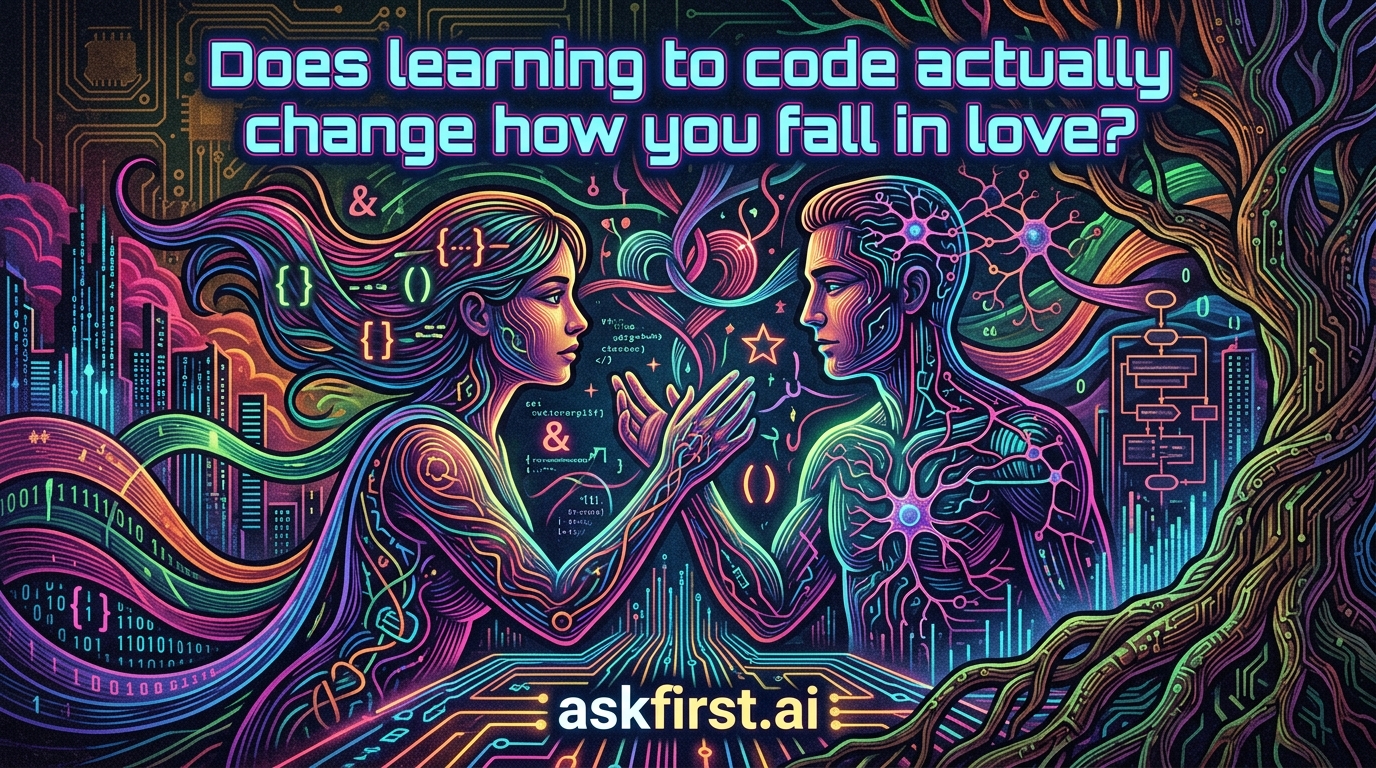
Learning to code is often viewed strictly as a professional skill, yet research suggests that the cognitive shift triggered by programming—known as computational thinking—permeates the deeper layers of human psychology, including the complex realm of romantic attraction. While emotions remain fundamentally biological, the mental models used to process social interactions can indeed be reshaped by the rigorous logic of software development.
The Decomposition of Intimacy
Coders are trained to practice decomposition, the act of breaking a massive, daunting problem into smaller, manageable sub-tasks. When applied to dating, this analytical lens changes the perception of 'chemistry.' Instead of seeing a relationship as a mysterious, ethereal 'spark,' those who code often begin to view interactions as a series of modular events. They analyze behaviors, communication patterns, and emotional reciprocity as data inputs. This perspective allows individuals to decouple from impulsive reactions, transforming the overwhelming chaos of falling in love into a more structured journey of understanding.
Optimization and The Stopping Problem
In computer science, the 'Secretary Problem' or the 'Optimal Stopping Theory' provides a mathematical framework for decision-making. When seeking the best candidate for a position—or a life partner—there is a mathematically ideal moment to stop searching and commit. Coders become acutely aware of these trade-offs. They understand that 'perfect' is the enemy of 'good,' and that infinite searching leads to diminishing returns. Consequently, people with coding experience often approach relationships with a heightened awareness of opportunity cost. This does not mean they treat people like objects; rather, it means they are more deliberate in their commitment, understanding the mathematical necessity of settling when the right variables align, rather than waiting for an elusive, non-existent ideal.
The Refactoring of Emotional Baggage
One of the most profound impacts of programming is the habit of refactoring—revisiting existing code to improve its efficiency without changing its outward behavior. In the context of love, this translates into 'emotional refactoring.' Individuals who code are conditioned to look at past relationship patterns—or 'bugs' in their personal history—to identify why a specific approach resulted in a crash. They cultivate a proactive desire to optimize their communication styles, identifying where miscommunications occur and creating cleaner, more direct protocols for conflict resolution. This leads to relationships that are, quite literally, more maintainable over time.
Debugging and Empathy
Programming is an exercise in empathy. Writing code that other humans must read requires clarity, documentation, and the ability to anticipate how another person will interpret your logic. This creates a cognitive habit of perspective-taking. When falling in love, the coder’s mind constantly asks: 'How is this input being interpreted by the other system?' This results in higher emotional intelligence, as the individual becomes adept at debugging their own reactions and considering the 'end-user'—in this case, the partner—as a priority in every interaction.
The Role of Iteration
Agile methodology dictates that development should be iterative: build, test, learn, and repeat. Those who integrate this mindset into their romantic lives avoid the fatalistic 'soulmate' myth. Instead of expecting a relationship to be fully functional upon launch, they treat intimacy as an agile process. They welcome feedback, value small improvements, and understand that relationships, like software, require continuous updates and bug fixes to remain secure and functional in a changing environment.
Summary of the Computational Shift
Ultimately, learning to code does not eliminate the mystery of love, nor does it turn a human connection into a cold, heartless equation. Instead, it provides a scaffolding of logic that helps navigate the uncertainty of romantic entanglement. By replacing anxiety with analysis, and impulsivity with iterative growth, those who learn to code may find themselves better equipped to build stable, long-lasting, and truly profound romantic connections. The intersection of logic and emotion provides a unique competitive advantage in the pursuit of human happiness, proving that even the heart is subject to the elegance of well-structured design.