The Psychology of Door Design: Why Pushing Is Our Default
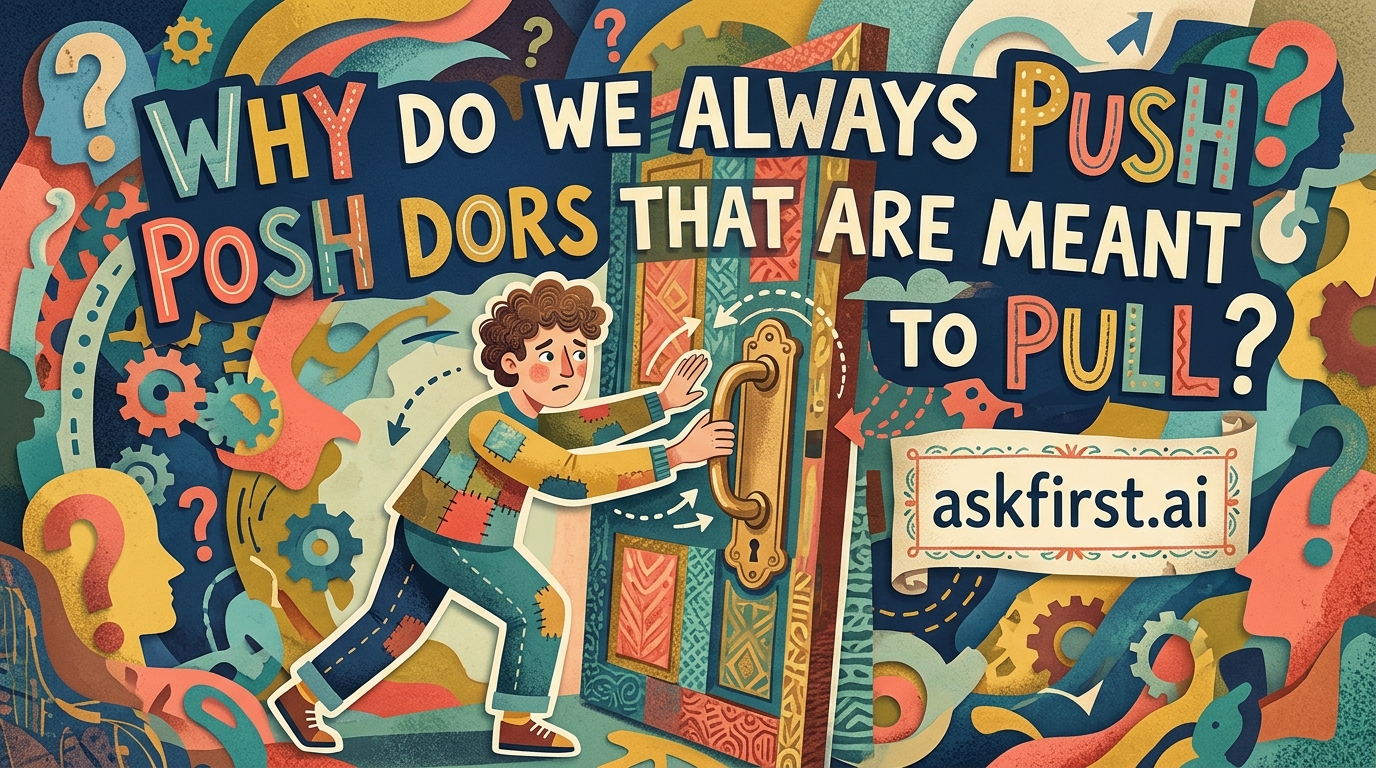
The phenomenon of pushing a door meant to be pulled is so ubiquitous that it has earned a specific term in the design community: the 'Norman Door.' Named after cognitive scientist Don Norman, author of the seminal book The Design of Everyday Things, these portals serve as a testament to the complex interplay between human instinct and architectural interface. While the error feels like a personal lapse in observation, it is almost always a failure of industrial design.
The Anatomy of the Norman Door
A Norman Door is defined by a design that provides the wrong affordance. In psychological terms, an affordance is a perceived property of an object that suggests how it should be used. When a designer places a flat metal plate on a door, the mind subconsciously interprets the flat surface as a target for the palm. A flat plate is a classic indicator that the door should be pushed. If the door requires a pull to open, but possesses a design element—like a vertical handle or a flat plate—that screams 'push,' the human brain will default to the visual cue rather than logic.
- Visual Dominance: The human brain processes visual cues faster than written instructions. A 'Pull' sign is often ignored because the physical design of the door overrides the linguistic command.
- The Motor Program: Humans develop habitual motor programs for repetitive tasks. Because many modern fire-safety doors are push-to-exit, the brain creates a heuristic that pushing is the safer and more standard way to interact with portals.
The Influence of Cultural Ergonomics
Ergonomics is not just about physical comfort; it is about the cognitive load of interacting with an environment. Cultural expectations play a massive role in how we perceive doors. In many Western societies, entrance doors are increasingly heavy and feature large push bars for accessibility compliance. This contributes to a 'push-first' cultural conditioning. When a person approaches a door, they are engaging in a split-second heuristic evaluation:
- Does the door have a handle? (Likely Pull)
- Does the door have a flat plate or a bar? (Likely Push)
When the environment breaks these rules, cognitive dissonance occurs. The brain assumes the door will behave in a certain way based on its shape, and when it fails to yield, it creates a moment of frustration known as 'interaction friction.'
Why We Cannot Simply 'Learn' Better
There is a common misconception that people should simply pay more attention. However, cognitive research shows that human attention is a finite resource. Expecting people to analyze the door mechanism every time they exit a building is unreasonable. Effective design should be intuitive, meaning it requires zero conscious thought to operate.
- The Power of Mapping: Good design uses mapping—the relationship between controls and their effects. A handle that must be grasped should only ever be used on a door that needs to be pulled.
- Visibility: If a door requires a pull, the hardware should provide a 'hook' or 'lever' that makes the pulling action a natural ergonomic outcome of the hand's placement.
The Evolution of Architectural Safety
It is vital to note that some 'wrong' designs were birthed from good intentions. The widespread use of panic bars—which allow people to push doors open during an emergency regardless of the normal opening direction—has ingrained the push motion into the collective psyche. In an emergency, pushing is faster and uses the weight of the entire body. Architects prioritize this life-safety feature, often resulting in heavy hardware on doors that would otherwise be simple pull-operated mechanisms.
Conclusion: The Future of Interaction
As we look toward the future, the design of entryways is shifting toward automation. Sensors and proximity detectors are slowly removing the human element of trial and error from door operation. However, for manual doors, the solution remains simple: design for the hand, not for the instruction manual. When a user encounters a door, they should intuitively know how to open it based on its physical geometry alone. The next time you find yourself pushing a pull-door, rest assured: you are not experiencing a lapse in intelligence, but rather a encounter with a design that failed to speak your brain's language.