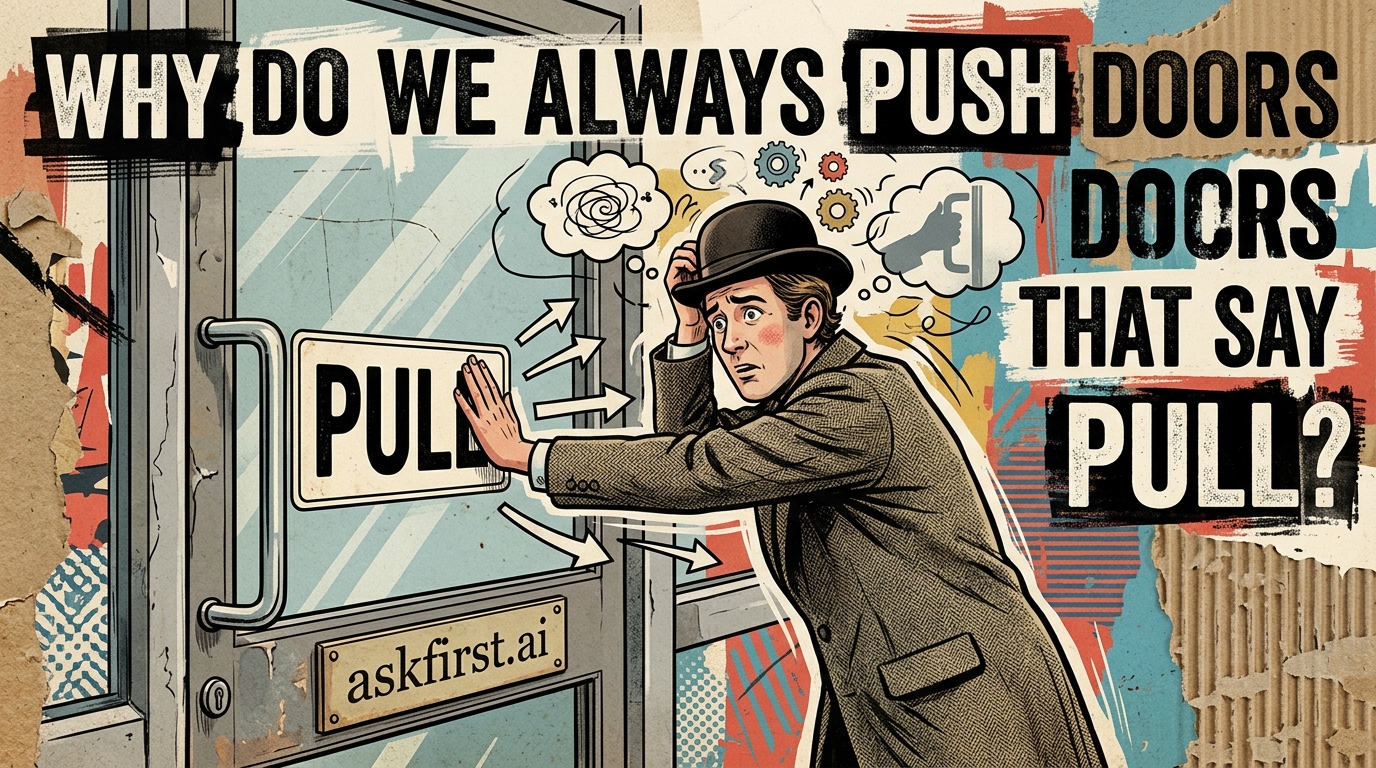
The phenomenon of pushing a door labeled 'pull' is a classic case of cognitive ergonomics, often referred to by experts as a 'Norman Door'—a term popularized by cognitive scientist Don Norman. This behavior is not a sign of individual clumsiness but rather a failure of industrial design. Humans possess a natural, subconscious mental model of how objects function based on their physical appearance. When a door features a flat metal plate, a vertical handle, or even a bar, our brain instantly categorizes it as something to be pushed. Conversely, a U-shaped handle or a knob suggests pulling. If the environment provides these 'affordances' that conflict with the actual mechanics of the door, the brain defaults to the visual cue rather than the text label. We process sensory input significantly faster than linguistic input, meaning our hands are moving toward a push before our eyes have finished reading the word 'pull'.
The Psychology of Affordances
At the core of this interaction is the concept of 'affordances', a term coined by psychologist James J. Gibson. Affordances are the perceived and actual properties of an object that determine how it can be used. For instance, a chair 'affords' sitting because of its physical structure. When a door design provides a strong visual 'push' signal—like a flat surface or a vertical bar—the brain experiences cognitive dissonance when presented with a 'pull' instruction. This conflict often results in the user ignoring the text entirely. According to Gestalt principles of perception, the brain seeks simple, coherent patterns; if an object looks like it should be pushed, the brain will force that interpretation regardless of textual warnings.
The Failure of Conventional Signage
Many architects and door manufacturers rely on signage to compensate for poor design, yet this is fundamentally flawed. In high-traffic environments, cognitive load is high, and human attention spans are limited. Humans practice 'satisficing'—a strategy where people choose the first available option that seems reasonable rather than taking the time to evaluate every possible instruction. If a person sees a handle, their motor cortex triggers an automatic grabbing motion. This happens in milliseconds, long before the higher-level cognitive process of reading and comprehension occurs. Furthermore, 'signage blindness' is a common psychological phenomenon where individuals ignore signs in public spaces because they are saturated with information and have learned that most signs are irrelevant to their immediate goals.
Designing for Intuition
To eliminate the confusion of the 'Norman Door,' designers must focus on the principle of 'mapping'. Effective mapping means that the physical controls match the intended action. If a door must be pulled, the design should make it impossible or counter-intuitive to push. This can be achieved by:
- Removing flat push-plates on pull-only doors.
- Using recessed handles that only invite a pulling motion.
- Creating symmetry that forces the user to pause and look for a clear opening mechanism.
- Employing color-coded hardware or tactile surfaces that distinguish the pull side from the push side.
When design successfully mirrors the intended function, instructions become entirely redundant. A perfect interface is one that requires no user manual; when someone struggles with a door, it is almost exclusively an indictment of the architect, not the user.
Why This Remains a Universal Experience
This behavior is universal because it taps into the fundamental way our sensory and motor systems interact. Across different cultures, languages, and age groups, the impulse to 'push' when encountering a large, flat surface remains consistent. It is a biological byproduct of our evolution, where quick, heuristic-based decision-making was essential for survival. Modern life forces us into environments filled with manufactured obstacles, and when those obstacles fail to provide accurate feedback, we fall back on these primitive habits. Ultimately, the next time a door confuses you, recognize that you are participating in a study of human interaction. The pull-labeled door that you stubbornly pushed is not a mistake; it is a profound lesson in how our environment dictates our behavior, and how much room remains for more thoughtful, human-centric engineering in our daily lives.