The Evolutionary Basis of Social Memory
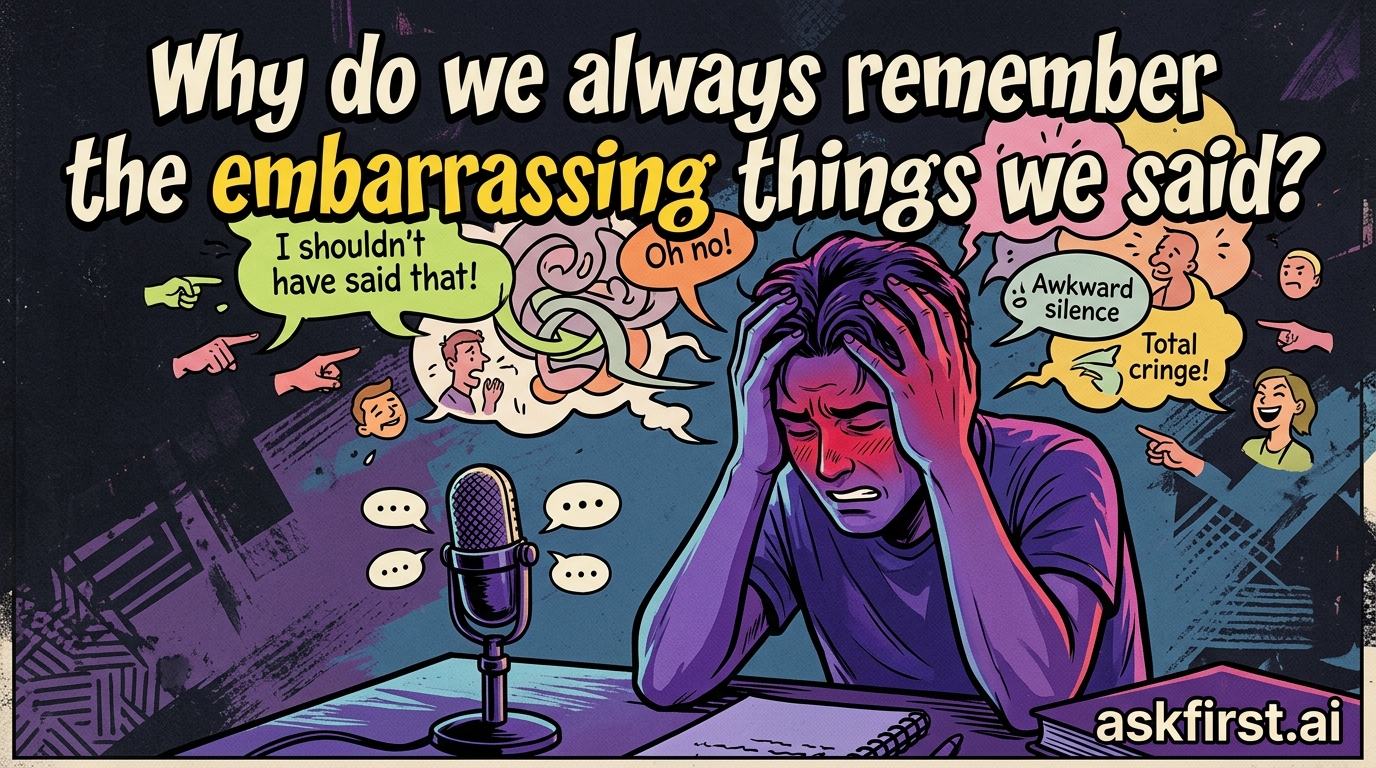
The phenomenon of ruminating on past social blunders is deeply rooted in human evolution. Humans are social animals, and historically, inclusion within a group was a prerequisite for survival. Being ostracized could result in literal starvation or exposure. Consequently, the brain developed a heightened sensitivity to social feedback. This sensitivity manifests as a 'spotlight effect'—a psychological tendency to overestimate how much others notice our actions and perceived failures.
The Role of the Negativity Bias
Psychology teaches us that the human brain is wired with a negativity bias. This means we are evolutionary predisposed to give more weight to negative experiences than positive ones. From a survivalist perspective, remembering a dangerous or 'socially lethal' situation is more critical than remembering a compliment. When an embarrassing moment occurs, the amygdala—the brain’s emotional processing center—triggers a stress response. This chemical surge cements the memory more vividly than neutral events, making these awkward recollections feel as if they happened only moments ago, even years after the fact.
Cognitive Mechanisms of Rumination
When people reflect on an embarrassing comment, they often engage in 'counterfactual thinking,' which involves visualizing how things could have turned out differently. This loop keeps the memory active. The brain struggles to distinguish between the emotional pain of the past and the safety of the present, leading to recurrent intrusive thoughts. Scientific research suggests that this is not merely a memory defect but a failed regulatory mechanism where the brain attempts to 'rehearse' social interactions to prevent future errors.
Why the Spotlight Effect Misleads Us
One of the most profound revelations in modern psychology is that while an individual might fixate on a slip of the tongue for years, others often forget it within minutes or never noticed it at all. This mismatch in perception is due to the Spotlight Effect. Because we are the center of our own internal universe, we assume our behavior is as salient to others as it is to us. However, others are usually preoccupied with their own social anxieties, rendering them largely oblivious to our fleeting gaffes.
Strategies for Mitigating Social Anxiety
To break the cycle of rumination, experts recommend several evidence-based cognitive strategies:
- Cognitive Reframing: Consciously shift the narrative from 'I am an idiot' to 'I am a human who had a clumsy moment.'
- Acceptance and Commitment Therapy (ACT): Rather than fighting the thoughts, acknowledge their presence without assigning them emotional value.
- Practicing Mindfulness: Focus on the present sensory experience to pull the brain out of the loop of internal monologue.
- The 'Others Forget' Reality Check: Remind yourself that people possess a limited bandwidth for observing others and are far less critical than the internal critic suggests.
Scientific Perspective on Emotional Regulation
Neuroscience confirms that the prefrontal cortex can learn to override these intrusive thoughts. By understanding that memory is reconstructive rather than objective, individuals can diminish the intensity of embarrassing memories. Every time a memory is recalled, it is reconstructed; by introducing a sense of compassion or humor during this process, the neural pathway associated with that memory becomes less tied to shame and more linked to neutral or positive associations over time.
Conclusion: Embracing Human Imperfection
Ultimately, the endurance of embarrassing memories is a byproduct of a brain striving to ensure social competence. It is an artifact of the desire to belong. By shifting the perspective to view these memories not as flaws, but as indicators of social growth, one can effectively minimize their impact. Learning to laugh at oneself is not just a social lubricant; it is a neurological tool for maintaining emotional health in a complex, interconnected world. Understanding that this struggle is universal serves as a powerful reminder of shared human experience.