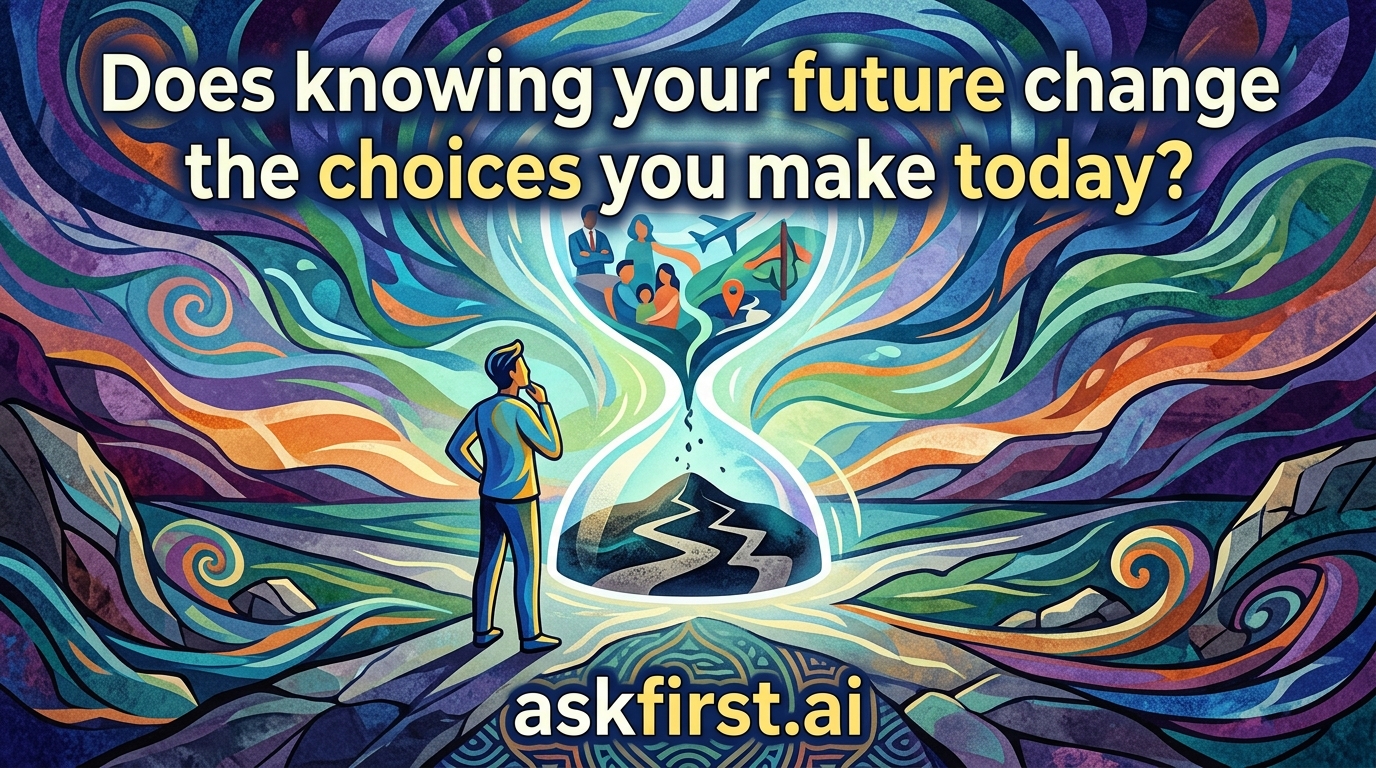
The concept of pre-knowledge—the ability to foresee events before they unfold—is a cornerstone of human mythology, philosophy, and modern cognitive science. This inquiry explores whether the act of knowing what lies ahead functions as a mechanism for alteration or if it serves as a fixed anchor for human behavior. By examining the interplay between psychological determinism and agency, we can uncover why the question of future-knowledge remains one of the most provocative intellectual puzzles.
The Paradox of Determinism vs. Agency
At the heart of this discussion lies the Newcomb’s Paradox, a classic thought experiment in decision theory. If an entity can perfectly predict your choices, does your decision matter? Philosophers argue that if the future is already set, knowing it effectively removes the illusion of free will. However, neuroscientific studies suggest that even when individuals believe they are making a free choice, their brains often initiate the action milliseconds before the conscious mind registers the 'decision.' When we overlay 'future-knowledge' onto this biological reality, it introduces a feedback loop: the information itself becomes a variable in the decision-making process. Thus, the future is never really fixed because the prediction itself informs the action that creates that very future.
The Psychological Impact: The Omission Bias
Human psychology is heavily influenced by the Omission Bias, the tendency to judge harmful actions as worse than equally harmful omissions. When individuals are presented with 'future knowledge'—perhaps through a data-driven prediction or a psychological assessment—they often freeze. This is known as 'Predictive Paralysis.' If one knows that a specific career path leads to burnout, they might abandon their passion entirely, despite the fact that the original prediction was based on data that did not account for the awareness of the outcome. Consequently, the knowledge of the future actively modifies the behavior, invalidating the original prediction. This demonstrates that human foresight is not just a passive observation; it is a catalyst for change.
Cognitive Reframing and Feedback Loops
Consider the Self-Fulfilling Prophecy in a social context. If an individual is told they will succeed in a competitive exam, their anxiety levels may decrease, leading to better preparation and actual success. Conversely, being told one will fail can lead to the 'Pygmalion effect' in reverse, where the individual ceases effort. This confirms that knowing the future acts as a psychological input. The 'choice' being made today is no longer an independent variable; it is now a response to the perceived future. Scientists often define this as an autopoietic system, where the system (the person) self-creates by responding to its own projected trajectory.
Scientific Perspective: Quantum Possibilities
From the viewpoint of theoretical physics, specifically the Many-Worlds Interpretation, knowing the future might simply involve shifting one's focus between different timelines. If one 'sees' a negative outcome, the choice to pivot is, in essence, a mechanism for navigating toward a more favorable branch of reality. This perspective turns the act of knowing from a deterministic trap into a navigational tool. If you see the rain, you carry an umbrella. The choice is a simple utility function: knowledge allows for optimization. By incorporating this into daily habits, we move from being 'prisoners of fate' to 'architects of probability.'
Practical Implications for Modern Life
How can this be applied to everyday decision-making?
- Probabilistic Thinking: Instead of asking 'What will happen?', ask 'What is the probability of this happening given my current trajectory?'.
- Value Alignment: If the predicted future does not align with core values, use that knowledge as a disruptor to break entrenched habits.
- Strategic Disruption: Introduce randomness into your routine to negate the 'predictability' of your current path, effectively keeping your options open.
Conclusion: The Future as an Active Variable
Ultimately, knowing the future does not simply change the choices you make; it transforms the very structure of your decision-making landscape. It shifts the human condition from a state of blind navigation to one of active steering. Because human behavior is reactive, the moment a 'future' enters your consciousness, it ceases to be an external destiny and becomes an internal motivation. Whether that motivation leads to growth, caution, or radical transformation depends on the observer's ability to remain objective. By treating the future not as a fixed destination but as a dynamic, malleable field of potential, we reclaim our agency. We do not just react to what we know; we refine the future with every subsequent, informed choice.