The Neurobiology of Social Pain: Why Rejection Feels Like a Physical Wound
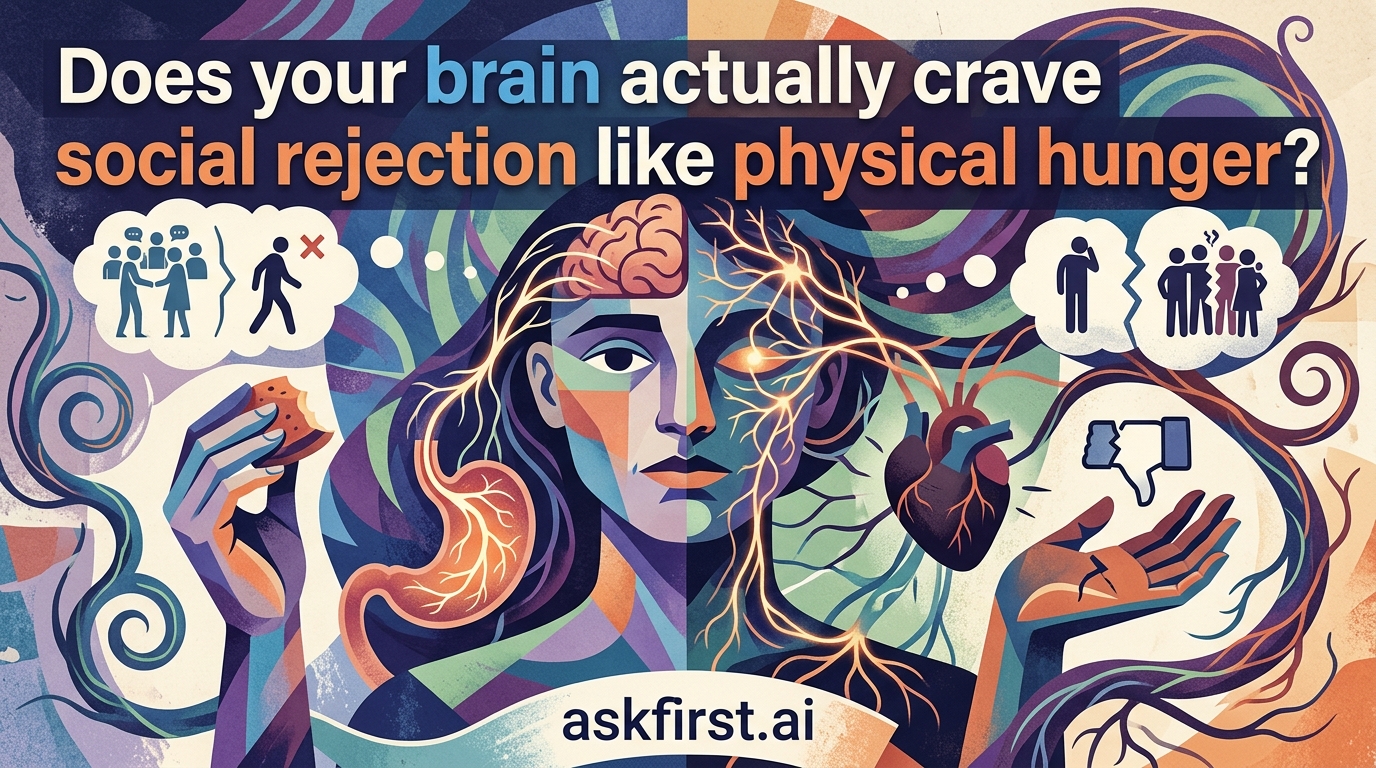
To understand whether the brain "craves" social rejection in the same way it craves food, we must first dismantle the common misconception that social pain is merely a metaphorical experience. Modern neuroscience has revealed that the human brain processes social rejection through the same neural circuitry used to process physical pain. However, while we do not "crave" rejection in the sense of desiring it, our evolutionary history has hardwired us to be hyper-vigilant toward it, creating a feedback loop that mimics the urgency of physiological hunger.
The Overlap of Neural Pathways: The Dorsal Anterior Cingulate Cortex
The most compelling evidence for the physical reality of social pain comes from the work of Dr. Naomi Eisenberger at the University of California, Los Angeles. In her foundational study published in the journal Science (2003), titled "Does Rejection Hurt? An fMRI Study of Social Exclusion," participants were placed in an fMRI scanner and asked to play a virtual ball-tossing game called Cyberball. Unbeknownst to the participants, the other players were computerized avatars programmed to eventually exclude the subject.
The brain scans revealed that the dorsal anterior cingulate cortex (dACC)—the exact region responsible for processing the distressing component of physical pain—lit up during moments of social exclusion. This suggests that the brain treats social rejection not as a minor inconvenience, but as a genuine threat to survival. In the ancestral environment, being cast out of a tribe was a death sentence. Consequently, the brain developed a "social pain" alarm system to alert us immediately when our standing in a group is compromised.
The Hunger Analogy: Why Rejection Feels Like Deprivation
While we do not "crave" rejection, the sensation of social exclusion often mimics the biological signals of hunger. This is largely due to the role of the opioid system in the brain. Research by Dr. Jaak Panksepp, a pioneer in affective neuroscience and author of Affective Neuroscience: The Foundations of Human and Animal Emotions, demonstrated that social attachment is mediated by endogenous opioids.
When we are socially connected, our brains release these natural opioids, creating a sense of warmth and satiety. When we are rejected, those levels drop, leading to a state of "social withdrawal" that mirrors the physiological distress of starvation. Just as a hungry person becomes fixated on finding food to restore homeostatic balance, a rejected person becomes hyper-focused on social cues, searching for ways to restore their connection to the group. It is not that the brain wants the rejection; it is that the brain is panicking because the "social caloric intake" has been cut off.
The Evolutionary Mechanism: The Social Thermostat
Evolutionary psychologists, such as Dr. Mark Leary of Duke University, argue in his work The Curse of the Self that social rejection acts as a "sociometer." Much like a fuel gauge in a car, our self-esteem and emotional state fluctuate based on our perceived social value. When we face rejection, the brain essentially triggers a "low fuel" warning.
Concrete examples of this are seen in how we alter our behavior after being rejected. Studies have shown that following a social rejection experience, individuals are significantly more likely to:
- Conform to group norms: To minimize the risk of further exclusion.
- Increase prosocial behavior: Engaging in altruistic acts to signal their value to the group.
- Hyper-analyze social interactions: Replaying conversations to identify where the "social contract" was broken.
This is not a "craving" for rejection, but a high-stakes survival response. The brain is attempting to repair a broken social bond, much like a body attempts to repair a torn muscle.
The Paradox of "Masochistic" Social Seeking
There is a phenomenon where individuals who have experienced chronic rejection in childhood may seek out rejecting environments in adulthood. Psychologists refer to this as repetition compulsion, a concept famously explored by Sigmund Freud in Beyond the Pleasure Principle. In this context, the brain may "crave" rejection not because it is pleasurable, but because it is familiar. The brain finds comfort in predictable patterns, even if those patterns are painful. This is a maladaptive survival strategy: the brain perceives the familiar pain of rejection as safer than the unknown potential of acceptance.
Conclusion: A Vital Survival Signal
In summary, the brain does not "crave" rejection in the sense of finding it nutritionally or emotionally nourishing. Instead, it processes rejection as a critical, life-threatening injury. Because our ancestors' survival depended entirely on group cohesion, the brain evolved to treat social exclusion with the same urgency and intensity as physical starvation.
The next time you feel the sting of rejection, recognize it for what it is: a sophisticated biological alarm system. It is your brain’s way of ensuring that you remain part of the collective, using the intensity of pain to demand that you re-establish the social bonds necessary for your long-term health and safety. You are not "addicted" to the pain; you are simply witnessing the ancient, powerful machinery of human survival in action.