The Evolutionary Logic Behind Regret
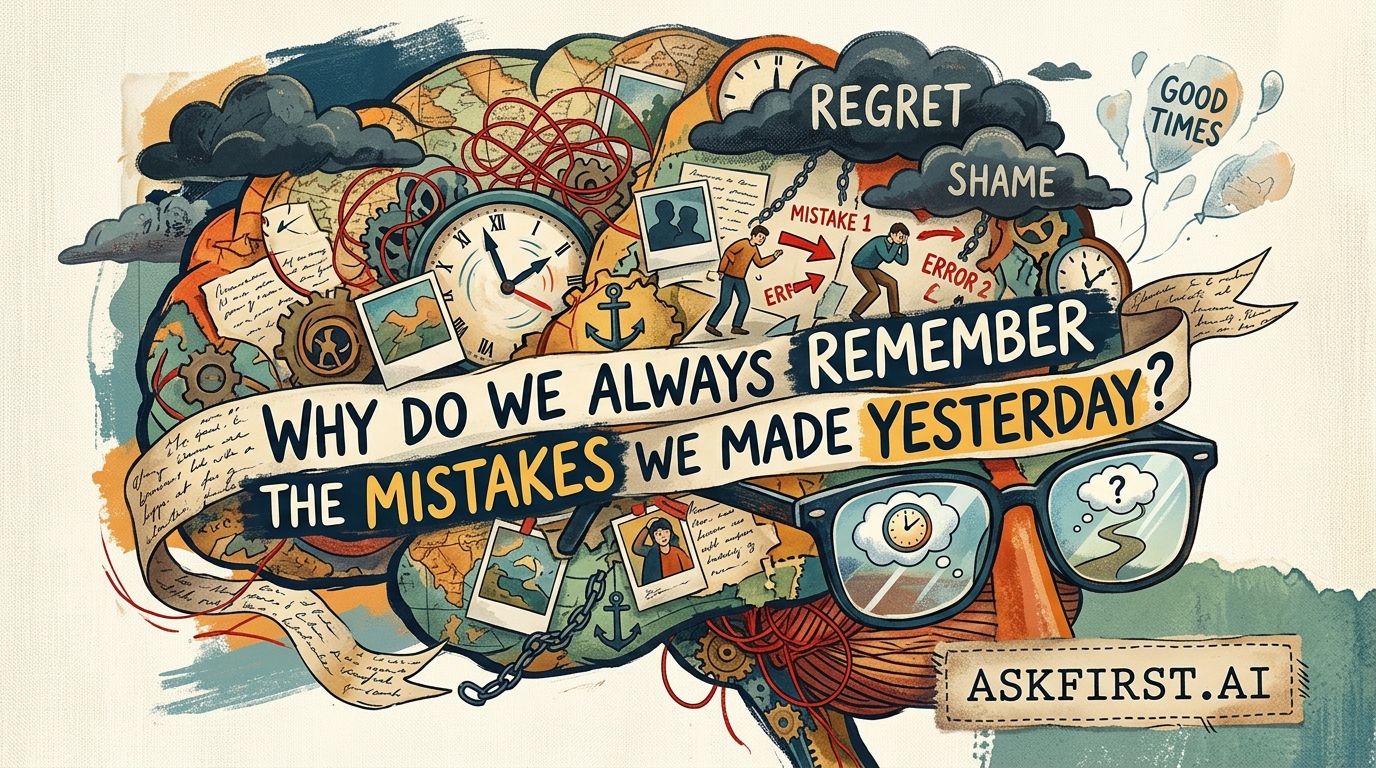
The human tendency to ruminate on past errors is not a glitch in cognitive software but rather a sophisticated survival mechanism refined over millennia. This phenomenon, often termed the 'negativity bias,' functions as a mental alarm system. From an evolutionary standpoint, the ability to recall a mistake—such as picking a poisonous berry or missing a cue from a predator—was far more critical to survival than remembering a successful afternoon stroll. The brain prioritizes threats and failures to ensure that future behavior patterns are adjusted to maximize safety and efficiency.
The Role of Episodic Memory and Neural Pathways
Memory consolidation plays a vital role in why these moments stay vivid. When an experience is coupled with strong emotions—such as embarrassment, guilt, or surprise—the amygdala signals the hippocampus to prioritize that memory for long-term storage. Consequently, mistakes often carry a high emotional charge, making them 'sticky.' Neuroscientifically, this is observed through the strengthening of specific neural pathways associated with error monitoring. The brain is essentially engaged in constant predictive modeling; by reviewing past mistakes, it updates its internal algorithms to anticipate and avoid similar outcomes in future scenarios.
The Zeigarnik Effect: Unfinished Mental Business
The Zeigarnik Effect, a well-documented psychological principle, posits that humans experience higher retention for interrupted or incomplete tasks compared to those that were completed. When a mistake occurs, it represents an unresolved mental loop. Because the goal—success or perfection—was not achieved, the mind keeps the 'file' open. It repeatedly triggers recall in an attempt to find a resolution, analyze the failure, and create a better strategy. This serves as a drive for self-improvement, compelling individuals to re-examine the situation until the brain can successfully map out a 'corrective' action.
Cognitive Reframing and Growth Mindset
While the impulse to ruminate can lead to anxiety, it is fundamentally a prerequisite for learning. The most successful individuals utilize this cognitive tendency to fuel a growth mindset. Instead of viewing the memory of a mistake as a sign of incompetence, it is more accurate to categorize it as 'data.' By analyzing the failure through an objective lens—asking questions like 'What specific variable caused this result?' and 'How can the process be adjusted?'—the brain transitions from self-criticism to strategic optimization.
Practical Strategies for Healthy Reflection:
- Objective Analysis: Write down the specific event, the outcome, and the objective factor that caused the error.
- The 5-Why Method: Ask 'why' five times to dig past emotional symptoms to find the root cause.
- Actionable Closure: Once the lesson is identified and documented, consciously tell the brain the 'file' is closed. This provides the mental relief that satisfies the Zeigarnik Effect.
The Impact of Social Calibration
Humans are fundamentally social beings. Errors made in social contexts often linger longer because they threaten an individual's standing within a group. The fear of social exclusion is ancient, and the brain hyper-fixates on interpersonal blunders to refine social navigation skills. By remembering a social faux pas, the brain is attempting to calibrate one's behavior to better align with group norms, thereby increasing social cohesion and personal security.
Turning Regret into Cognitive Capital
Ultimately, the preoccupation with yesterday’s mistakes is an indicator of a functioning, learning mind. If one were unable to remember errors, growth would be impossible. The key lies in shifting the relationship with these memories. Instead of letting them operate as unbidden, painful flashes of shame, they should be harnessed as a curated library of lessons. By systematically reviewing past errors, individuals cultivate a form of 'cognitive capital' that allows for smarter decision-making, higher emotional intelligence, and greater resilience in the face of future challenges.
In essence, remembering the mistake is the first step toward the mastery that prevents it from recurring. The human mind is perpetually designing the version of the future that is slightly more efficient, slightly more prepared, and significantly more capable than the version of the past that necessitated the mistake in the first place.