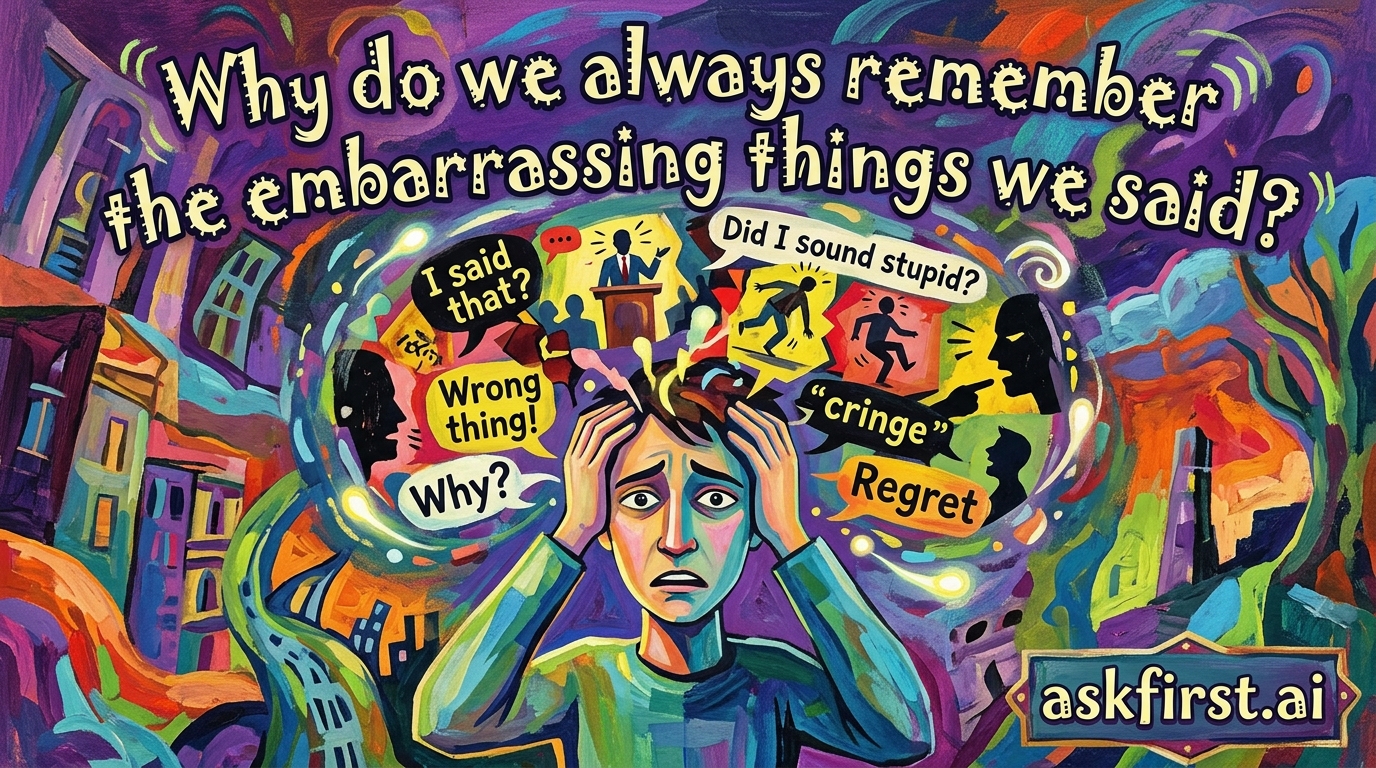
The Psychology of Social Reflection: Why We Dwell on Embarrassment
The phenomenon of rumination on past social blunders is a universal human experience. While it often feels like a personal curse, this cognitive loop is actually rooted in evolutionary survival mechanisms designed to ensure social cohesion. Understanding why the brain fixates on these moments requires a dive into neuroscience and evolutionary psychology.
1. The Evolutionary Utility of Social Pain
Humans are fundamentally social creatures. Throughout history, belonging to a group was synonymous with survival. Being cast out from a tribe meant certain death due to lack of resources or protection. Consequently, the brain developed a 'social thermostat' to monitor acceptance. Embarrassment serves as a painful warning sign that social status is threatened. When a person says something perceived as awkward, the brain triggers a negative emotional response—often called social pain—to reinforce behaviors that promote belonging. Essentially, the memory is sticky because it carries high 'emotional weight' that tells the brain: Do not repeat this behavior, or risk social exclusion.
2. The Negativity Bias: Why Mistakes Outweigh Triumphs
Psychological research consistently demonstrates a Negativity Bias, the tendency for the human brain to place more weight on negative experiences than positive ones. From an survivalist perspective, this is efficient: noticing a predator or a toxic plant is far more important than finding a pretty flower. By internalizing and repeatedly reviewing past errors, the brain is attempting to 'simulate' future scenarios to avoid similar mistakes. While this was useful for dodging tigers, it is far less helpful when analyzing a dinner party conversation from three years ago.
3. Spotlight Effect: The Misperception of Observation
Much of the distress caused by embarrassing memories stems from the Spotlight Effect, a psychological phenomenon where individuals overestimate the extent to which their actions and appearance are noticed by others. In reality, most people are far too consumed with their own internal thoughts and insecurities to dwell on another person's minor social slip-up. Because the individual is the center of their own universe, they mistakenly assume they are the center of everyone else's universe as well. Recognizing that most observers likely forgot the event within seconds can help dismantle the anxiety associated with the memory.
4. Cognitive Mechanisms of Rumination
When the brain enters a loop of replaying a moment, it is engaging in rumination. This is a passive, repetitive focus on the causes and consequences of personal distress. The brain’s default mode network (DMN)—the system responsible for self-referential thought—is highly active during these times. To break this cycle, psychologists often recommend 'cognitive reappraisal.' Instead of viewing the event as a reflection of personal character, one can view it as a neutral data point or an outcome of high cognitive load. Re-framing the memory transforms it from a 'source of shame' to a 'learning experience.'
5. Practical Strategies to Tame the Memory
- Practice Self-Compassion: Acknowledge that the brain is simply trying to keep you safe and accepted. Treat yourself with the same kindness you would offer a friend who made a small mistake.
- The Objective Observation Technique: Try to visualize the memory as if you are a third-party observer watching a film. This creates emotional distance and reduces the visceral 'cringe' response.
- Focus on the Present: Engage in high-focus activities that force the DMN to go dormant, such as solving complex puzzles, physical exercise, or learning a new skill.
- Challenge the Validity: Ask yourself: 'Does this memory define who I am today?' In nearly every instance, the answer is a resounding 'no.'
Conclusion: A Sign of Humanity
It is vital to recognize that the ability to feel embarrassed is actually a sign of high social intelligence. It proves that an individual is aware of the social landscape and cares about how their actions impact others. Those who never feel embarrassed often lack the empathy or awareness required for complex social bonding. Therefore, while these memories are uncomfortable, they are also a testament to a person's desire to grow, connect, and thrive in a communal environment. Next time the brain pulls up a 'cringe' highlight reel, accept it as an artifact of a functioning, social, and protective mind, then gently let it go.