The Fascinating Origin of the Computer Bug
It is one of the most endearing pieces of technological folklore: the story that the term 'computer bug' originated when a literal insect was found obstructing the machinery of an early computer. While the term 'bug' had been used by engineers to describe mechanical glitches since the time of Thomas Edison, the incident involving the Harvard Mark II computer in 1947 serves as the definitive point where computing history and entomology collided. This event, led by the legendary Grace Hopper and her team, changed the language of software development forever.
The Historical Context: The Harvard Mark II
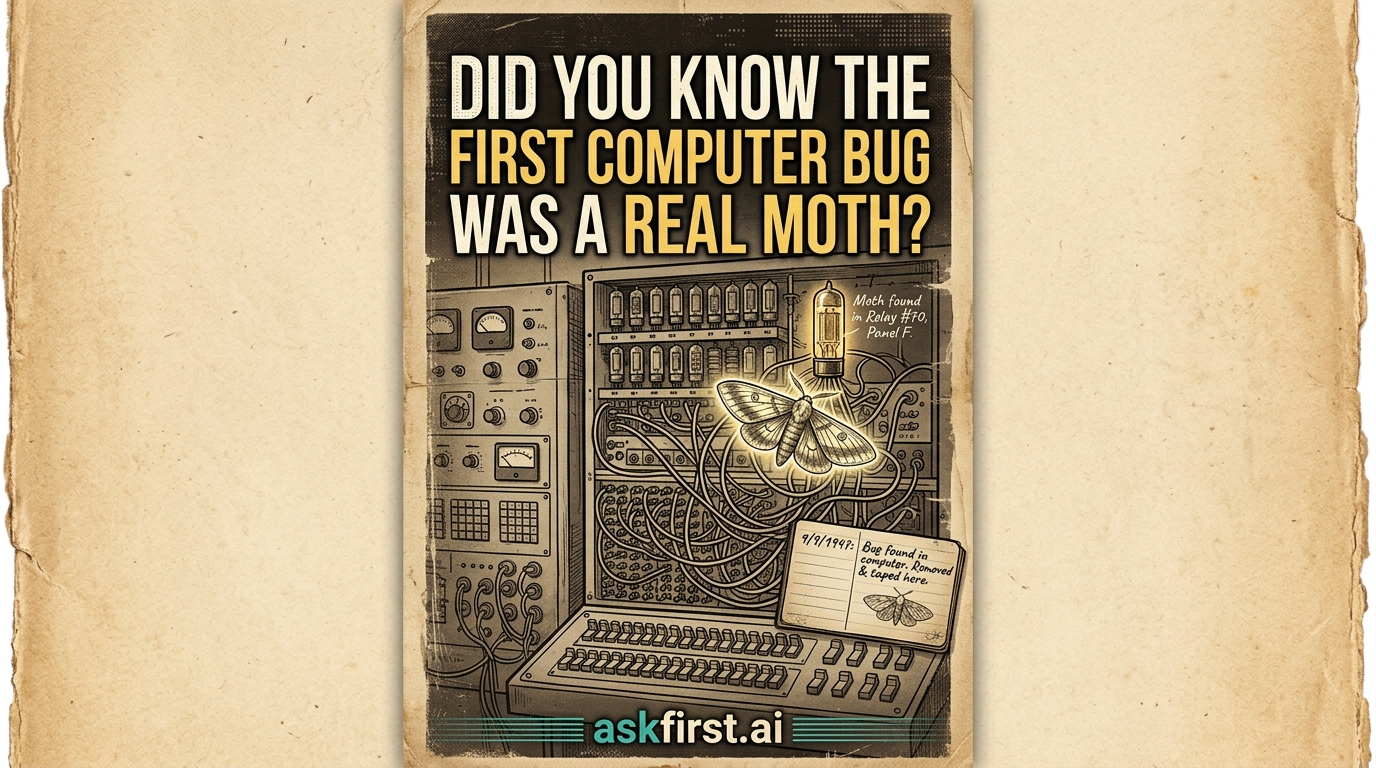
In September 1947, the Harvard Mark II—an electromechanical computer built by Howard Aiken—began experiencing persistent malfunctions. Operators investigated the hardware, searching for the source of the errors. Inside one of the relay components, they discovered a moth trapped in the mechanism. The moth had effectively wedged itself between the relay contacts, preventing the device from closing and thus disrupting the flow of electrical signals. This physical obstruction represented the quintessential definition of a hardware fault.
Documenting the Discovery: The Famous Logbook
What makes this story so compelling is that it was meticulously documented. Grace Hopper, a pioneering computer scientist who later invented the first compiler, and her team removed the moth and taped it into the facility’s logbook. Beside the specimen, they wrote the now-famous annotation: 'First actual case of bug being found.' This logbook entry is currently preserved at the Smithsonian National Museum of American History. It serves as a tangible bridge between the physical world of engineering and the abstract, logic-driven world of modern software.
Debunking the Myth: Was it the Absolute First 'Bug'?
While this story is iconic, it is essential to distinguish between the etymology of the word and the actual event. Thomas Edison, in letters dating back to the 1870s, frequently used the term 'bug' to describe technical glitches in his inventions. He viewed these imperfections as minor nuisances that required systematic troubleshooting. Consequently, the 1947 moth incident was not the moment the word 'bug' was coined; rather, it was the moment the word became literal. It transformed from a metaphorical description of an obscure error into a practical description of a physical pest causing a computation failure.
The Evolution of Debugging
Following the discovery, the term 'debugging' entered the vocabulary of every programmer and engineer. In the early days of computing, 'debugging' often involved literally checking the hardware, wires, and punch cards for physical damage or oxidation. As programming shifted from physical wiring to written code, the definition of a 'bug' evolved to include logical errors, syntax mistakes, and architectural flaws. Today, debugging is a sophisticated discipline that involves:
- Static Analysis: Examining source code without executing it to find potential vulnerabilities.
- Dynamic Testing: Running code through automated environments to simulate user behavior and stress test systems.
- Traceability and Profiling: Using specialized tools to track data flow and memory management in real-time.
Why This Story Matters for Future Generations
This tale is more than just a historical footnote. It serves as a reminder that computing—no matter how complex or virtual it becomes—is fundamentally rooted in the physical world. Even in an era defined by artificial intelligence and cloud-based architecture, every line of code relies on hardware that is subject to the laws of physics, heat, and entropy. The moth represents the humble, often chaotic reality that sits beneath the surface of sophisticated digital ecosystems. It encourages programmers to remain curious, meticulous, and always willing to look for the simplest explanation when things go wrong.
Legacy in Modern Technology
Today, we use high-level abstractions to build software, but the spirit of the 'bug' persists. Every time a developer encounters an unhandled exception or a race condition, they are engaging in the same troubleshooting lineage started by the team at Harvard. By understanding the literal history of the computer bug, we gain a deeper appreciation for the transition from electromechanical machines to the silicon-based microprocessors that power the modern world. The moth reminds us that progress is not a straight line, but a series of discoveries, interventions, and improvements driven by human ingenuity and the occasional unexpected encounter with nature.