The Alien Intelligence of the Deep: Rethinking Biological Paradigms
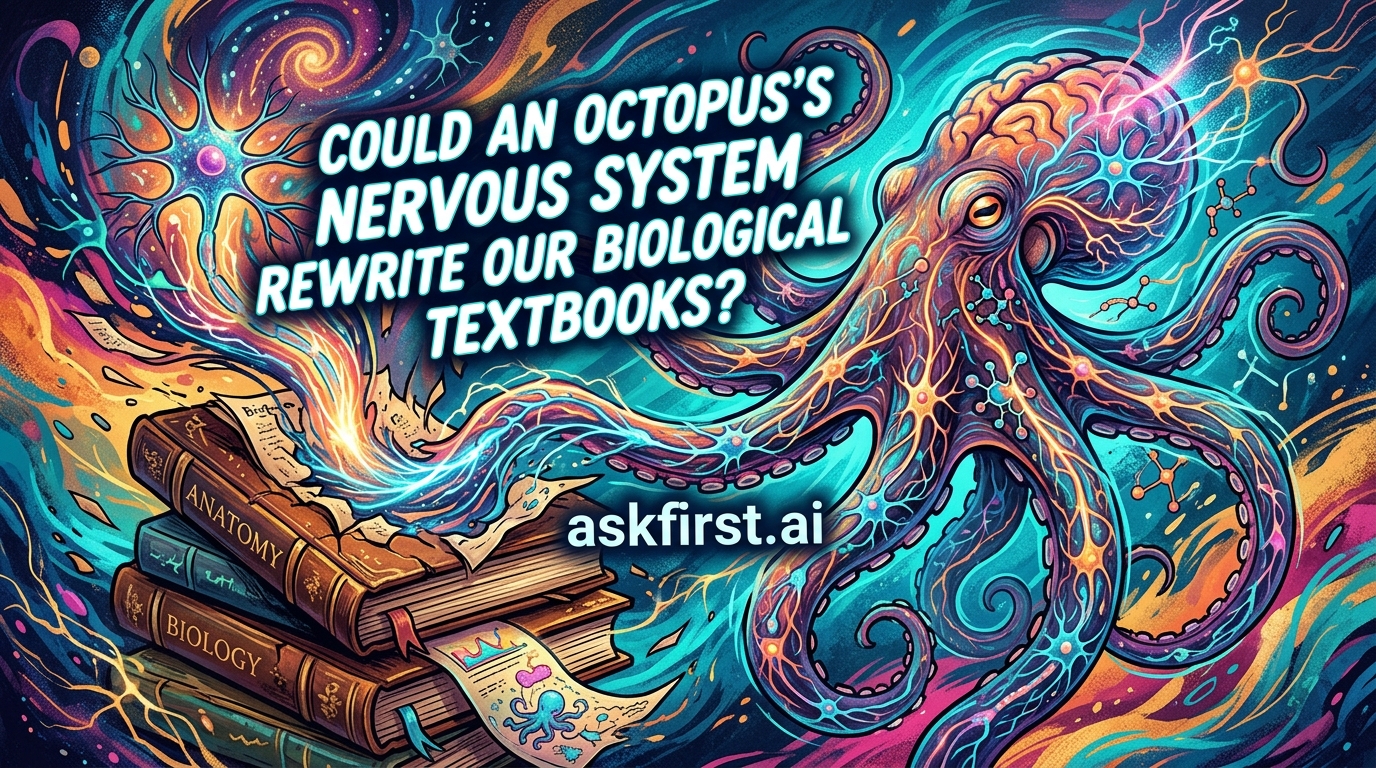
The octopus represents perhaps the most significant challenge to our conventional understanding of neural evolution. While most complex organisms, particularly vertebrates, rely on a centralized brain that functions as the exclusive seat of cognitive processing, the octopus operates under a fundamentally different architectural framework. This biological anomaly suggests that the evolutionary path toward intelligence is not singular, but rather a branching, multi-faceted phenomenon that could indeed necessitate a rewriting of fundamental biological textbooks.
Distributed Intelligence: A Decentralized Command Structure
The most striking feature of the octopus nervous system is its decentralized nature. Of the approximately 500 million neurons in an octopus, only about one-third are located in the central brain. The remaining two-thirds are distributed throughout the eight arms. This creates a system where each arm possesses a degree of autonomy, capable of processing sensory information and executing motor commands without direct intervention from the central brain.
- Sensory Integration: The arms can 'taste' and 'touch' their environment independently, allowing the octopus to navigate complex crevices simultaneously with all eight limbs.
- Autonomy in Action: Research indicates that an amputated arm can continue to react to sensory stimuli and even attempt to perform tasks like grasping food, demonstrating a form of local neural independence that is virtually unseen in complex vertebrates.
The RNA Editing Revolution: Beyond Genomic Determinism
Beyond neural structure, the octopus challenges the 'central dogma' of molecular biology. In most organisms, RNA is a faithful transcript of DNA. However, octopuses demonstrate an unprecedented rate of RNA editing. This process allows them to modify the instructions encoded in their DNA before they result in protein synthesis. This effectively allows the animal to adapt its nervous system to changing environmental temperatures and conditions without waiting for the slow, generational process of genetic mutation.
- Dynamic Adaptation: By editing RNA, octopuses can tune the electrical properties of their neurons. This allows them to function optimally in cold, deep-sea waters or warmer, shallower regions, a feat that would normally require millennia of selective evolution.
- Functional Complexity: This molecular plasticity suggests that the octopus is not merely a product of its genetic code, but an active participant in its own physiological refinement.
The Evolutionary Convergence of High Cognition
Evolutionary biology has long looked at intelligence through the lens of primate development. However, the octopus evolved its complex intelligence along a completely different path—descending from a mollusk ancestor. This is a profound example of convergent evolution, where nature has arrived at the solution of 'high-level consciousness' through two distinct, entirely unrelated anatomical blueprints.
This discovery forces a paradigm shift in how science defines 'intelligence.' If a creature with a nervous system based on a radically different plan can exhibit problem-solving, tool use, and complex social behavior, it suggests that intelligence is an inevitable emergence in the universe wherever complexity is allowed to flourish.
Why This Rewrites Biological Textbooks
Standard textbooks are built on the 'vertebrate-centric' model, which assumes that sophisticated behavior requires a centralized, protective skull housing a singular brain. The octopus shatters this expectation. By demonstrating that cognitive complexity can emerge from a decentralized, arm-linked network, it forces us to reconsider the following:
- The definition of self: Where does the 'mind' reside in a creature where the body performs complex calculations without the brain's explicit command?
- Cognitive modeling: Can artificial intelligence architectures learn more from the decentralized nature of the octopus than from the centralized human brain model?
- Biological limits: How much of an organism's performance is driven by inherited genes versus active, real-time molecular editing?
Conclusion: The Future of Neural Science
As we continue to explore the depths, the octopus remains a biological outlier that commands respect. Its existence is a testament to the infinite adaptability of life. By studying these masters of the sea, scientists are not just learning about a single species; they are expanding the horizons of biology, uncovering principles of distributed processing and molecular fluidity that were once thought impossible. The octopus does not just sit in our textbooks; it actively demands that we draft new chapters on the versatility of life itself.