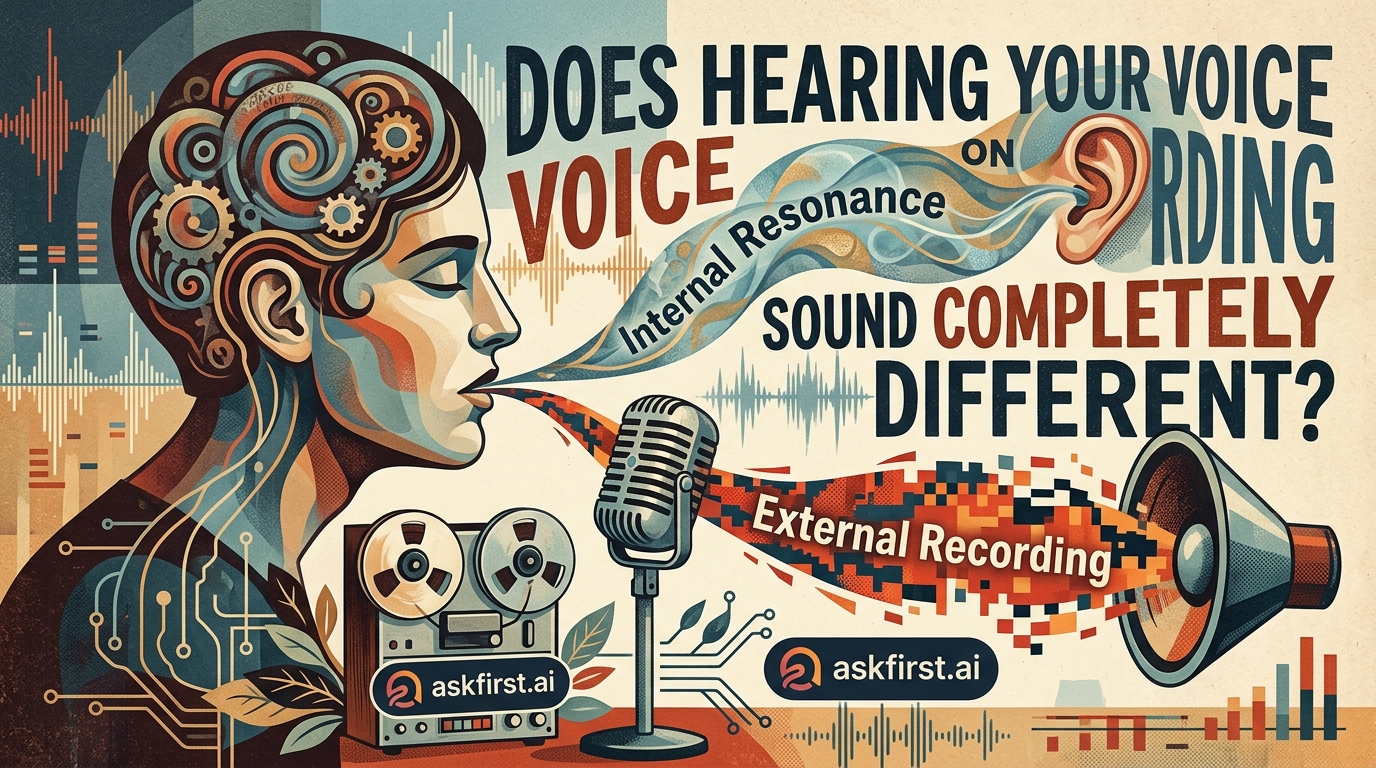
The phenomenon of hearing your own voice played back on a recording and experiencing a visceral sense of shock or dissonance is a universal human experience. Almost everyone remembers the first time they heard their voice captured on tape or digital media, only to be met with a thin, reedy, or altogether "stranger" sound than the one they perceive while speaking. This discrepancy is not merely a psychological quirk; it is a fundamental biological and physical reality rooted in how sound waves interact with the human anatomy.
The Physics of Sound Transmission: Air vs. Bone
To understand why your voice sounds different on a recording, you must first distinguish between the two primary ways sound reaches your inner ear (the cochlea). When you speak, you are effectively listening to a "dual-track" audio feed.
The first track is air conduction. This is the sound of your voice traveling out of your mouth, reflecting off surfaces in the environment, and entering your ear canal. This is the exact same sound that a microphone captures and that everyone else hears when you speak.
The second track is bone conduction. As your vocal cords vibrate to produce sound, those vibrations travel directly through the cartilage and bones of your skull, specifically the jaw and the temporal bone. This internal vibration reaches the cochlea with significantly more low-frequency emphasis. Because bone is a denser medium than air, it transmits low-frequency vibrations more efficiently. Consequently, when you speak, you hear a "bass-boosted" version of your own voice that is physically impossible for anyone else to hear.
In his seminal work The Auditory System: Anatomy, Physiology, and Clinical Correlates, Frank E. Musiek and Jane A. Baran explain that this internal conduction adds a richness and depth to the voice that is perceived only by the speaker. When you listen to a recording, the bone conduction component is completely stripped away, leaving only the air-conducted sound. This loss of the "internal bass" is what makes your recorded voice sound higher-pitched and thinner than you expect.
The Psychological Impact: The "Voice Confrontation" Effect
The discrepancy between the voice you expect and the voice you hear is known in psychology as the "Voice Confrontation Effect." It is a jarring experience because it forces a confrontation between your internal self-concept and external reality.
For most of your life, you have identified your "self" with the bass-heavy, resonant sound vibrating inside your head. When that sound is absent on a recording, your brain experiences a form of cognitive dissonance. You are effectively hearing a stranger who sounds like you, but lacks the "authority" or "depth" you associate with your own identity.
Research conducted by psychologists such as Phil Holzwarth and colleagues in studies regarding self-perception often highlights that people tend to rate their recorded voices as less attractive or less confident than they perceive their "internal" voices to be. This is largely because the internal voice is associated with your own ego and personal intent, whereas the recorded voice is an objective, detached acoustic signal.
Why Your Brain Struggles to Recognize You
Beyond the physics of bone conduction, there is a neurological component to this phenomenon. When you speak, your brain is actively involved in the motor execution of producing speech. Neuroscientist David Poeppel, in his research regarding the neurobiology of language at New York University, notes that the brain's auditory cortex is partially suppressed during self-generated vocalization. This mechanism, known as "corollary discharge," helps the brain distinguish between sounds you make and sounds made by the environment.
Because your brain is already "expecting" the sound of your voice as you produce it, the arrival of the actual sound wave is processed differently than a voice you hear from an external source. When you hear a recording, this neural suppression is absent. You are listening to your voice with the same objective, analytical ear you use to listen to a radio host or a friend. This "external listener" mode makes you hyper-aware of nuances—such as your inflection, pacing, or regional accent—that you usually ignore when you are the one doing the speaking.
Concrete Examples of the Discrepancy
Consider the experience of professional voice actors or radio hosts. Even seasoned professionals often report feeling uncomfortable when listening to their own broadcasts. In The Sound of Your Voice by Dr. Michael Benninger, a leading otolaryngologist, it is noted that even those who have trained their voices for years cannot escape the physics of bone conduction.
A practical way to test this is to record yourself while plugging your ears. When you plug your ears, you accentuate the bone conduction path, making your voice sound deep and muffled. If you then record that same speech and play it back through headphones, the difference becomes even more dramatic because the "internal" sound is completely replaced by the "external" signal.
Conclusion
The feeling that your recorded voice is "wrong" or "alien" is a completely normal reaction to the loss of bone-conducted resonance. You are not hearing a distorted version of your voice; you are hearing the voice that the rest of the world has been listening to all along. While the initial experience is often uncomfortable due to the mismatch with your self-perception, it serves as a fascinating reminder of how much of our identity is constructed through the unique, private sensory feedback loops of our own bodies. Your voice is not "different" on a recording; it is simply stripped of the private, internal performance that only you are privileged to hear.