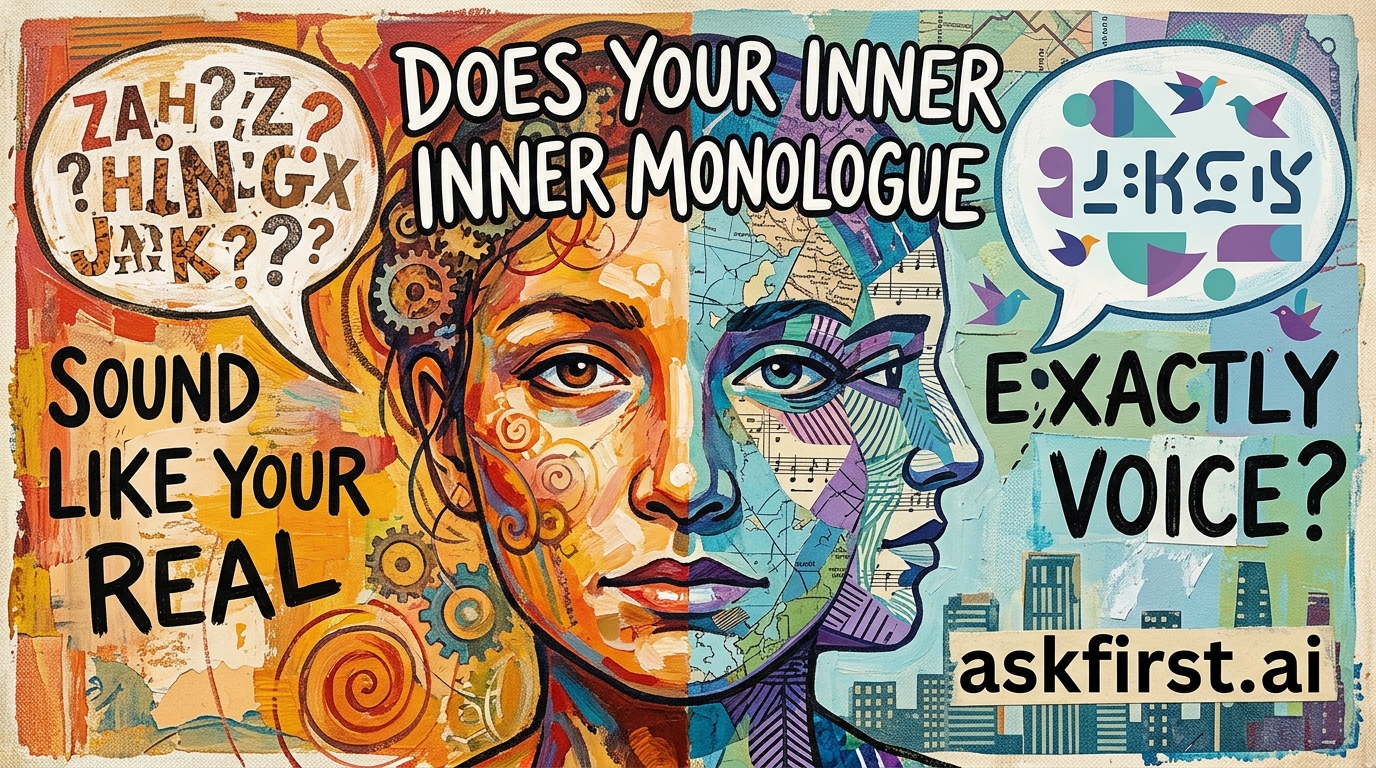
The Anatomy of the Internal Voice
The phenomenon of inner monologue, technically referred to as endophasia, is one of the most intriguing aspects of human cognition. While many people intuitively believe that their internal thought processes mirror their audible, spoken voice, scientific research suggests that the reality is far more nuanced, fluid, and often disconnected from physical vocal characteristics. Understanding why this internal narrative voice rarely sounds like a recording of oneself requires a deep dive into neurology, psychology, and linguistic processing.
Sensory Mismatch and Neural Simulation
When a human speaks, the brain receives auditory feedback from the ears (air conduction) and vibrations through the skull (bone conduction). This creates a unique signature that is recognized as "the self." However, inner speech does not involve physical sound waves. Instead, it relies on a process known as motor simulation. The brain activates the regions responsible for motor speech production—such as Broca's area—without triggering the muscles of the larynx or vocal cords. Because the external auditory system is bypassed during this internal rehearsal, the brain does not process the feedback that creates the distinctive texture, pitch, and timbre of the physical voice.
- The Lack of Auditory Feedback: Without air pressure changes hitting the eardrum, the "sound" perceived during inner speech is a construct of memory and intent rather than a literal sound recording.
- Conceptual Representation: Internal thoughts are often processed as abstract conceptual units rather than phonetically complete sentences. The brain fills in the gaps, leading to a generalized "voice" that serves as a mental placeholder rather than a literal echo.
The Variability of Mental Narratives
Research has shown that not every individual experiences a consistent internal voice. The population displays high variability in how internal experiences manifest:
- Auditory Thinkers: Individuals who hear a distinct, voice-like quality in their head, often possessing a consistent tone, rhythm, and accent.
- Visual Thinkers: Individuals who process information through imagery, symbols, or abstract concepts, often having no "voice" at all.
- Kinesthetic Thinkers: Those who process thoughts through feelings, movements, or sensations, ignoring auditory labels entirely.
For those who do have an internal monologue, it often takes on a different persona depending on the context. Sometimes it is neutral and objective; at other times, it may reflect internalized authorities, such as a parent, teacher, or societal standards. This suggests that the brain treats the internal voice as a dynamic tool for regulation rather than a fixed reproduction of the biological self.
Why Do People Think It Is Their Real Voice?
Psychologically, the brain works hard to maintain a sense of unity and identity. By labeling the internal monologue as "mine," the brain creates a sense of agency and control. This phenomenon is closely linked to Self-Monitoring Theory. Because the internal monologue is used to plan future speech and evaluate past actions, the brain aligns this internal stream with the person's identity. Thus, people convince themselves that the voice is their own, even if the acoustic properties are non-existent or radically different from reality.
Neuro-Linguistic Perspectives on Inner Speech
Modern linguistics posits that inner speech is a highly condensed version of external language, often called 'mentalese'. This medium is faster than speech and is stripped of the physical limitations of the vocal tract. The brain performs a 'compression' of information, making the inner voice seem faster, more concise, and more articulate than the messy reality of spoken communication.
Conclusion: The Illusion of Sameness
In essence, the inner monologue is not a recording, but a reconstruction. It is a neural simulation intended to facilitate problem-solving, emotional regulation, and planning. It sounds like "you" not because it shares your vocal cords, but because it shares your intent and perspective. The disparity between the inner voice and the outer voice is a testament to the sophistication of the human mind, which can create a stable sense of identity even while operating across multiple sensory modalities simultaneously. Understanding this distinction allows for greater mastery over self-talk, helping individuals realize that they are the architects of their internal dialogue rather than passive observers of a playback recording.