The Evolutionary Architecture of Human Decision-Making
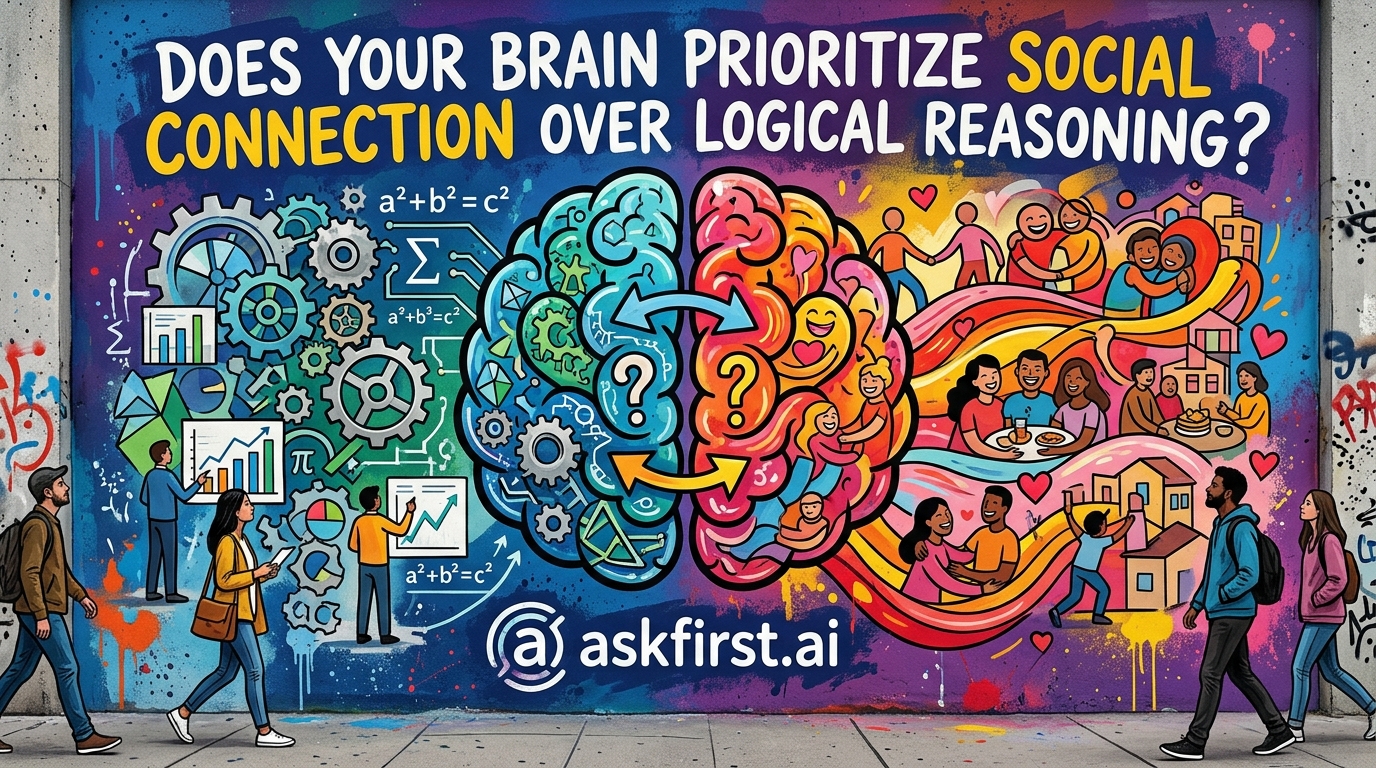
Evolutionary biology suggests that the human brain operates under a complex hierarchy of survival needs. While logic and analytical reasoning represent the pinnacle of cortical development, these processes often take a back seat to the primordial drive for social integration. The human species, essentially weak and slow when compared to apex predators, survived the harsh conditions of the Pleistocene era specifically through hyper-cooperation. Consequently, the brain developed a dedicated circuitry to monitor and maintain social standing, often overriding cold, objective logic to ensure communal safety.
The Social Brain Hypothesis
The Social Brain Hypothesis, championed by anthropologists like Robin Dunbar, posits that the primary driver for the evolution of our massive neocortex was not tool use or environment manipulation, but the sheer complexity of managing social relationships within a group. Navigating friendships, hierarchies, and coalition-building requires significantly more processing power than calculating the trajectory of a rock. When the brain senses a threat to social standing, it activates the same neural regions associated with physical pain. This creates a powerful motivation to suppress contrary logical conclusions if those conclusions risk social ostracization or group exclusion.
Why Conformity Trumps Accuracy
Consider the classic Asch Conformity Experiments. When individuals are placed in a group and asked to compare the length of lines, many participants knowingly provide an incorrect answer simply to align with the majority. This is not a failure of intelligence or logic; it is a successful adaptation to a social environment. The brain concludes that being wrong while part of a group is safer than being right while isolated. This mechanism is a cognitive filter that prioritize 'belonging' over 'truth.' The amygdala, often involved in detecting threats, signals potential social danger when one expresses a dissenting view, effectively triggering a 'fight or flight' response that inhibits the prefrontal cortex—the seat of logical reasoning.
Neural Hijacking: The Power of Peer Influence
- Cognitive Dissonance Resolution: When logic conflicts with group norms, the brain performs mental gymnastics to rationalize the group's stance, reducing the internal distress known as cognitive dissonance.
- Dopaminergic Feedback: Receiving positive social validation releases dopamine, the brain's reward chemical. This reward is often more immediate and potent than the abstract satisfaction of solving a logical puzzle.
- Mirror Neurons: These specialized cells allow humans to simulate the feelings and actions of others. While great for empathy, they also lead to emotional contagion, where group emotions easily override personal analytical assessments.
Practical Implications for Modern Life
In the modern age, this hard-wired prioritization explains phenomena such as echo chambers, social media tribalism, and collective belief biases. People do not necessarily believe misinformation because they are unintelligent; they believe it because the psychological cost of rejecting a group's shared reality is perceived as too high. Logical reasoning remains a tool that can be deployed when time and calm are available, but social connection serves as the brain's default operating system, especially under conditions of stress or uncertainty.
How to Reclaim Logical Autonomy
To transcend these ancient defaults, individuals must cultivate 'meta-cognitive awareness.' This involves recognizing that the initial, gut-level urge to agree with peers or reject an idea based on its origin is a social adaptation rather than a truth-seeking one. By creating artificial pauses between stimulus and response, one can engage the prefrontal cortex, allowing objective facts to enter the decision-making process. Recognizing this inherent bias is the first step toward genuine intellectual independence. Science tells us that while we are programmed to connect, we are also equipped with the neuroplasticity to override these impulses. The goal is not to abandon social connection, but to balance it with the pursuit of empirical truth, understanding that true wisdom lies at the intersection of meaningful human relationships and rigorous, unbiased analysis.