The Paradox of Social Isolation in Crowds
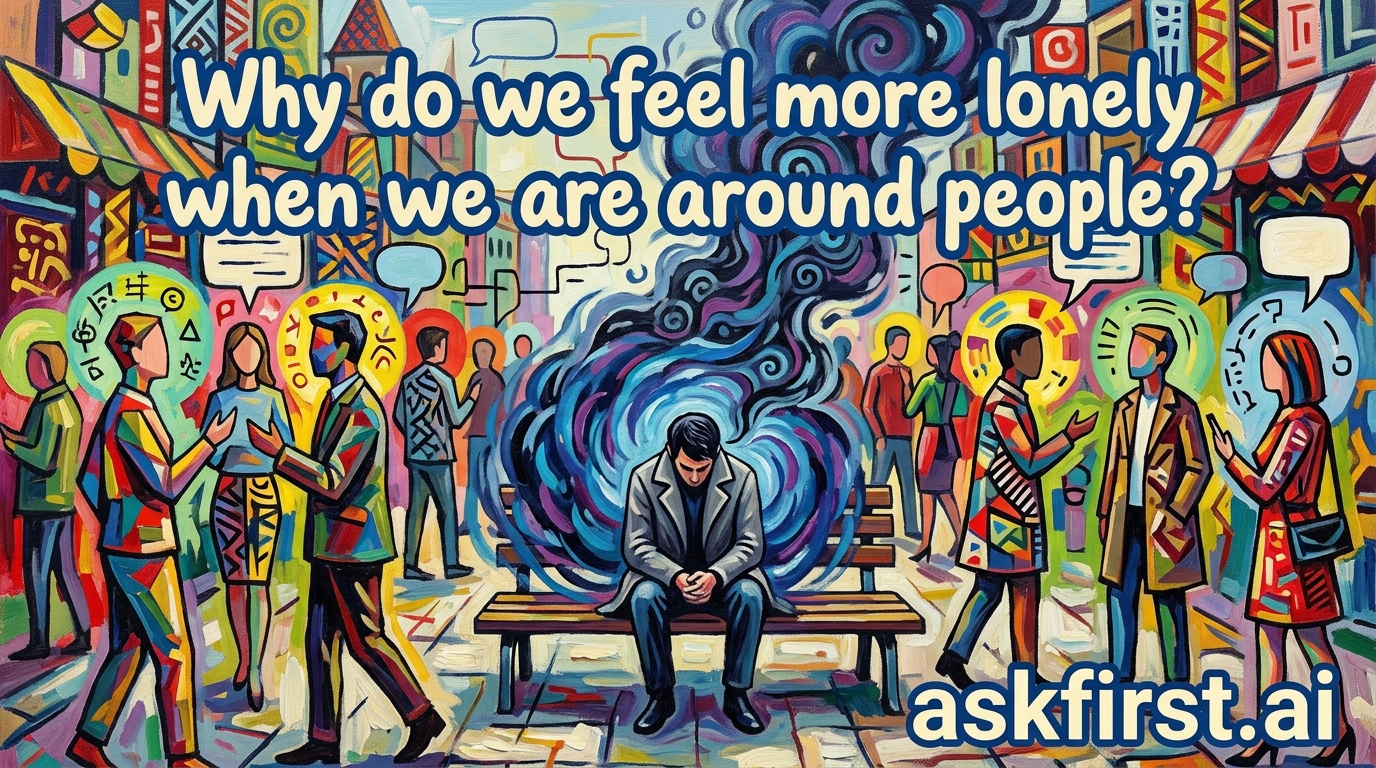
It is a profound psychological mystery that one can feel deeply isolated while standing in a room full of people. This phenomenon, often termed 'collective loneliness', occurs when physical proximity does not equate to emotional intimacy or social connection. The discrepancy arises not from a lack of people, but from a mismatch between desired and actual social engagement.
The Psychology of Perceived Social Disconnect
Loneliness is not merely the absence of social contact; it is the subjective experience of a gap between one's social needs and one's current reality. When an individual is surrounded by others, the contrast between their internal emotional state and the external environment becomes stark. This is frequently linked to social comparison theory, where individuals subconsciously evaluate their own social success against the interactions of others. If a person feels that their interactions are superficial, forced, or lacking in 'true' understanding, the presence of others acts as a mirror that reflects that void, intensifying the feeling of isolation.
- Surface-Level Interactions: Frequent 'small talk' can reinforce the sensation of distance if deep, meaningful connection is what the brain craves.
- The Mismatch Theory: Our evolutionary biology evolved for small, tight-knit tribal units. Modern life often forces us into large, anonymous groups where the lack of 'tribal' bond triggers an alarm system in the brain, signaling social exclusion.
The Role of Emotional Camouflage
Another significant driver of this sensation is social camouflaging. Many individuals consciously or subconsciously mask their authentic selves to fit into social settings, fearing judgment or rejection. By presenting a filtered version of personality to the crowd, the individual inadvertently creates a wall between themselves and others. Because the 'true self' remains unseen, the individual feels that no one is actually connecting with them—only with the mask they have built. Consequently, even amidst laughter and conversation, the internal experience is one of profound secrecy and separateness.
Neuroscience and Social Hunger
Research in neuroscience suggests that the feeling of loneliness can act as a biological 'hunger'. Much like physical hunger tells the body it needs nutrients, social loneliness tells the brain it needs social integration to survive. When a person is in a crowd but lacks perceived integration, the brain's social surveillance system remains hyper-active. This state of constant scanning for authentic connection in a group that feels 'alien' can be mentally exhausting. The prefrontal cortex, responsible for social cognition, may become overloaded by the complex task of navigating groups where deep bonds are absent.
Strategies for Reclaiming Connection
Understanding that this feeling is a standard human response to a lack of genuine belonging can empower individuals to shift their approach to social environments:
- Prioritize Quality Over Quantity: Instead of seeking crowded environments, focus on settings that allow for deep, one-on-one dialogue. Vulnerability, while initially daunting, is the primary key to dismantling the wall of loneliness.
- Practice Active Authenticity: Reducing the use of social masks allows for authentic signals to be broadcast. When individuals allow themselves to be seen as they truly are, they attract those who resonate with their true nature.
- Reframing Loneliness: View the feeling of loneliness as a data point rather than a flaw. It is a signal to pivot toward activities or relationships that provide meaningful sustenance, rather than continuing to consume 'social junk food' in settings that offer no genuine connection.
The Evolutionary Perspective
From an evolutionary standpoint, the feeling of loneliness is an adaptive mechanism. In ancestral environments, being ostracized from a group could be fatal. Therefore, humans developed a heightened sensitivity to social exclusion. When we feel lonely around others, it may be the brain identifying that the current 'tribe' is not providing the necessary emotional safety or support, prompting a signal to find deeper connections. Recognizing this as an evolutionary relic can reduce the shame often associated with feeling isolated, turning a source of distress into a clear indicator of what the spirit requires to thrive. In a world of digital noise and rapid-fire social encounters, the ability to cultivate intentional, meaningful presence remains the most effective antidote to the modern epidemic of loneliness.