The Psychology of the 'Norman Door' Phenomenon
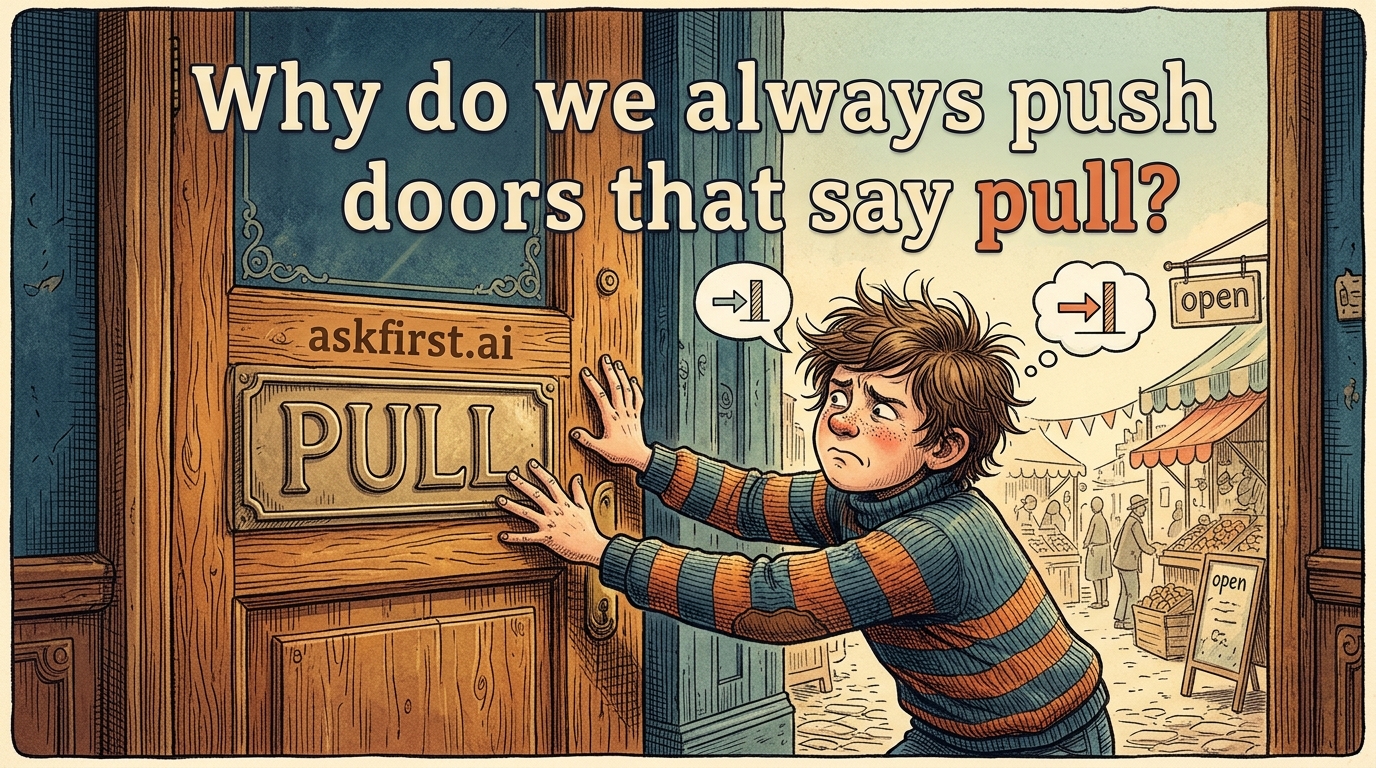
Human interaction with the built environment is governed by silent scripts, yet these scripts are often misread due to the cognitive shortcuts our brains naturally employ. The phenomenon of pushing a door labeled 'pull' is a classic example of a 'Norman Door'—a design failure named after cognitive scientist Don Norman. When the design of an object does not provide immediate, intuitive information about how to operate it, the human brain reverts to heuristic thinking, leading to predictable behavioral errors.
The Role of Affordances
In design psychology, the term affordance refers to the perceived and actual properties of an object that suggest how it can be used. A handle on a door has a physical affordance for grasping and pulling. When a door is equipped with a flat metal plate rather than a handle, it provides a strong affordance for pushing. When a designer places a handle on a door that is meant to be pushed, the visual signal contradicts the mechanical function. The human brain subconsciously prioritizes the physical affordance (the handle) over the symbolic instructions (the text), causing a momentary lapse in decision-making.
Cognitive Heuristics and System 1 Thinking
Psychologist Daniel Kahneman identified two systems of thought: System 1 (fast, intuitive, emotional) and System 2 (slow, deliberative, logical). Navigating through a building is a task usually relegated to System 1 to conserve mental energy. When approaching a door, the brain performs a rapid scan. If a door looks 'pushable,' the brain executes that motor command before the rational System 2 has a chance to read the 'Pull' sign. By the time the mistake is realized, the individual has already committed to the push motion. This is not a failure of intelligence; it is a manifestation of the brain's drive for efficiency.
The Design Mismatch: A Case Study
Many architectural decisions prioritize aesthetics over ergonomics. A large, beautiful push-plate might ruin the desired look of an entrance, so designers force a handle onto it. This creates a cognitive friction that disrupts the user experience. According to research in environmental psychology, humans are biologically programmed to interact with objects based on their perceived weight and structural orientation. A flat surface invites pressure, while a vertical protrusion invites gripping. When these expectations are violated, the user feels a sense of confusion that can sometimes lead to annoyance or embarrassment.
How Architects Can Fix This
To eliminate this universal struggle, architects and building managers should adhere to the following principles:
- Visible Mapping: The physical appearance of the door must communicate its function. If the door requires a pull, use a vertical bar or a handle that makes it impossible to push. If the door requires a push, use a flat plate that makes it impossible to pull.
- Clear Visual Cues: Place instructional text at eye level and in a high-contrast format, though recognize that visual instructions will always be secondary to physical affordances.
- Standardization: Create consistency throughout a building. If every push door has a specific type of plate and every pull door has a specific type of handle, the brain learns the pattern, reducing the need for active processing.
Conclusion: A Lesson in Human-Centric Design
The frustration of pushing a pull door is a powerful reminder that our environment is constantly shaping our behavior. Designers have the responsibility to align mechanical function with psychological expectations. When they succeed, we move through the world effortlessly. When they fail, we are left standing in front of an entrance, questioning our own reflexes, trapped in a minor but recurring battle between human habit and poor industrial design. Ultimately, the next time you find yourself pushing a pull door, recognize that the error lies in the design, not your mind. You are simply a victim of an object that speaks a language your brain refuses to learn.