The Fascinating Mechanism of False Memories: Why Brains Rewrite History
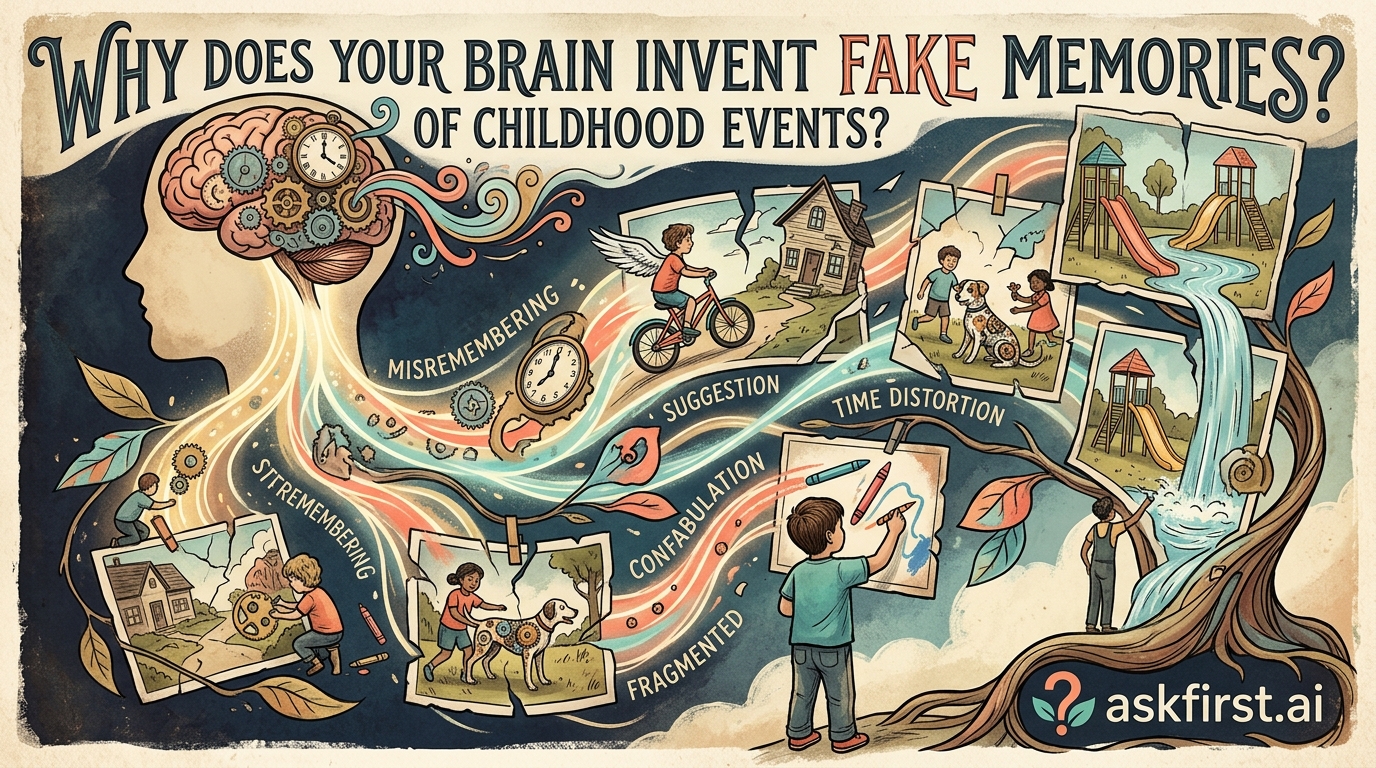
The phenomenon of false memories is not a sign of cognitive dysfunction, but rather a testament to the creative, predictive, and reconstructive nature of the human brain. Unlike a digital video recorder that stores files in an immutable format, human memory is a fluid, adaptive process. Every time a memory is recalled, it is reconstructed from scratch, making it susceptible to distortion, omission, and embellishment. This process, known as memory reconsolidation, is essential for learning and adaptation but inherently flawed in its accuracy.
The Constructive Nature of Cognition
Human memory is fundamentally reconstructive. When the brain attempts to access a childhood event, it does not retrieve a stored image like a photograph. Instead, it pulls together disparate fragments of sensory input, semantic knowledge, and emotional tags. If gaps exist in this recollection—which they almost always do—the brain proactively fills these gaps with information from other sources to maintain a coherent narrative. This filler often comes from photos viewed later, stories told by parents, or even generalized knowledge about how such events usually happen. By the time the brain finishes 'assembling' the memory, the line between original experience and later inference is blurred, sometimes permanently.
Psychological Mechanisms and The Curiosity Gap
- Source Monitoring Errors: This is the primary culprit behind false memories. It occurs when the brain remembers the content of an event but fails to attribute it to the correct source. For instance, a child might see a movie about a clown at a birthday party and, years later, vividly 'remember' being at that party themselves. The brain retains the emotional excitement but loses the metadata regarding where that memory originated.
- The Misinformation Effect: Research by Elizabeth Loftus has demonstrated that exposure to post-event information can significantly alter the original memory. If a person is asked a leading question—'How fast was the car going when it smashed into the other?' versus 'hit'—the brain integrates that intensity into the memory itself. This demonstrates that memories are not isolated entities but are malleable to external suggestions.
- Schema Integration: The brain relies on schemas, or mental blueprints, to organize information. If an event contradicts a schema, the brain may subtly adjust the memory to better fit existing expectations of reality, thereby making the memory feel more 'logical' and consistent with the individual's world view.
The Evolutionary Advantage of Imperfection
One might wonder: why would evolution design a memory system that is so prone to error? The answer lies in functional utility.
- Future Simulation: The brain did not evolve to be a perfect historian; it evolved to be a survival machine. Memory is primarily a tool for simulating future events. By generalizing memories, the brain creates a flexible knowledge base that helps individuals predict outcomes in new, similar situations. Accuracy is often sacrificed for speed and applicability.
- Coherence and Identity: Maintaining a coherent 'self-narrative' is crucial for psychological stability. The brain prioritizes creating a life story that makes sense, even if it requires tweaking minor details to align with the current sense of self. This helps in social bonding and maintaining a consistent internal identity over time.
Busting the Myths of 'Flashbulb' Memories
Many individuals believe that intense, emotional events are immune to distortion. These are known as 'Flashbulb Memories.' However, longitudinal studies have proven that even these vivid recollections are subject to significant decay and change. While the confidence in these memories remains high, the accuracy often drops significantly as years pass. The perceived 'clarity' is merely an illusion created by the high emotional intensity associated with the recollection, leading to a false sense of certainty.
Conclusion: Embracing the Fluidity of Memory
Understanding that the brain invents fake memories shifts the perspective on what it means to remember. Rather than viewing memory as a precise retrieval system, it is better described as a generative engine. While this can lead to misconceptions, it is also what allows humans to be highly imaginative, empathetic, and adaptable. By recognizing that memories are reconstructions, one can become more humble about the certainty of their past and more appreciative of the brain's incredible capacity to create meaning from the raw, fragmented data of human experience. This realization does not diminish the value of personal history; instead, it highlights the remarkable and ongoing process of human self-creation.