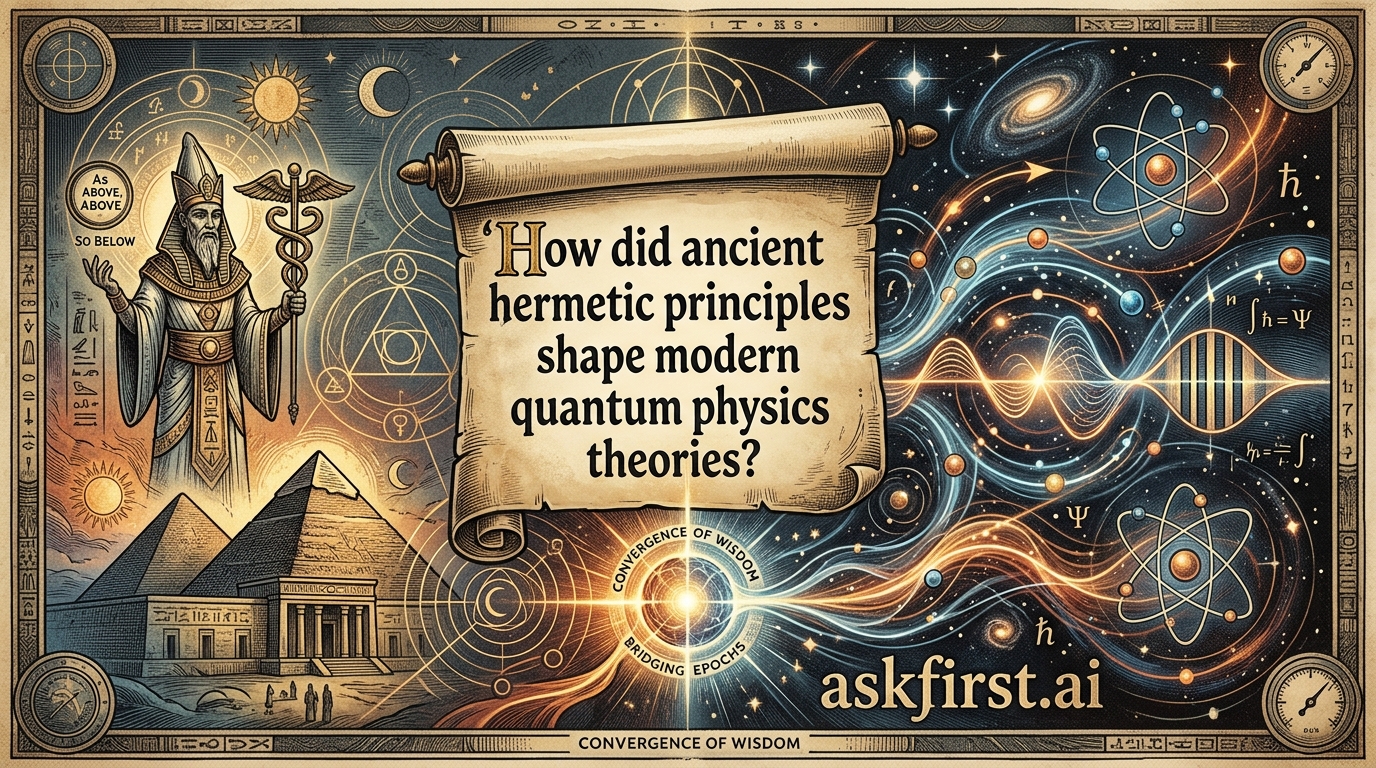
The intersection of ancient Hermetic philosophy and modern quantum physics represents one of the most compelling dialogues between mysticism and empirical science. While separated by millennia, both disciplines converge on a singular, foundational premise: the universe is not a collection of isolated, solid objects, but rather a dynamic, interconnected field of energy and information. The Kybalion, a seminal text attributed to the "Three Initiates" and published in 1908, codifies the seven Hermetic principles that mirror, with startling accuracy, the observations made by 20th-century physicists such as Niels Bohr, Werner Heisenberg, and David Bohm.
The Principle of Mentalism: The Observer Effect
The first Hermetic principle, "The All is Mind; the Universe is Mental," suggests that reality is a construct of consciousness. In quantum mechanics, this is echoed in the "Observer Effect." The famous double-slit experiment demonstrated that subatomic particles behave as waves of probability until they are measured or observed. At the moment of observation, the wave function collapses into a definite particle state.
Physicist Sir James Jeans, in his influential work The Mysterious Universe (1930), famously remarked, "The universe begins to look more like a great thought than like a great machine." This aligns perfectly with the Hermetic view that matter is secondary to the "Mental" substrate. Just as the Hermeticist views the world as a manifestation of the Divine Mind, quantum theorists like Max Planck acknowledged that he regarded consciousness as fundamental and matter as a derivative of consciousness.
The Principle of Correspondence: As Above, So Below
"As above, so below; as below, so above" is perhaps the most famous Hermetic axiom. It posits that the laws governing the macrocosm (the universe) are mirrored in the microcosm (the atom). In the mid-20th century, the physicist David Bohm, particularly in his seminal book Wholeness and the Implicate Order (1980), proposed the theory of the "Holographic Universe."
Bohm argued that the entire universe is folded into every part of itself. Much like a hologram, where any small fragment contains the information of the entire image, the subatomic realm contains the structural blueprints of the cosmic scale. This principle provides a theoretical bridge between General Relativity (the physics of the large) and Quantum Mechanics (the physics of the small), suggesting that the universe operates through a unified, fractal-like structure that repeats its fundamental patterns across all dimensions of existence.
The Principle of Vibration: Energy as the Fundamental Reality
The Hermetic Principle of Vibration states that "Nothing rests; everything moves; everything vibrates." This is the cornerstone of modern quantum field theory. We now know that at the deepest level, "solid" matter is merely a vibration of quantum fields. Electrons, quarks, and photons are not billiard balls, but excitations in an underlying field.
Fritjof Capra, in his groundbreaking book The Tao of Physics (1975), meticulously details how the subatomic world is a continuous dance of energy. He notes that the modern physicist, much like the ancient Hermeticist, views the universe not as a static collection of objects, but as a vibrant, rhythmic process. The "frequency" of a particle determines its identity, much like the pitch of a note in music. If the vibration stops, the particle (in our conventional understanding) ceases to interact with the field, effectively dissolving back into the vacuum.
The Principle of Polarity and Paradox
Hermeticism teaches that "Everything is Dual; everything has poles; everything has its pair of opposites." This is the philosophical precursor to the quantum concept of wave-particle duality. Light and matter exhibit properties of both particles (localized, discrete entities) and waves (spread-out, continuous fields).
Niels Bohr, the father of the Copenhagen interpretation, developed the concept of "Complementarity" to explain this. He argued that the contradictory nature of light—being both wave and particle—is not an error in our understanding, but an inherent feature of reality. Just as heat and cold are merely different degrees of the same thing (temperature), particle and wave are two poles of the same quantum phenomenon. This reconciliation of opposites is a quintessentially Hermetic approach to resolving paradoxes in nature.
The Principle of Correspondence and Non-Locality
Finally, the Hermetic principle of "Correspondence" finds a modern expression in the phenomenon of Quantum Entanglement. When two particles become entangled, they remain connected regardless of the distance between them. A change in the state of one instantly affects the other, defying the traditional limits of space and time.
John Bell, who formulated "Bell’s Theorem," proved mathematically that the universe is "non-local." This confirms the Hermetic worldview that the universe is an interconnected web. If all things were not fundamentally linked through a deeper, underlying reality, the instantaneous communication between entangled particles would be impossible.
Conclusion
The bridge between Hermeticism and quantum physics is not one of coincidence, but one of shared intuition regarding the nature of existence. The ancient seers sought to understand the "All" through introspection and symbolic observation, while modern physicists utilize mathematics and high-energy colliders. Both arrive at the same destination: a universe that is fundamentally mental, vibratory, interconnected, and paradoxical. By looking back at these ancient principles, we gain a deeper philosophical context for the radical findings of 20th and 21st-century science, reminding us that the search for truth is a continuous, timeless endeavor.