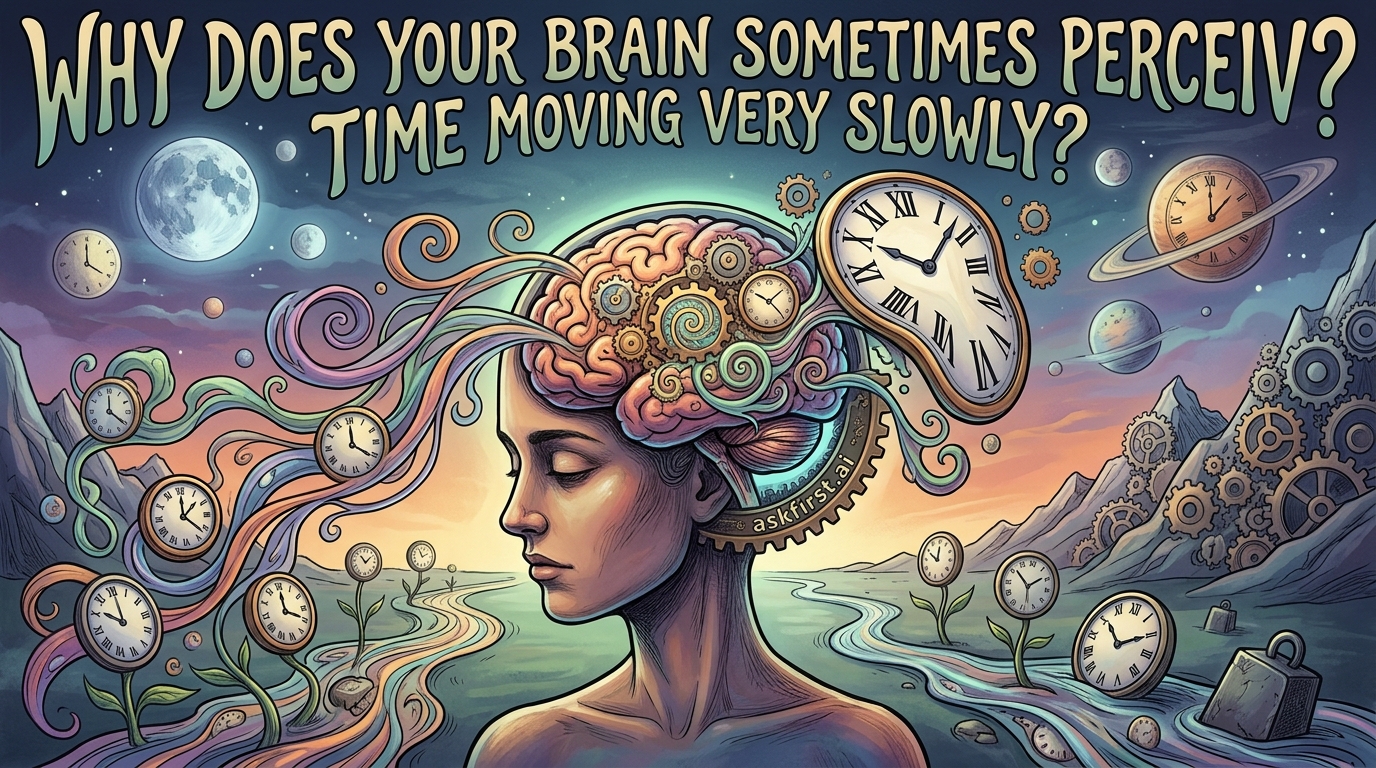
The Neuropsychology of Temporal Distortion
The perception of time is not a fixed, objective reality managed by an internal clock; rather, it is a fluid, reconstructive process governed by the brain. When an individual feels that time is dragging, it is usually a result of the brain dedicating more cognitive resources to processing sensory input. This phenomenon, often referred to as 'temporal dilation,' serves as a fascinating intersection of neurology, psychology, and cognitive awareness.
The Role of Novelty and Information Density
One of the most robust explanations for why time feels slow during certain moments is the Novelty Effect. When the brain encounters unfamiliar environments or tasks, it must work harder to encode new information into long-term memory. According to the 'Memory-Storage Size' model, the perceived duration of an event is directly proportional to the amount of memory consumed by that experience.
- High-Density Encoding: During a new or intense experience, such as a first visit to a foreign country, the brain records sensory data in high resolution. When the brain later retrieves these dense memories, the duration of that interval feels extended.
- Routine Habituation: Conversely, in familiar environments—like a daily commute—the brain enters 'autopilot' mode. Because the environment is predictable, the brain minimizes resource allocation. The result is a lack of distinct episodic memories, leading to the sensation that the time 'vanished.'
Emotional Modulation and the Amygdala
The amygdala, the brain's emotional processing hub, plays a critical role in how time is perceived during high-arousal states. Fear or extreme excitement often leads to a feeling that time has slowed down, most famously observed in accidents or 'near-miss' scenarios.
- Increased Vigilance: In a perceived threat, the amygdala increases its activity, effectively 'upgrading' the sampling rate of the visual cortex.
- Evolutionary Advantage: This serves an evolutionary purpose. By capturing more information per second, the brain allows for a sharper, more detailed response to environmental stimuli. The brain is not actually slowing down time, but it is processing a higher volume of frames, creating the subjective illusion of a slow-motion sequence.
Dopamine and the Internal Pacemaker
Neurotransmitters like dopamine regulate the 'internal pacemaker'—the mechanism by which the brain tracks rhythmic intervals. Research suggests that high levels of dopamine can accelerate the internal clock. If the internal clock ticks faster than the actual physical passage of time, the outside world will appear to slow down. Conversely, low levels of dopamine are associated with the feeling that time is moving quickly, as the internal pacemaker slows down, causing external events to feel compressed.
The Impact of Attention and Focused Concentration
When attention is explicitly directed toward time, the sensation of duration changes significantly. If an individual is waiting for something and constantly checking the clock, they are hyper-aware of the passage of intervals. This meta-cognition—thinking about thinking—interferes with the flow state.
- Distraction vs. Observation: In states of 'flow' (deep immersion), the sense of self-time disappears. In states of boredom or forced waiting, the monitoring of the clock creates a feedback loop that makes every second feel laborious.
- The Oddball Effect: Unexpected stimuli can briefly distort time. When an unusual or 'odd' stimulus appears in a sequence of otherwise identical stimuli, the brain allocates more attentional resources to that specific event, making it seem as if it lasted longer than its neighbors.
Conclusion: The Subjective Clock
Ultimately, time perception is a psychological construction. The brain prioritizes survival, learning, and efficiency over chronological accuracy. By expanding time during high-stakes or novel moments, the brain provides the organism with a greater opportunity to analyze, learn, and react to its surroundings. This is why childhood feels endless compared to adulthood; as we age, we experience fewer truly 'novel' events, and our internal encoding slows down.
Understanding these mechanisms offers a unique perspective on the human condition: time is not merely a measurement on a watch, but a dynamic interpretation of experience itself. By actively seeking out novelty and engaging deeply with the world, it is possible to effectively 'expand' one's life, making the perceived years feel fuller and richer in detail.