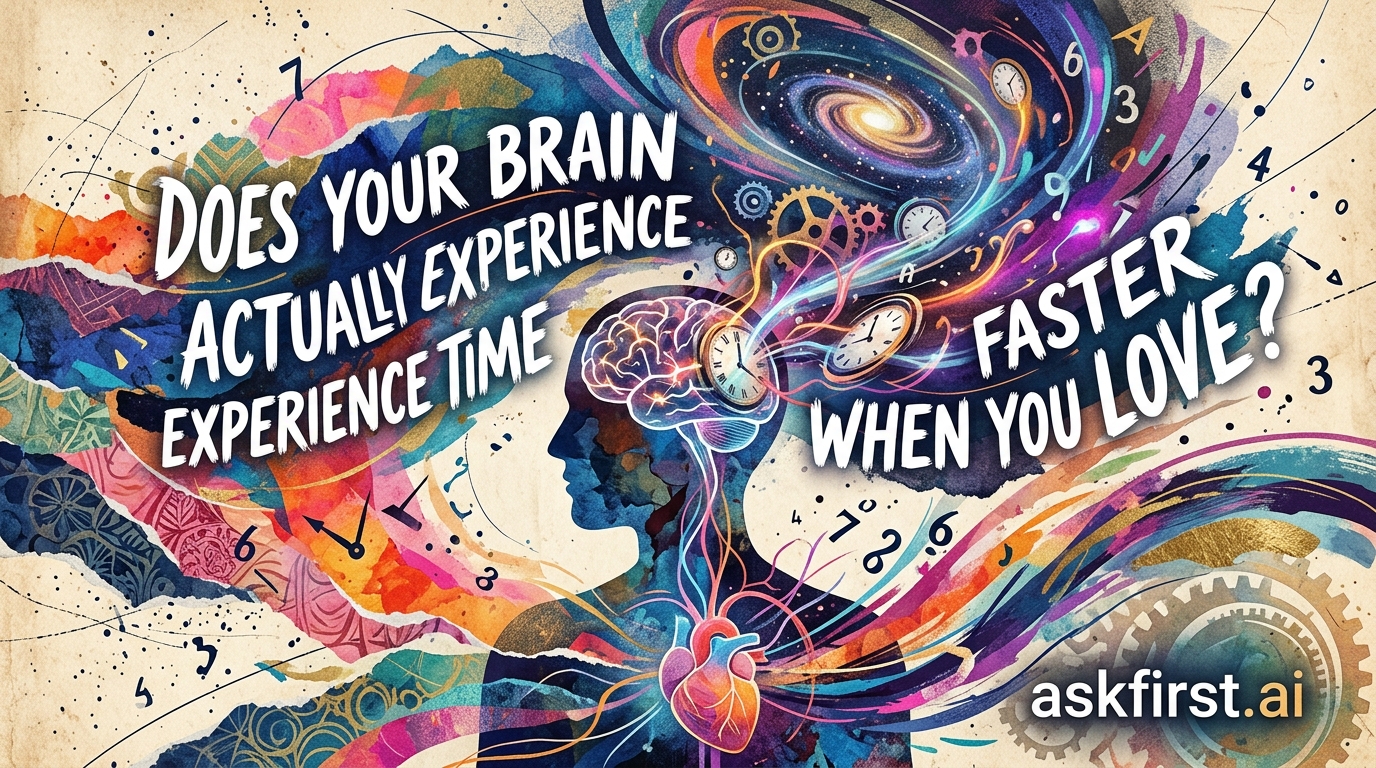
The Chronological Illusion of Affection
The perception of time is not a fixed mechanical constant; it is a fluid psychological construct synthesized by the brain. When individuals experience the intensity of love, they often report that time feels as though it is accelerating, a phenomenon known as temporal compression. This experience is grounded in the complex intersection of neurology, emotion, and cognitive attention mechanisms.
The Neural Basis of Time Perception
The brain processes time through two distinct systems: the retrospective assessment and the prospective experience. When the brain is focused intently on a person or an activity, it operates in a high-engagement state. According to the Oddball Effect, when the brain encounters novel or highly emotionally salient stimuli, the rate of sensory processing increases. During the early stages of romantic attraction, the brain is flooded with dopamine and norepinephrine. These neurotransmitters heighten focus and alertness, causing the neural hardware to process information more rapidly. Because more data points are being encoded during a given interval, the brain perceives the passage of time as being much faster than when it is in a state of boredom or routine.
Why Time Flies When You Are Having Fun
There is a well-documented psychological principle stating that time perception is inversely proportional to the amount of attention paid to it. In routine tasks, the brain monitors time closely, leading to a sensation that time is moving slowly. Conversely, when an individual is in love, their attention is fixated on the object of their affection, creating a state of deep engagement or 'flow'.
- Hyper-focus: The brain effectively 'tunes out' peripheral time-keeping cues, such as the ticking of a clock or the rhythmic nature of daily work.
- Dopaminergic Influence: The reward-seeking behavior associated with love stimulates the mesolimbic system. As this system remains highly active, the conscious mind essentially bypasses the internal monitoring of temporal duration.
- Reduced Metadata Processing: Because the emotional reward is so high, the brain stops placing markers on memory segments, leading to the subjective feeling that 'hours felt like minutes'.
Retrospective vs. Prospective Duration
It is vital to distinguish between how love feels in the moment and how it is remembered.
- In the moment (Prospective): Time feels like it is moving faster due to the high density of emotional engagement and the lack of attention directed toward the passage of time.
- In memory (Retrospective): Interestingly, once the moment has passed, the brain often perceives the experience as having lasted longer. This is known as the Holiday Paradox. Because the brain encoded a high volume of new, emotionally charged memories, looking back at the period makes it seem vast and rich, even if the subjective experience during the moment was one of 'lost' time.
The Role of Oxytocin and Empathy
Beyond dopamine, the hormone oxytocin plays a crucial role in how we perceive social connectivity. Oxytocin serves to synchronize the brain activity of two people. When this synchronization occurs, the individual perception of self-identity temporarily blurs into a collective unit. This blurring disrupts the standard cognitive framing that is necessary to track the objective passage of time. When the 'self' is less distinct, the temporal boundaries that define individual existence become permeable, leading to a sense of timelessness.
Scientific Perspectives and Cognitive Models
The Internal Clock Model suggests that humans have a physiological pacemaker in the basal ganglia. Love affects the 'switch' mechanism that determines how many pulses are counted in a given interval. High emotional arousal increases the speed of the pacemaker, but it simultaneously distracts the consciousness from counting the pulses. This creates the 'faster time' sensation. Furthermore, researchers in behavioral psychology have found that:
- Stress vs. Love: Paradoxically, intense fear causes time to feel slow (to facilitate survival-based reactions), whereas love causes it to accelerate (to facilitate social bonding).
- The Neurobiology of Focus: Studies in neural imaging show that during periods of intense romantic affection, the prefrontal cortex—the area associated with executive function and temporal awareness—exhibits different activity patterns, prioritizing emotional integration over chronological observation.
Conclusion
The perception of time speeding up during periods of love is a sophisticated byproduct of our neurological architecture. It is an evolutionary adaptation that favors deep engagement and pair-bonding by removing the distractions of linear time measurement. While physics defines time as a constant, the human brain redefines it through the lens of emotional intensity. Ultimately, the sensation that time is 'disappearing' is a testament to the depth of human connection and the brain’s incredible ability to prioritize meaningful experiences over objective reality.