The Psychology of Design and the Norman Door Phenomenon
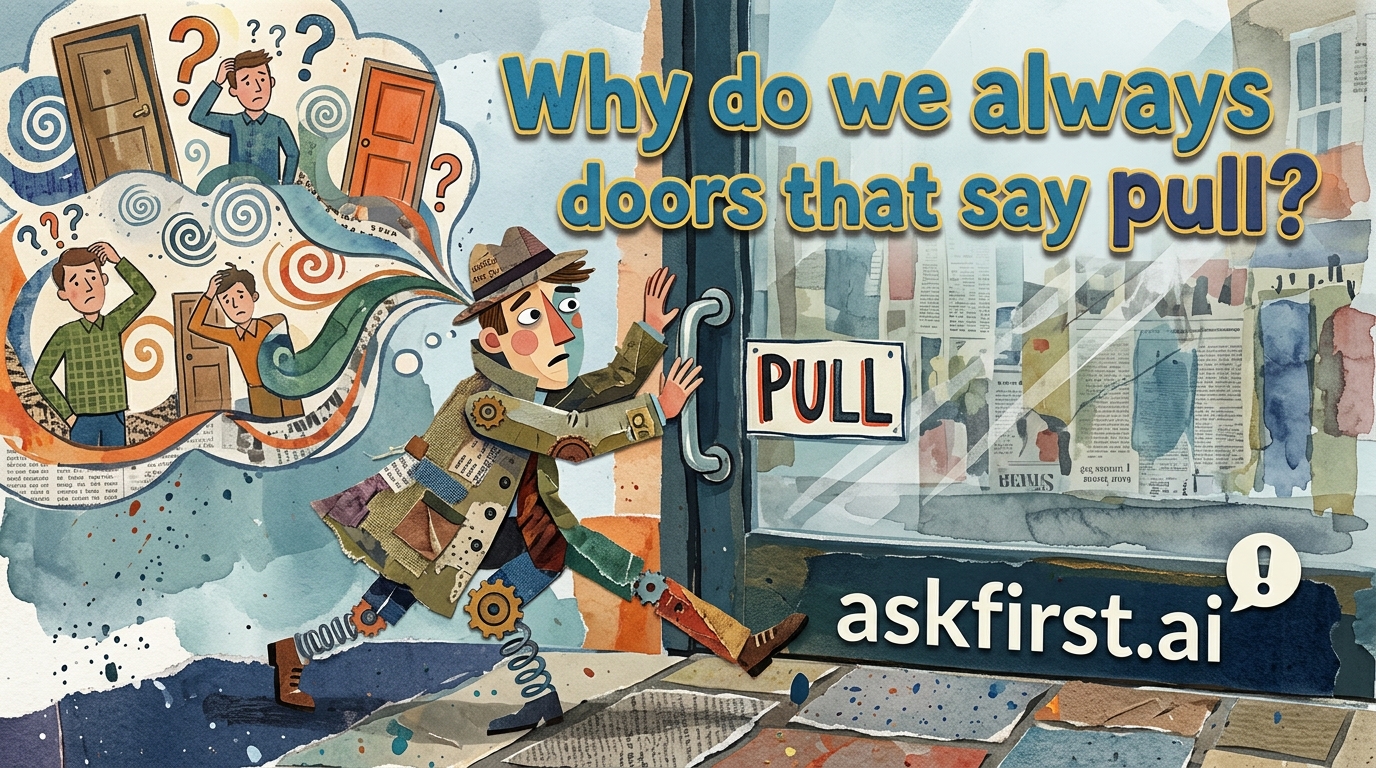
The experience of encountering a door marked 'pull' and instinctually pushing it is a universal frustration. This common design error, famously termed the 'Norman Door' by cognitive scientist Don Norman in his seminal work The Design of Everyday Things, highlights a fundamental disconnect between how objects are engineered and how the human brain processes environmental cues. When a door does not provide clear affordances—visual signals that indicate how an object should be used—the human brain reverts to subconscious heuristics based on past experience.
The Role of Affordances
An affordance is a property of an object that suggests how it might be used. A handle on a door is a classic affordance for pulling; a flat metal plate is an affordance for pushing. However, architects and building contractors often install handles on both sides of a door for aesthetic consistency, creating a visual contradiction. When a user approaches such a door, the presence of a handle creates a 'strong signal' to pull, regardless of the text written on a small, often obscured sticker. Because humans are visual creatures who scan for intuitive cues, the text label is secondary to the physical form. When the physical affordance conflicts with the intended function, the brain prioritizes the physical intuition over the linguistic command.
Cognitive Overload and Automaticity
Human beings operate on 'automaticity'—a state where the brain relies on past habits to navigate familiar environments to conserve cognitive energy. Walking through doors is a mundane activity that rarely requires conscious deliberation. This is referred to as System 1 thinking, characterized by fast, instinctive, and emotional processes. When someone approaches a door, they are likely thinking about their destination or the task ahead, not the mechanics of the entrance. If the door handle presents a shape that the brain has associated with 'pulling' thousands of times before, that action is initiated before the eyes can even process the 'pull' sign. The sign requires conscious, reflective thought (System 2), but the body has already reacted based on the physical design. This is not a failure of intelligence; it is a testament to the brain's efficiency in automating physical movement.
The Evolution of Door Engineering
Historically, doors were simple architectural elements. As construction techniques evolved, the push for 'symmetrical' interior design led to the ubiquity of standardized hardware. Manufacturers produce handles in bulk, and architects prefer visual uniformity, leading to the installation of pull-style hardware on doors that are meant to swing outward or inward based on fire safety regulations. Fire codes mandate that egress doors must swing in the direction of exit paths to prevent jamming in a panic. Therefore, a door might be designed to be pushed for safety reasons, but given a handle designed for pulling. This conflict is inherently structural and reflects a lack of Human-Centered Design (HCD) in the construction phase.
Bridging the Gap: Solutions for Better Interaction
To mitigate this common error, modern designers and user experience experts advocate for the following principles:
- Mapping: The physical design should map directly to the intended action. If a door must be pushed, it should only have a flat push-plate, never a handle.
- Forcing Functions: Some designers use physical barriers or recessed designs that make it impossible to pull the door, thereby removing the possibility of error.
- Signifiers: If hardware cannot be changed, the signifier must be loud and clear, such as using high-contrast color coding or placing the sign exactly at eye level on the interaction point (the handle itself).
Why This Matters in a Modern World
While the 'push-pull' error might seem trivial, it is a masterclass in the importance of user experience (UX) design. The frustration felt when a door does not open as expected is a minor, yet powerful example of what happens when engineering fails to account for human psychology. By studying these small lapses, professionals in technology, architecture, and engineering learn to create systems that align with how the human mind naturally functions rather than forcing users to adapt to poorly conceived artifacts. The next time you find yourself pushing a pull door, remember: the mistake is not yours, but rather a flaw in the dialogue between the object and your innate behavioral patterns.