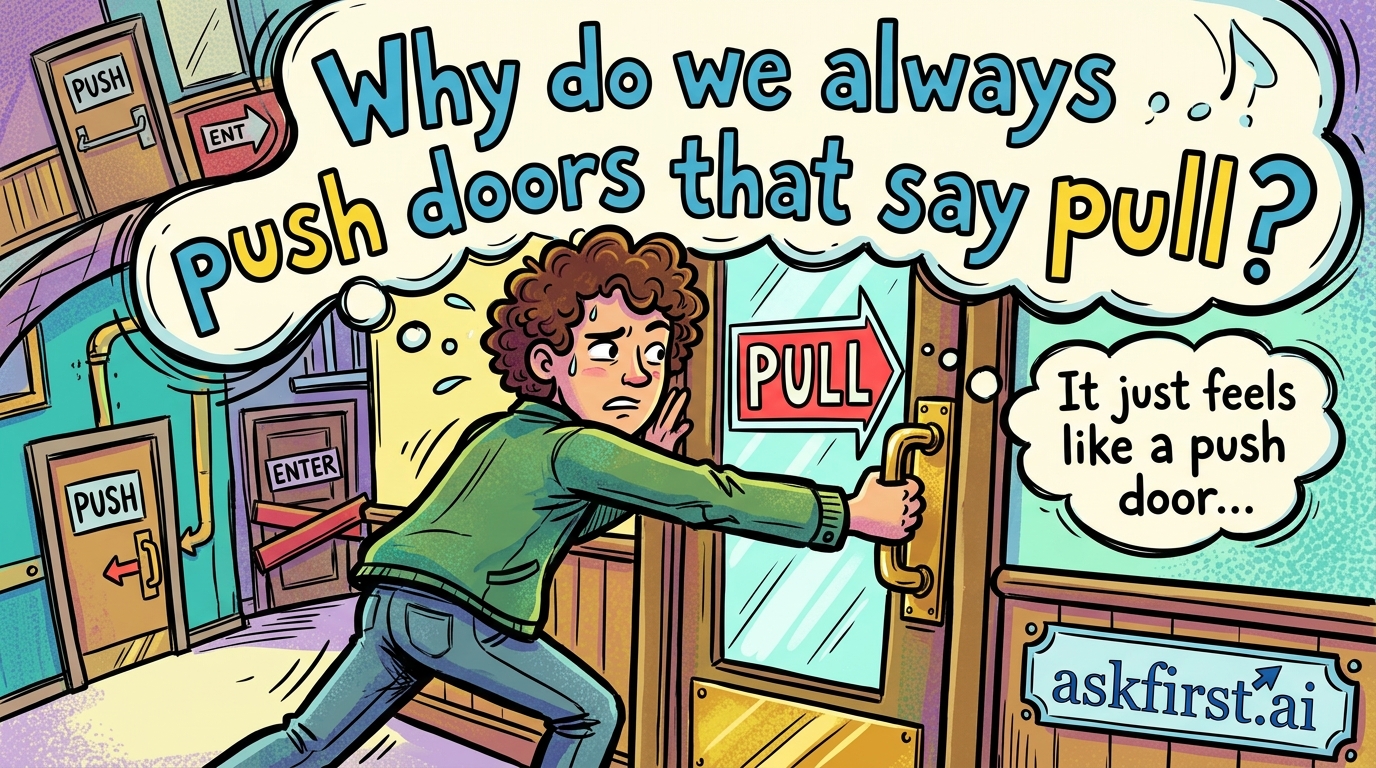
The phenomenon of pushing a door labeled 'pull' is a classic case of a 'Norman Door', a term coined by cognitive scientist Don Norman in his seminal work The Design of Everyday Things. This occurrence is not a failure of intelligence but a profound failure of industrial design. When an object’s appearance provides the wrong cue for its function, the human brain relies on habitual patterns rather than conscious analysis.
The Psychology of Affordance
At the core of this interaction is the concept of 'affordance.' An affordance is a visual clue that suggests how an object should be used. A handle, by its very physical shape, typically suggests two actions: pulling or grasping. If a door has a flat metal plate, the affordance is pushing. If it has a vertical bar or handle, the affordance is pulling. When designers place a vertical handle on a door that must be pushed, they create a design contradiction. The human brain subconsciously processes the vertical handle as a signal to pull, overriding the cognitive effort required to read the small, often faded 'pull' sign.
Cognitive Overload and Habitual Processing
Humans operate primarily through 'System 1' thinking, as defined by psychologist Daniel Kahneman. System 1 is fast, instinctive, and emotional. When walking toward a door, the mind is rarely focusing on the instructional text. Instead, it is scanning the environment for rapid navigation. Because the subconscious associates handles with pulling, the individual engages in the physical action before the conscious mind has a chance to evaluate the textual warning. This is not carelessness; it is the brain's efficient way of managing thousands of mundane tasks throughout the day.
Why Design Fails
Many architects prioritize aesthetics over user experience. A door might be designed to look symmetrical from both sides, leading to identical hardware on both the push and pull sides. This symmetry destroys the functional cues that users rely on. Furthermore, in commercial settings, building codes often mandate that doors in public buildings open outward for fire safety (an 'egress' requirement). If the hardware provided for this exit is a handle, the conflict is baked into the architecture itself.
The 'Error' as a Systemic Issue
To understand this behavior, one must look at the Gulf of Execution. This is the gap between the user's goal (opening the door) and the actual operation of the mechanism. If the design does not bridge this gap intuitively, the user will experience frustration. Expert designers often suggest the following:
- Eliminate ambiguity: Replace handles with flat push plates on the side that requires pushing.
- Use natural mapping: Ensure the mechanism matches the intended movement.
- Provide feedback: If a door must be pulled, the handle should be the only prominent feature on that side.
Societal Impacts of Poor Design
While pulling a push-door seems like a minor annoyance, it represents a wider issue in ergonomics. Consider the healthcare or manufacturing sectors, where split-second delays caused by counter-intuitive design can lead to actual errors. When we encounter a 'pull' sign on a door we just pushed, we are experiencing the friction of an imperfect world.
Summary of Principles for Better Interaction
- Visible Cues: An object should clearly signal its utility through its form alone, without the need for supplementary signage.
- Reduced Cognitive Load: Do not force users to read instructions for basic physical maneuvers.
- Feedback Loops: Ensure that when a user interacts with an object, the result is immediate and consistent with their expectations.
Ultimately, when you find yourself pushing a door that says pull, remember that the fault lies with the designer, not with you. The 'Norman Door' remains the gold standard in behavioral science for demonstrating how the physical environment shapes human behavior in unexpected and sometimes humorous ways. By prioritizing clarity, industrial designers can reduce the cognitive burden on society, one door at a time. The evolution of human-computer interaction and industrial design continues to move toward 'invisible design,' where the object's function is so obvious that conscious thought is never required. Until that vision is fully realized across our architecture, we remain at the mercy of confusing handles, perpetually pushing when we should be pulling.