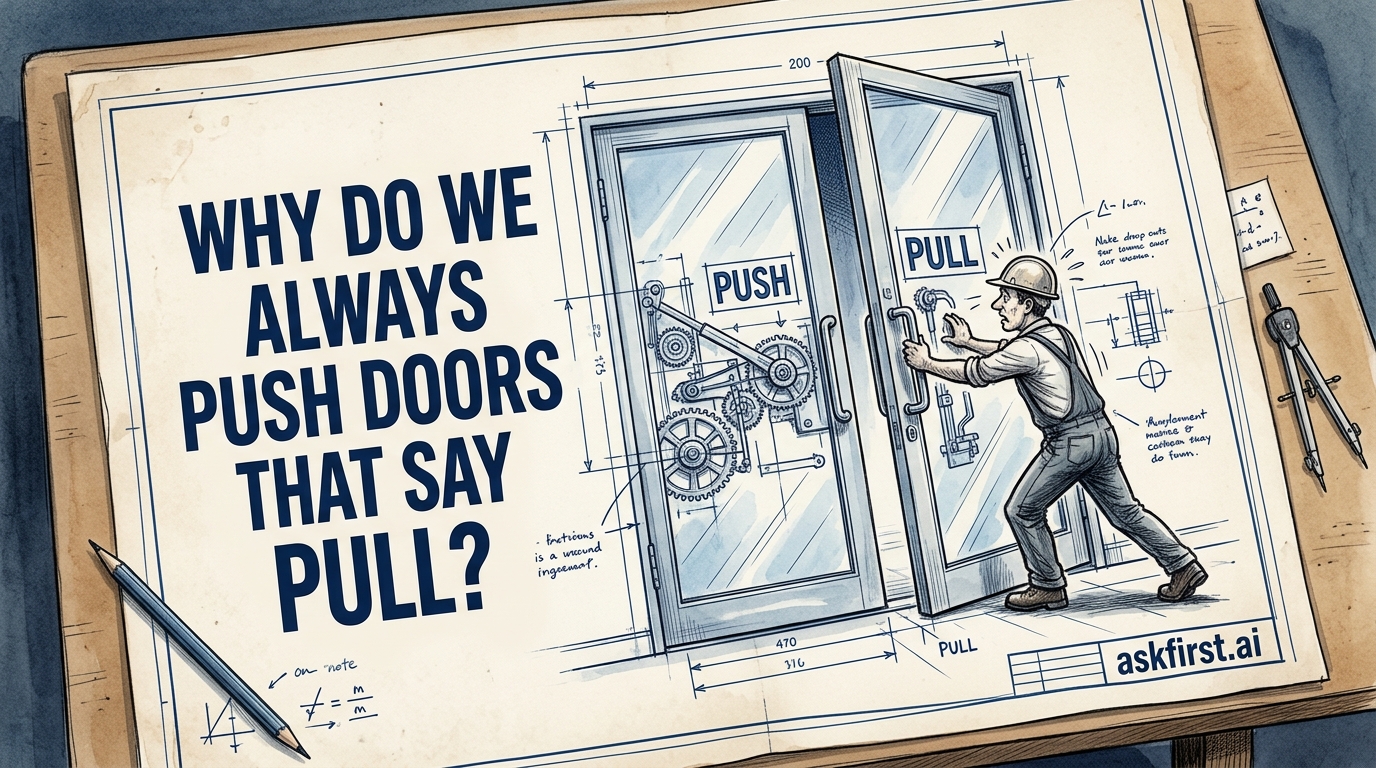
The phenomenon of pushing a door labeled 'pull' is a classic example of a 'Norman Door'—a term coined by design expert Don Norman in his seminal work, The Design of Everyday Things. It highlights a fundamental disconnect between human psychology and physical design. When a door is designed poorly, the user struggles not because they lack intelligence, but because the object's appearance provides misleading instructions. ### The Psychology of Affordances At the heart of this issue is the concept of affordances. An affordance is a visual clue that tells a user how an object should be interacted with. If a door has a flat metal plate on one side, that plate creates an 'affordance' for pushing. Even if a 'pull' sign is pasted on the wall nearby, the physical presence of the flat surface is a more powerful sensory cue than the text. Human brains are hardwired to process visual, physical feedback faster than abstract symbols or language. Our motor systems interpret a flat, smooth surface as a target for the palm of the hand, leading to the automatic reflex to push. ### Cognitive Load and Habitual Processing Human behavior is largely driven by System 1 thinking, as described by psychologist Daniel Kahneman. This is the fast, intuitive, and subconscious mode of processing that handles repetitive daily tasks to save mental energy. When approaching a door, the brain does not stop to analyze every sign; it scans the object for immediate operational cues. If the handle shape suggests a 'push' motion (like a flat plate), the brain adopts this motion to minimize cognitive load. By the time the mind registers the word 'pull', the arm is already in motion. We are victims of our own efficiency. ### Cultural and Environmental Conditioning Beyond individual psychology, there is a cultural element of habit. We interact with thousands of doors in a lifetime, and the vast majority of 'exit' doors in public buildings are designed to open outwards for safety (fire codes often mandate this). Because we are conditioned to push our way out of buildings, the act of pushing becomes our 'default mode' when entering or exiting any space that feels like a transition point. When a designer places a door that deviates from these standard expectations—such as an inward-opening door with a handle that looks like a pusher—it creates a conflict between learned habit and immediate reality. ### The Engineering Perspective From an engineering standpoint, this is a failure of signifiers. A good design should require no instruction manual. If a door needs a sign to tell a person how to operate it, the design is considered flawed by experts. Designers often prioritize aesthetics—like a sleek, handle-less look—over functional clarity. A vertical bar or a handle that requires grasping acts as a strong signifier for 'pulling,' whereas a flat plate is an universal signifier for 'pushing.' When these elements are mismatched, the user becomes confused. ### How to Mitigate the Design Flaw Architects and industrial designers are increasingly moving toward universal design standards to eliminate this friction: * Visual Cues: Using handle types that dictate the necessary motion (vertical pulls vs. flat plates) regardless of signage. * Color Coding: Highlighting the contact area to suggest interaction intuitively. * Simplified Mechanisms: Ensuring that doors in high-traffic public areas follow consistent patterns, reducing the 'surprise' factor. Ultimately, pushing a door that says pull is not a sign of absent-mindedness; it is an indictment of the design that ignored the user's innate mental patterns. We interact with the world based on what objects 'ask' us to do rather than what signs tell us to do, making the study of door design a fascinating window into the quirks of the human mind.





Ask First can make mistakes. Check important info.
© 2026 Ask First AI, Inc.. All rights reserved.|Contact Us