The Psychology of Unnecessary Apologies: Understanding the Reflexive 'Sorry'
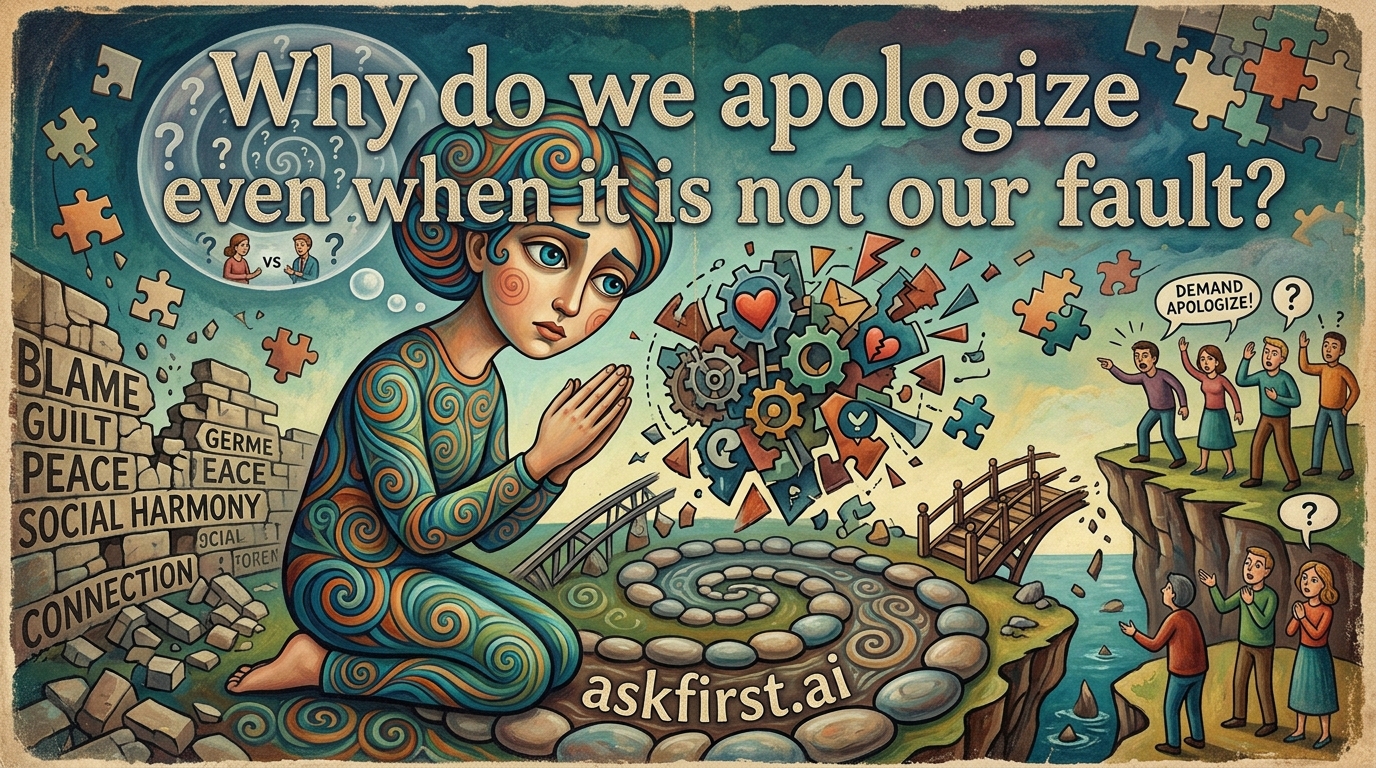
Human beings often find themselves uttering the word 'sorry' in scenarios where no actual wrongdoing has occurred. This phenomenon is deeply embedded in social cognition, serving as a linguistic lubricant that maintains harmony and reduces friction in interpersonal exchanges. Rather than a confession of guilt, these apologies function as a form of social signaling, intended to validate the feelings of others or diffuse perceived tension.
1. The Role of Empathy and Social Smoothing
At the core of the reflexive apology lies high emotional intelligence. When individuals apologize for minor inconveniences—such as someone bumping into them—they are frequently engaging in a mechanism known as 'social smoothing.' By taking ownership of a situation, the speaker signals that they value the comfort of the other person above the rigid enforcement of logical accountability. Research in social psychology suggests that this behavior helps establish a collaborative atmosphere, which is essential for long-term group cohesion.
2. The Conflict-Avoidance Mechanism
Many people are conditioned to perceive any form of tension as a potential threat to their social standing. An apology acts as a powerful tool to de-escalate potential conflict. By effectively 'lowering one's status' through an apology, an individual signals submissiveness, which can deactivate a potential aggressor's hostile response. This is an evolutionary holdover from tribal life, where maintaining group harmony was essential for survival. Modern society might not require the same defensive tactics, but the biological drive to avoid social friction remains potent.
3. Cultural and Gendered Dimensions
Sociological studies reveal that the tendency to apologize varies significantly across cultures and gender lines. In certain collectivist cultures, an apology is less about admitting personal failure and more about acknowledging that a disruption in social order has occurred. Similarly, historical research has suggested that women are statistically more likely to apologize for minor occurrences than men. This is not necessarily due to a higher propensity for guilt, but rather a reflection of different social expectations regarding empathy and communal management. The apology, in this context, is a strategy to ensure that the environment remains polite and cooperative.
4. The 'Sorry' as an Expression of Regret, Not Fault
It is vital to distinguish between a 'formal apology' and an 'expression of sympathy.' When one says 'I am sorry to hear that,' there is zero implication of culpability. Often, the reflexive 'sorry' for events out of our control functions identically. It is a linguistic shorthand for: 'I recognize that the current state of affairs is suboptimal, and I empathize with the distress this causes.' Understanding this distinction can help individuals reclaim their sense of personal agency without feeling as though they are perpetually accepting blame for things they did not initiate.
Strategic Communication: When to Withhold the Apology
While apologizing serves as a useful social tool, experts in professional development suggest that excessive apologizing can diminish personal authority. In a workspace, constant unnecessary apologies—often referred to as 'over-apologizing'—can signal a lack of confidence. To optimize social efficacy, consider these strategies:
- Pivot to gratitude: Replace 'Sorry for the delay' with 'Thank you for your patience.'
- Assess the impact: Ask if the situation genuinely warrants an apology or if it is merely a minor life hiccup.
- Neutralize language: If no one is at fault, acknowledge the situation without pinning blame on the self.
The Future of Social Interaction
As we look toward a future defined by increased digital communication, the nuance of the 'sorry' will likely evolve. In text-based mediums, where tone is often lost, the reflexive apology serves an even greater purpose as a bridge for clarity and kindness. By recognizing that these utterances are generally motivated by social altruism rather than true self-reproach, we can foster a deeper understanding of human connectivity. We apologize because we care about the equilibrium of our environment, and that, in essence, is a testament to the fundamental human desire for a peaceful, shared existence.