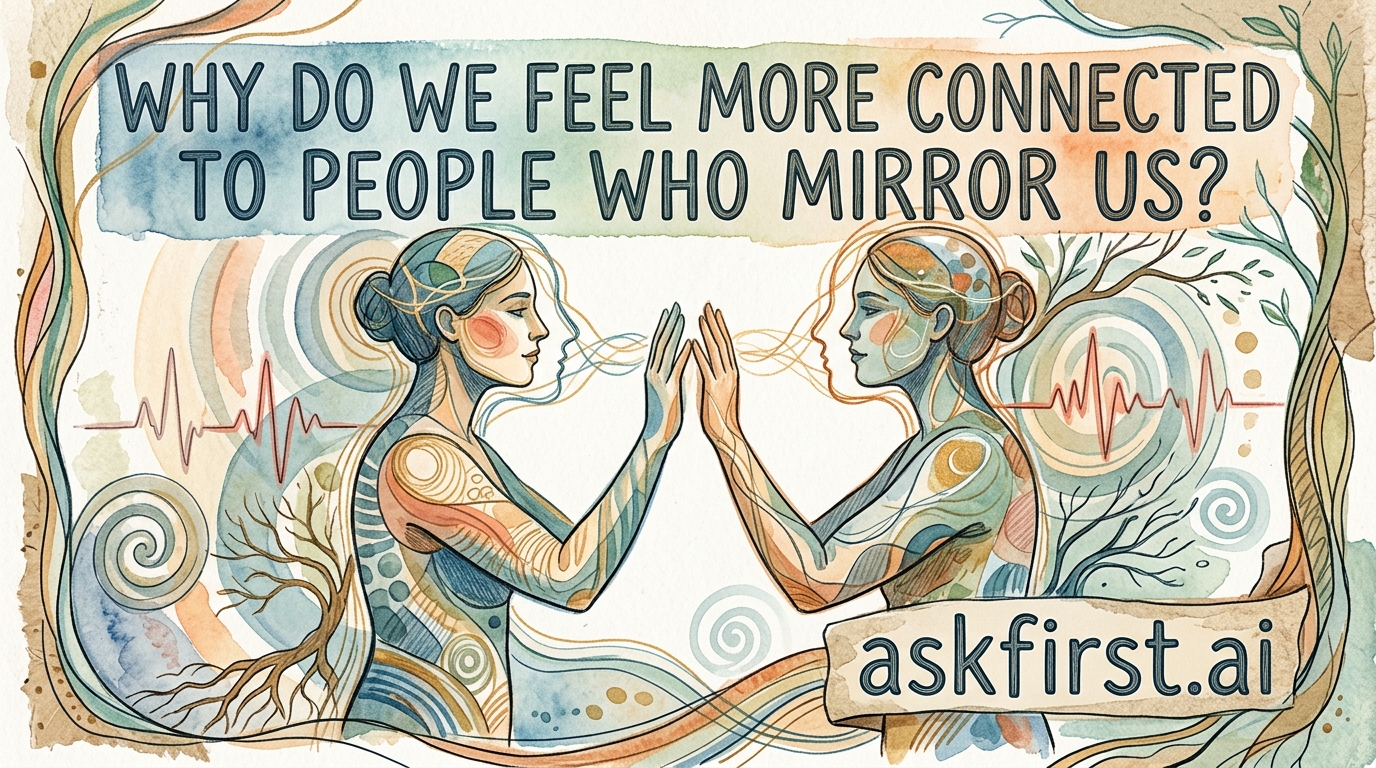
The phenomenon of mirroring, often referred to by psychologists as the 'chameleon effect', serves as an essential, non-conscious social lubricant that bridges the gap between individuals. When we unconsciously mimic the gestures, postures, facial expressions, and speech patterns of those we interact with, we are engaging in a biological process designed to foster empathy and establish trust. This behavior is rooted in the evolutionary drive to maintain social cohesion, acting as a silent signaling system that tells our interaction partner, 'I am like you, and therefore, I am safe.'### The Biological Basis of MirroringAt the heart of this behavior lies the mirror neuron system. First discovered in the 1990s by researchers studying macaque monkeys, these specialized brain cells fire both when an individual performs an action and when they observe another individual performing the same action. In humans, this system is significantly more sophisticated, encompassing a wider network of brain regions that bridge the gap between perception and action. When one person adopts the posture or vocal tone of another, the observer's mirror neurons fire, creating a shared neural experience. This neural resonance serves as the foundation for empathy, allowing us to 'feel' the emotions and physical states of others as if they were our own.### Why Mirroring Creates ConnectionThe social impact of mirroring is profound. Studies in social psychology, such as those conducted by Chartrand and Bargh, demonstrate that when people mirror each other, they perceive the interaction as more successful and pleasant. There are three primary reasons why this occurs: 1. Validation of Self: When someone mirrors us, they are subtly confirming that our mannerisms and expressions are acceptable. This provides an immediate, subconscious boost to our self-esteem. 2. Reduced Cognitive Load: Interaction becomes easier when we are 'in sync' with another person. It removes the friction of deciphering alien behavioral cues, allowing the conversation to flow with less mental effort. 3. The Trust Signal: Mimicry is a hallmark of the 'in-group.' Throughout human history, tribes and social collectives developed specific mannerisms to distinguish members from outsiders. By mirroring, we perform a primal handshake that confirms our place within the same metaphorical tribe, immediately lowering social defenses.### The Science of Strategic MimicryIn professional and interpersonal contexts, the power of mirroring is often consciously applied, a technique sometimes referred to as 'pacing and leading' in neuro-linguistic programming. By matching the energy, pace of speech, and intensity of a conversation partner, individuals can significantly increase their likability and persuasiveness. However, the efficacy of this practice hinges entirely on subtlety. If mirroring is blatant or overt, it triggers an immediate defensive reaction; the observer feels mocked or manipulated rather than understood. The most successful connections are forged through organic, non-conscious mimicry—a genuine reflection of engagement and rapport.### Emotional Contagion and Shared StatesMirroring leads directly to emotional contagion, the rapid spread of moods and feelings from one person to another. If a friend laughs, we find it easier to smile; if someone displays genuine distress, our own physiology may mirror that tension through shallow breathing or furrowed brows. This shared emotional state builds a sense of intimacy that is difficult to achieve through language alone. Words are logical and slow, but non-verbal mirroring is instantaneous and visceral, cutting through complex thought to strike directly at the core of human emotional processing.### Long-term Implications for RelationshipsIn stable, long-term relationships, mirroring evolves from simple mimicry of gestures into a sophisticated alignment of perspective and intent. Couples who have been together for years often develop 'micro-synchrony,' a state where their rhythms of speech, breathing, and movement become deeply intertwined. This is the ultimate expression of the mirroring phenomenon: a complete integration of social behaviors that reinforces the bond between two individuals. While mirroring is an instinctive tool for initial rapport, its persistence in deep relationships demonstrates its role as a continuous maintainer of intimacy and unity.### ConclusionThe reason we feel so profoundly connected to those who mirror us is that, at a neural level, we are dissolving the boundaries between ourselves and the 'other.' We are biologically wired to seek out reflections of our own existence in our peers, and when we find that reflection, our brains reward us with a sense of safety, belonging, and profound understanding. By understanding the science of mirroring, we gain deeper insight into the invisible threads that weave human society together, proving that our connections are built not just on what we say, but on how we move together through the world.


Ask First can make mistakes. Check important info.
© 2026 Ask First AI, Inc.. All rights reserved.|Contact Us