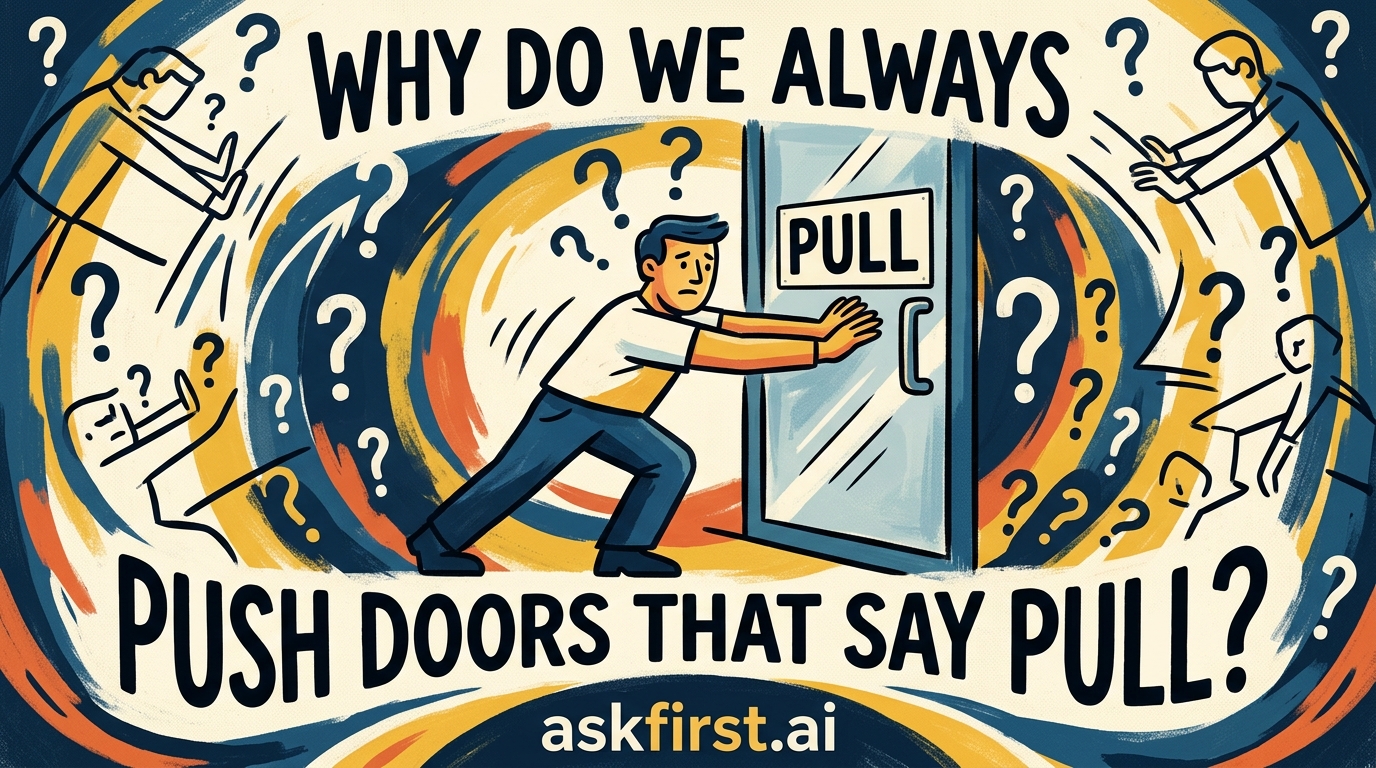
The phenomenon of pushing a door labeled 'pull' is a classic example of a Norman Door, a design failure rooted in the intersection of cognitive psychology and industrial design. Named after Don Norman, the author of The Design of Everyday Things, these doors serve as a universal symbol for how bad design forces human error upon users, regardless of their intelligence or experience. When the physical design of an object conflicts with its intended use, the brain relies on subconscious habits rather than reading instructional text. ### The Psychology of Affordances Norman introduces the concept of 'affordances'—physical properties of an object that dictate how it should be used. A flat plate on a door acts as a strong visual cue for pushing, while a handle or a vertical bar implies pulling. When a designer places a flat metal plate on a door that must be pulled, they create a 'false affordance.' The mind perceives the object as something meant to be pushed, and because processing visual cues is significantly faster than reading text, the brain ignores the sign and follows the visual intuition provided by the plate. This is not a lapse in judgment but a testament to how the brain prioritizes rapid, pattern-based information processing. ### Why Reading Fails People in high-stress or 'autopilot' environments rarely read signage until an action fails. When approaching a door, the brain predicts the outcome based on thousands of prior experiences. If 90% of doors encountered daily are pushed, the brain generates an automatic response. The cognitive load required to stop, read the sign, and override the motor impulse is often higher than the impulse to move forward. In UX design, this is known as the 'cognitive friction' of unnecessary instructions. If a door requires a sign to explain how it works, the design is functionally broken. ### Architectural Considerations and Safety Beyond psychology, there is a fundamental safety component tied to building codes. Doors often pull outward for egress in emergency situations to prevent crowding or crushing during a fire or evacuation. However, from the street, that same door must appear seamless or hidden. This architectural tension—where the designer prioritizes the facade over the user experience—leads to the ubiquitous 'pull' signs. Designers often value the aesthetic of a clean entryway over the intuitive navigation of a space, resulting in the user feeling foolish for a failure that originated in the drafting phase. ### Mitigating the Norman Door Effect To fix this, architects and designers are encouraged to rely on signifiers rather than instructions. Instead of a sign, the door hardware should signal the function: - Use vertical bars or handles for pull doors. - Use flat plates or small 'push' pads for push doors. - Ensure consistency across a building so that users can build a mental model of how doors behave in that specific environment. When signifiers match the required action, the error rate drops to near zero. ### The Universal Human Experience This experience serves as a humbling reminder of human fallibility in the face of bad design. The next time you find yourself pushing a 'pull' door, take solace in the fact that the design failed you, not the other way around. Understanding the mechanism behind this mistake allows one to better appreciate the invisible engineering that shapes daily interactions. By designing with human cognitive processes in mind—prioritizing subconscious visual cues over conscious reading—we can create environments that feel intuitive rather than frustrating. The legacy of the Norman Door remains a core case study for any field involving human-computer or human-environment interaction, proving that the best design is the kind that requires no instruction manual at all.




Ask First can make mistakes. Check important info.
© 2026 Ask First AI, Inc.. All rights reserved.|Contact Us