The Phenomenon of Automaticity and Memory Gaps
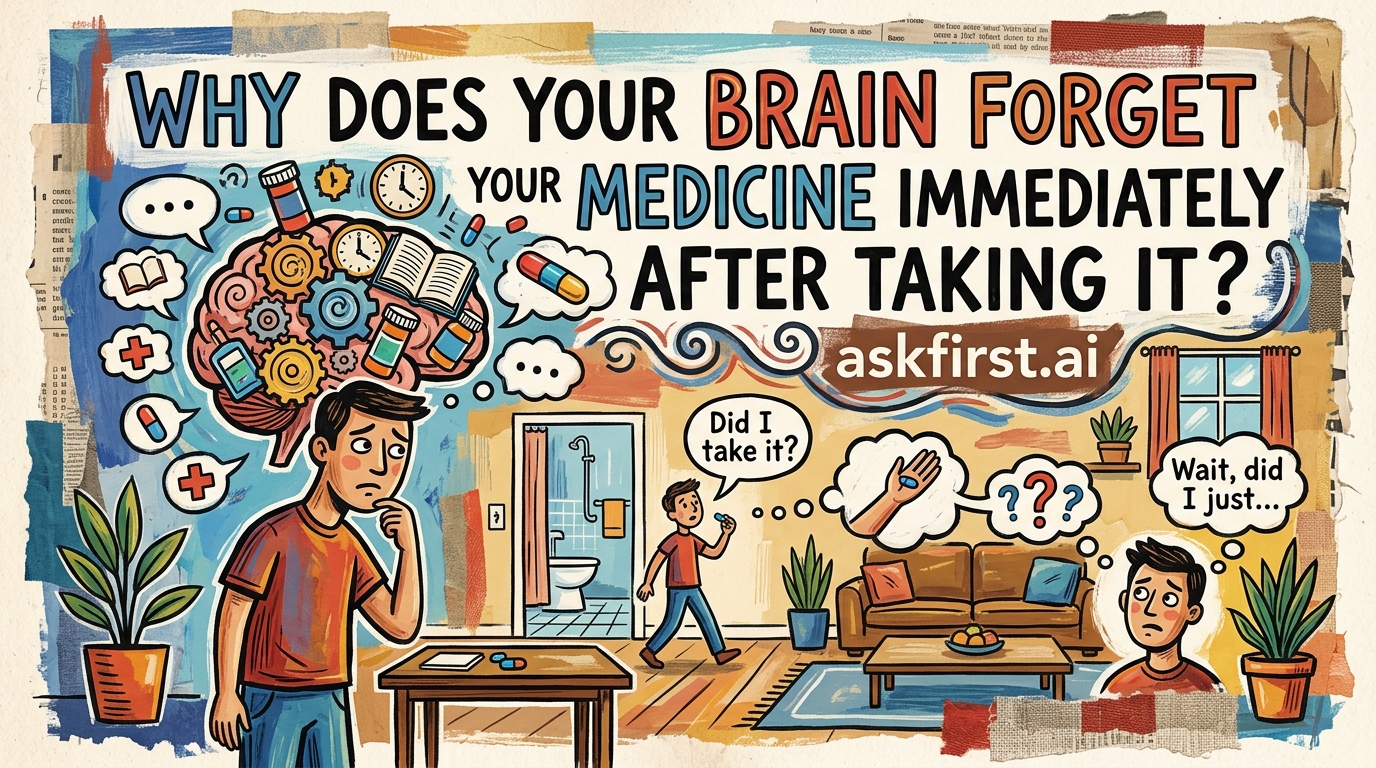
It is a pervasive experience: you reach for your pill bottle, swallow the medication, and five minutes later, you find yourself frozen in confusion, wondering if you actually took it. This cognitive hiccup is not a sign of early-onset memory loss or cognitive decline; rather, it is a fascinating byproduct of how the human brain manages routine tasks. The core of this issue lies in the concept of Automaticity.
The Role of the Basal Ganglia
When a task becomes a habit, such as taking a daily vitamin or prescribed medication, the brain shifts control from the prefrontal cortex—the center of conscious, effortful decision-making—to the basal ganglia. The basal ganglia are responsible for managing patterns and routines. As a behavior becomes deeply ingrained, the brain essentially puts the process on autopilot to save metabolic energy.
By outsourcing the task to the basal ganglia, the conscious brain is freed to focus on more complex, novel, or urgent demands. Consequently, the act of taking medicine becomes a 'background process.' Because the prefrontal cortex was barely involved in the performance of the action, it never encodes a strong 'episodic memory' of the event. Memory, particularly episodic memory, requires a degree of conscious attention; if you are mentally preoccupied while swallowing a pill, your brain simply never records the 'file' for that specific moment.
The Impact of Prospective Memory
This phenomenon is further complicated by Prospective Memory, which is the ability to remember to perform an intended action at a future time. Prospective memory is notoriously fragile. It requires the brain to hold an intention in the mind while simultaneously interacting with the environment. If a distraction occurs—a phone notification, a stray thought, or a shift in focus—the 'intention' can be overwritten or discarded by the executive function, leading to the sensation of having forgotten the act entirely.
Psychological and Environmental Hooks
There are several factors that exacerbate this 'blind spot':
- Contextual Familiarity: If you take your medication in the same place, at the same time, every day, your environment becomes a powerful 'cue.' Your brain recognizes the kitchen counter and the bottle, and it initiates the motor sequence automatically without needing to log the event.
- Cognitive Load: If the brain is processing complex information during the routine, the 'attentional bandwidth' is stretched. The act of medication-taking is often treated as low-priority information, leading the brain to discard it to optimize efficiency.
- The Illusion of Uncertainty: Because the brain did not register the action, it generates a 'false uncertainty.' You feel like you haven't taken the pill simply because there is no conscious memory trace of the act occurring, even though the biological reality is that you did.
Strategies to Mitigate Memory Gaps
To overcome this routine-induced amnesia, one must disrupt the automaticity of the behavior to force the brain to 'notice' the action. Strategies include:
- The 'Anchor' Method: Pair the medication with a non-routine, sensory-specific event. For instance, after taking the pill, flip the bottle upside down or place a small object, such as a coin or a specialized token, next to the bottle. This physical change in the environment forces the brain to process a visual anomaly, which creates a stronger memory trace.
- Conscious Verbalization: Speak the action aloud. Saying, 'I am taking my medicine now' recruits language centers and auditory processing, which creates multiple sensory 'hooks' for memory storage.
- Utilization of Digital Aids: Use smart pill organizers or smartphone alarms that require an active confirmation. By forcing a physical interaction—like checking a box or pressing a button—the task shifts back from the automated basal ganglia to the conscious, effortful prefrontal cortex.
Conclusion: The Efficiency Trade-off
Ultimately, forgetting whether you took your medication is a testament to the brain's incredible efficiency. The brain is designed to filter out 'noise' and automate mundane activities to survive in complex environments. While this can lead to temporary confusion regarding daily routines, understanding the neurological mechanism behind this behavior reveals that the brain is working as intended. By consciously disrupting the automatic loop, one can effectively regain control over these transient memory gaps and ensure consistency in health management.