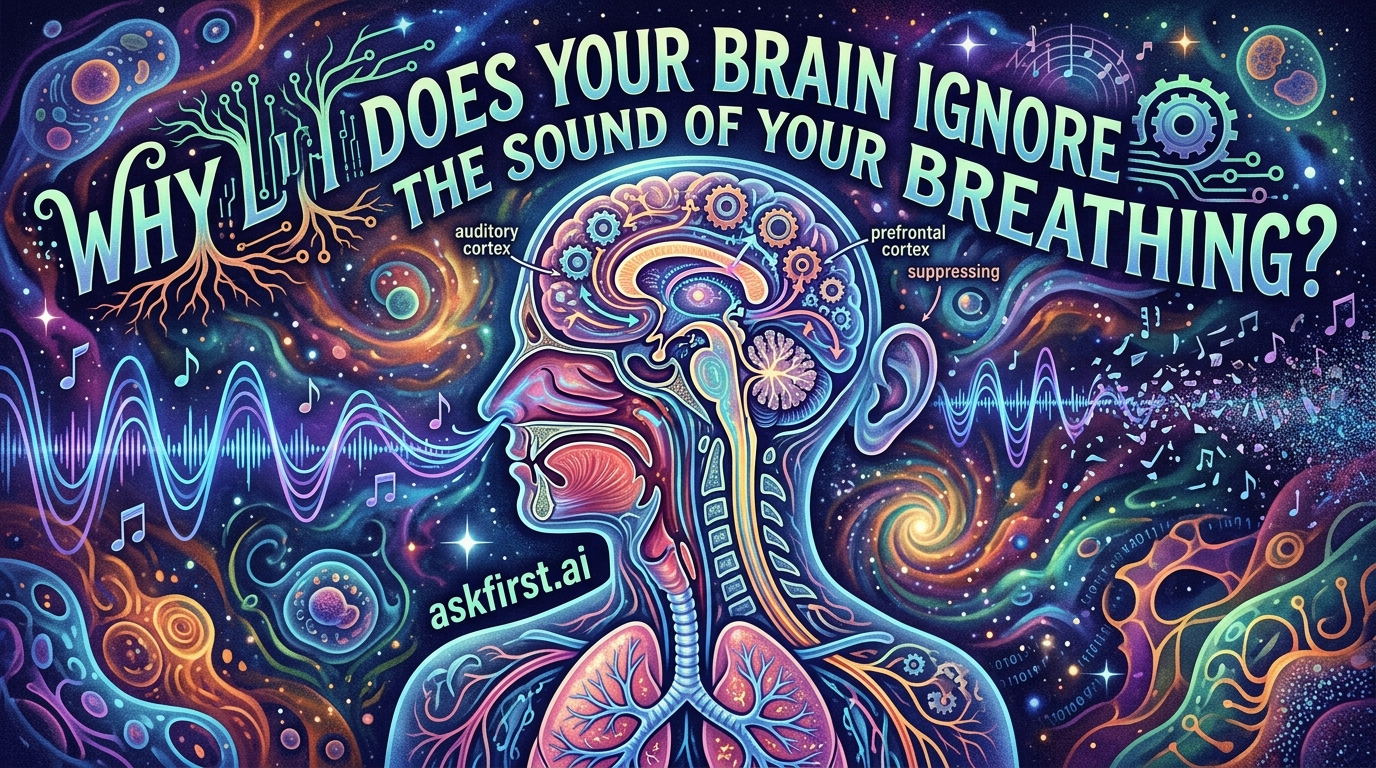
The Neural Filtering Phenomenon
The reason the human brain consistently ignores the sound of its own breathing is a masterpiece of biological efficiency. This process is known as sensory gating, a critical neurophysiological mechanism that prevents the central nervous system from becoming overwhelmed by redundant, non-threatening, or self-generated stimuli. Every second, millions of bits of information flood the sensory organs, but only a fraction reaches conscious awareness.
The Mechanism of Sensory Gating
When a stimulus is constant and predictable, such as the sound of air moving through the nasal cavity or lungs, the brain employs habituation. Habituation is a simple form of learning where an organism decreases its response to a stimulus after repeated exposure. Because the sound of breathing is present from birth and occurs in a rhythmic, predictable pattern, the brain classifies it as 'background noise' rather than an external event requiring attention.
- Predictability: The brain creates an internal model of self-generated sensory input.
- Efficiency: By suppressing the signal of 'self,' neural resources are saved for detecting environmental changes—like the rustle of leaves or a voice calling a name—which could indicate danger or opportunity.
- The Thalamus Gate: The thalamus acts as a relay station, filtering incoming sensory data before it reaches the cerebral cortex. It actively inhibits the perception of sounds it identifies as 'expected.'
Corollary Discharge: The Brain's 'Self-Check'
Scientists often refer to a process called corollary discharge to explain why the brain distinguishes self-generated sensations from external ones. When the motor cortex sends a command to the respiratory muscles to contract, it simultaneously sends a 'copy' of that command—the corollary discharge—to the sensory areas. This signal essentially tells the auditory system, 'I am about to cause a sound; do not react to it.' This is the same reason why it is neurologically impossible to tickle oneself; the brain anticipates the touch and dampens the sensory response.
Why This Matters for Evolutionary Survival
Evolution favors organisms that can discern a shifting environment from a static one. If a human were forced to consciously acknowledge the sound of every heartbeat, every breath, and every flicker of eye movement, the cognitive load would lead to severe sensory overload. By filtering out the 'white noise' of biological existence, the brain maintains a clean slate, ready to react to external triggers that might mean survival. This filtering is not a flaw; it is a vital evolutionary adaptation that prioritizes the 'now' in a complex world.
Factors That Disrupt the Filtering
While this process usually works perfectly, certain factors can temporarily disable these filters:
- Hyper-Awareness (Focused Attention): If one intentionally focuses on the sound of breathing, the neural 'gate' opens. This is a common experience in meditation or when someone suddenly notices their pulse during intense quiet.
- Stress and Anxiety: High arousal levels can sometimes dampen the effectiveness of sensory gating, leading to hyper-sensitivity, where every internal sound feels amplified.
- Hearing Loss: In individuals with diminished hearing, the brain may enter a state of increased sensitivity (compensatory plasticity) to detect subtle environmental cues, which can occasionally lead to increased awareness of internal biological sounds.
Clinical and Psychological Perspectives
Psychologists studying sensory processing suggest that the failure of this filtering mechanism is linked to certain clinical conditions. For instance, in some cases of ADHD or auditory processing disorders, the brain fails to properly execute the gating process. This leads to a persistent feeling of distraction or over-stimulation, as the brain fails to ignore the 'unimportant' data. Understanding this filtering system has provided breakthroughs in how scientists study neurodivergence, illustrating that what seems like a simple oversight—ignoring breath—is actually the brain working precisely as it should.
Conclusion: The Beauty of Neural Efficiency
The silence of one's own existence is a testament to the brain's dedication to optimizing reality. By masking the sound of respiration, the mind ensures that humanity remains focused on the environment rather than being tethered to its own mechanics. This seamless background processing allows for deep concentration, complex social interaction, and survival, making it one of the most elegant examples of evolutionary engineering present in every single human being.