The Psychology of Anthropomorphism
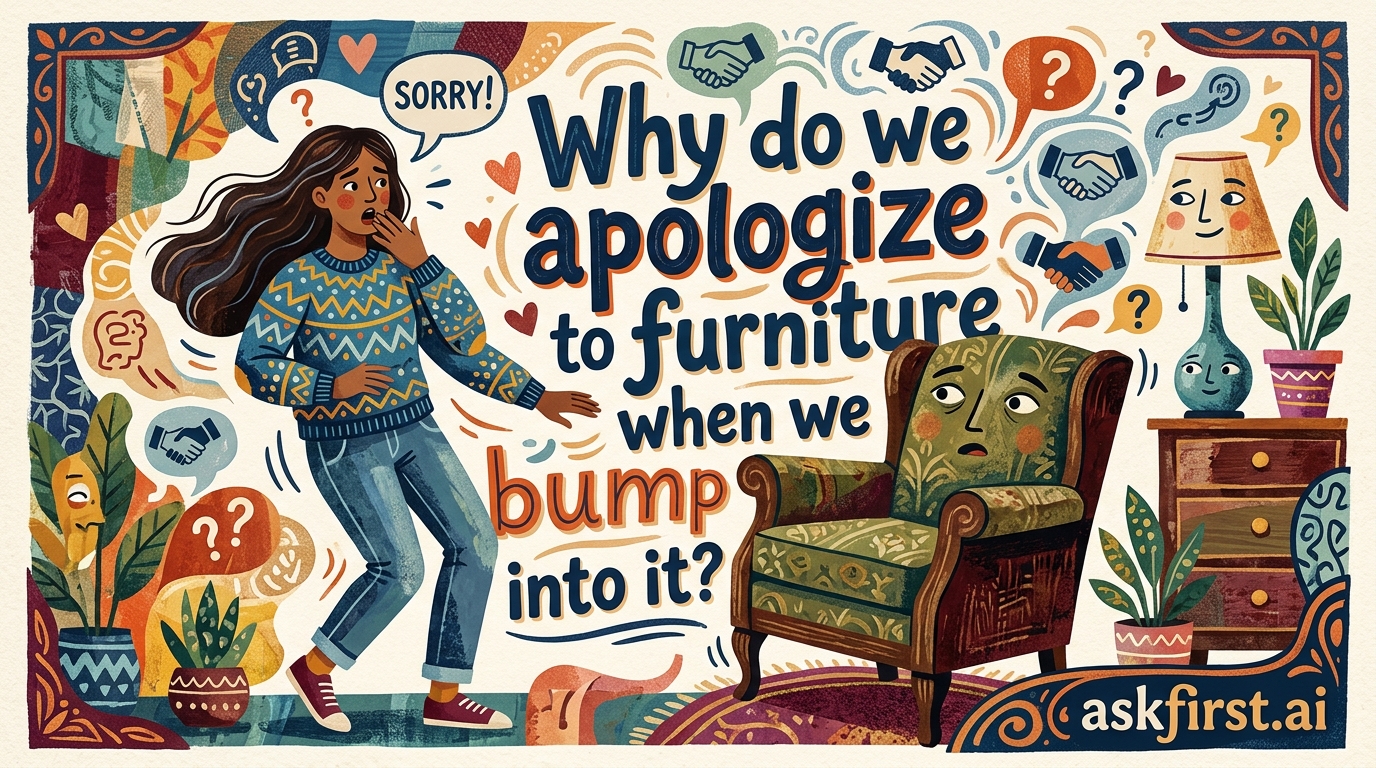
Human beings possess an innate, evolutionary tendency known as anthropomorphism—the attribution of human traits, emotions, or intentions to non-human entities. When an individual bumps into a chair or a table, the reflexive "sorry" is not a sign of irrationality; rather, it is a fascinating byproduct of how the human brain processes social interaction. Evolutionarily, our brains are optimized to recognize "agents" in our environment. For our ancestors, failing to distinguish between a swaying bush (wind) and a predator (an agent) could have been fatal. Thus, the brain is hyper-vigilant in detecting agency, often over-detecting it in inanimate objects.
The Social Lubricant Hypothesis
Psychologists argue that saying "sorry" to a piece of furniture acts as a form of emotional regulation. When an individual experiences physical pain from a collision, the brain experiences a brief spike in cortisol and distress. Apologizing is a social heuristic—a mental shortcut used to mitigate tension and smooth over accidental conflicts. Because the brain struggles to immediately differentiate between a social "bump" (another person) and a mechanical "bump" (an object), the apology emerges as an automated response designed to restore harmony to the environment. It is a psychological buffer that minimizes the abrupt nature of the negative event.
Cognitive Overload and Motor Reflexes
Behavioral science suggests that actions taken under the stress of pain are often driven by System 1 thinking—the fast, automatic, and intuitive processing system described by Nobel laureate Daniel Kahneman. When one stubbed their toe, the motor cortex initiates a pain response, and the linguistic center concurrently fires an apology before the logical, slow, and deliberative System 2 has a chance to intervene. This suggests that the apology is not a "thought-out" action but a "hard-wired" reflex. Research indicates that when we interact with objects that seem to "get in our way," we subconsciously assign them a level of intent. If a table "attacks" our shin, we categorize it as an obstacle, and the brain applies the standard social protocol of reconciliation.
The Role of Mirror Neurons
Neuroscientific research into mirror neurons provides further clarity. These neurons fire both when an individual performs an action and when they observe another performing that same action. While mirror neurons are primarily associated with social empathy, they play a part in how we navigate physical space. By projecting our own consciousness into the object, we subconsciously view the interaction as a mutual collision. This is the same reason why people swear at their printers or plead with their car to start on a cold morning. We are extending our social intelligence onto our physical tools.
Cultural Conditioning and Linguistic Habit
Furthermore, linguistic patterns play a significant role. Cultures that emphasize politeness and social harmony often have higher rates of anthropomorphic object interaction. In these settings, the word "sorry" is a high-frequency "social lubricant" that is ready to be deployed at a moment's notice. The habit is so ingrained that it becomes divorced from the necessity of a sentient recipient. It is not about the table's feelings; it is about the speaker's internal commitment to a social standard of behavior that prioritizes order and kindness, even toward objects.
The Benefits of Personification
Interestingly, this behavior serves a function in human-computer interaction (HCI) design. Designers often create interfaces that react to user inputs to increase engagement because humans prefer "relatable" tech. Studies show that when computers offer polite responses, users feel less frustrated during errors. By extending human-like qualities to our environment, we create a more predictable and harmonious world. Apologizing to the furniture is essentially a harmless manifestation of a cognitive skill that makes our complex, multi-agent world navigable. It reflects a mind that is constantly projecting social structure onto the physical realm to reduce chaos.
Conclusion
While it might seem humorous to apologize to a lamp, it is a testament to the sophistication of the human social brain. We are social animals built for connection, and our brains apply those social rules everywhere, even when they aren't strictly necessary. So, the next time the sofa gets a "pardon me," take it as proof that the brain is functioning perfectly—constantly smoothing over edges in a world that is full of unexpected bumps.