The Invisible Architect: Understanding Subconscious Social Selection
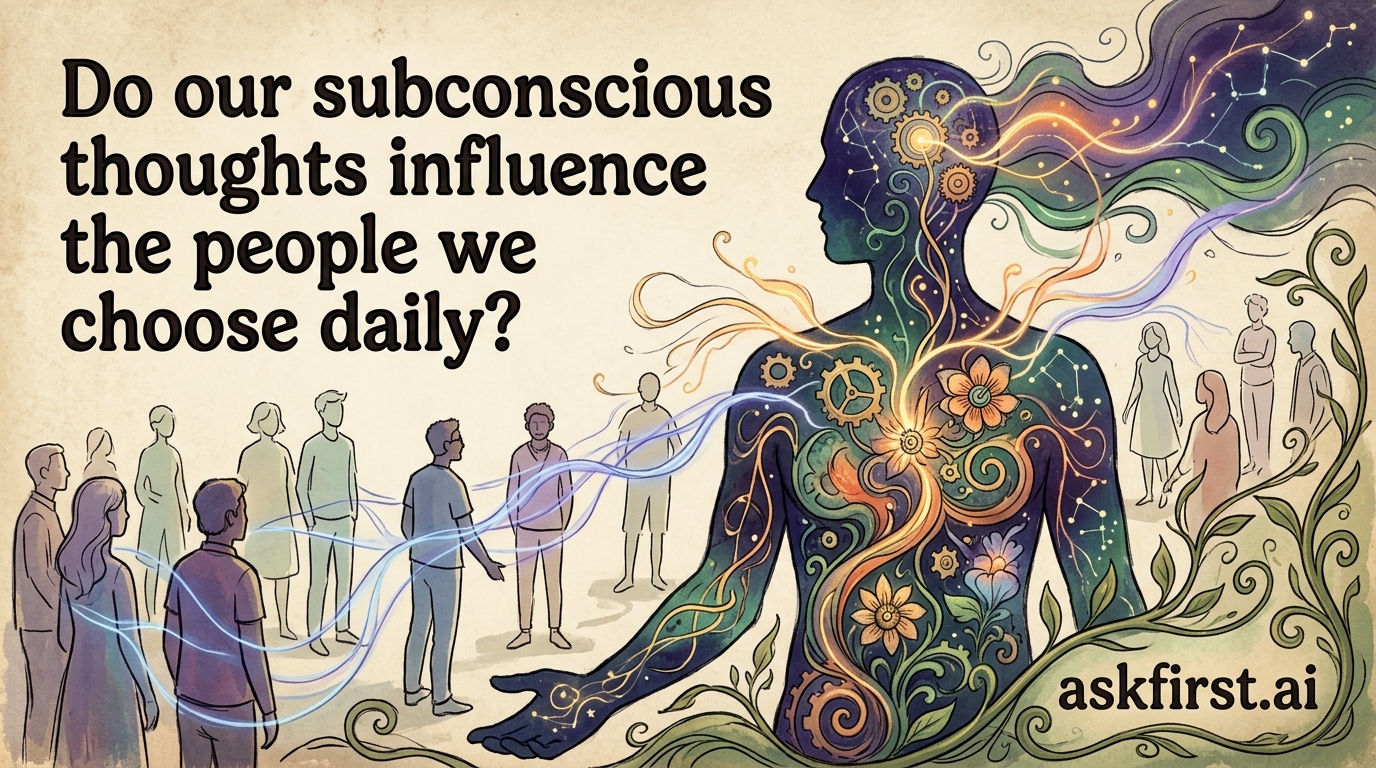
Human interaction often feels like a series of conscious decisions, yet emerging research in social psychology and neuroscience suggests that the vast majority of our interpersonal dynamics are driven by subterranean forces beneath our awareness. We believe we choose our friends, partners, and colleagues based on logic, shared interests, or values, but the reality is that the subconscious mind is a high-speed processor making snap judgments long before our conscious minds catch up. This phenomenon creates an invisible social architecture that dictates much of our daily lives.
The Mechanism of Implicit Association
At the core of these choices lies the Implicit Association Test (IAT) framework, which demonstrates how deeply ingrained biases, preferences, and patterns reside in our neural pathways. Our brains are essentially prediction machines that scan for familiar patterns. When we encounter new individuals, the amygdala and other regions associated with emotional processing evaluate them based on 'schemas'—pre-existing cognitive structures. If a stranger mimics the non-verbal cues, vocal cadence, or even the scent of a person from our formative years, we may feel an instantaneous, inexplicable rapport. This is not intuition in the mystical sense; it is pattern recognition.
Psychological Hooks: Why We gravitate Toward Familiarity
- The Mere Exposure Effect: Humans generally prefer what is familiar. If your brain has cataloged certain behavioral traits as 'safe' or 'nurturing' due to early life experiences, you will subconsciously migrate toward people who display those specific traits, even if those people might be objectively problematic for your long-term goals.
- The Projection Bias: We often mistake our own traits in others for external qualities. If you value punctuality but rarely acknowledge how much it governs your social vetting, you might simply 'feel' that someone is reliable without knowing why, unaware that your subconscious is analyzing their every movement to confirm they match your internal standard.
- The Attachment Style Loop: As defined by Attachment Theory, our subconscious selection is heavily influenced by whether we developed secure, anxious, or avoidant attachment patterns in childhood. Anxious-leaning individuals often subconsciously pursue individuals who provide just enough intimacy to feel close but enough distance to trigger their classic search for validation. It is an unconscious reenactment of familiar relationship dynamics.
Beyond the Conscious Filter: The Role of Heuristics
Decision-making in daily social life relies on heuristics—mental shortcuts. Because processing every single social variable consciously would lead to 'cognitive load' exhaustion, the brain outsources this task to the subconscious. When selecting a business partner or a casual acquaintance, your brain checks for cues of social status, emotional intelligence, and trustworthiness in milliseconds.
Research indicates that humans can determine a person's trustworthiness within just 100 milliseconds of seeing a face. This assessment is entirely subconscious and serves to streamline social navigation. By the time you introduce yourself, your brain has already labeled the interaction as 'favorable' or 'avoidance-worthy.'
Can We Reclaim Agency?
If the subconscious dominates our choices, is free will merely a passenger? Not entirely. While we cannot turn off the subconscious, we can 'calibrate' it.
- Awareness Audits: Regularly evaluate the commonalities in your social circle. Are you picking people based on a specific role they play in your psyche, such as 'the one I need to save' or 'the one who challenges me unnecessarily'?
- Delaying Snap Judgments: By introducing a cooling-off period before committing to deep relationships or major professional partnerships, we allow the prefrontal cortex—the logical brain—to verify the snap judgment of the subconscious.
- Reframing Familiarity: Consciously seeking out new types of people who defy your typical 'social profile' can, over time, rewrite the predictive patterns your brain uses to evaluate others.
Conclusion: The Synthesis of Choice
We are indeed influenced by the deep-seated currents of the subconscious, but these influences are not fixed destinies. By understanding that our social choices are governed by heuristics, attachment histories, and pattern recognition, we turn a hidden biological process into a manageable psychological framework. Choosing the people in our lives becomes a dance between the rapid, instinctive impulses of our evolutionary brain and the deliberate, values-driven objectives of our conscious minds. When we master this balance, we stop being reactive to our social environment and start becoming the conscious architects of our own communities.