The Cognitive Illusion of Certainty
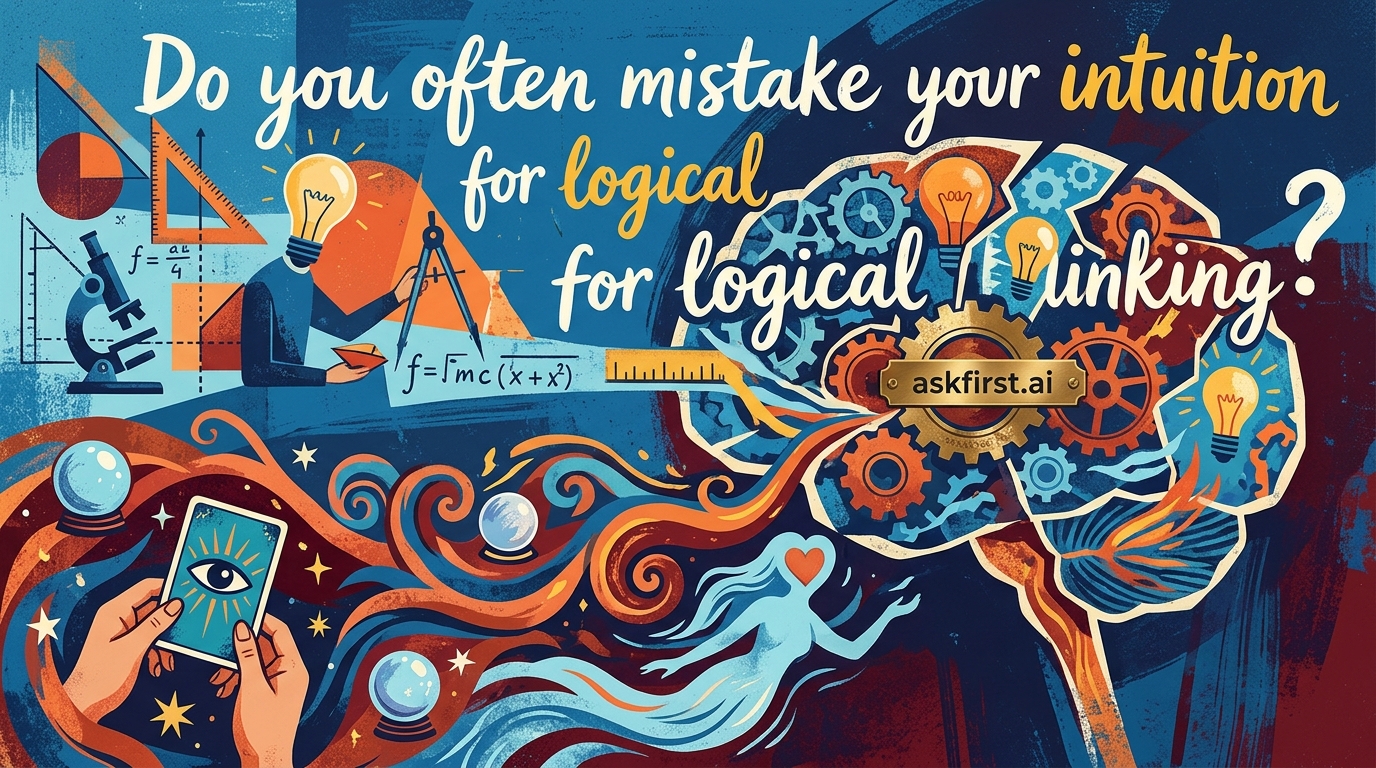
Human cognition is an intricate tapestry of rapid-fire assessments and deliberate analytical processing. Frequently, individuals experience a phenomenon where a 'gut feeling'—the intuitive snap judgment—is mistaken for the product of rigorous, step-by-step logical reasoning. This confusion, deeply rooted in the architecture of the brain, serves as a primary driver of decision-making errors in everything from daily habits to complex strategic planning. Understanding the distinction between these two systems is essential for improving intellectual clarity and decision efficacy.
The Dual-Process Theory
Psychologists, most notably Daniel Kahneman, have popularized the Dual-Process Theory, which categorizes human thought into two distinct systems:
- System 1 (Intuition): This system operates automatically, quickly, and with little or no effort. It is the realm of associative memory, emotional reactions, and heuristics. It is evolutionary, designed for survival, allowing for immediate responses to environmental threats or opportunities.
- System 2 (Logic): This system allocates attention to the effortful mental activities that demand it, such as complex computations, logical deduction, and deliberate choice. It is slower, requires cognitive energy, and is prone to fatigue.
The friction occurs when System 1 generates a fast, intuitive answer to a complex problem, and the brain—seeking efficiency—accepts this answer as the product of System 2 deliberation. This is often termed the 'illusion of validity.'
Why Intuition masquerades as Logic
Several cognitive biases facilitate this mistaken identity, often leading to overconfidence:
- The Availability Heuristic: People estimate the probability of events based on how easily examples come to mind. If a scenario feels vivid or intuitive, the brain interprets it as logically sound because it is 'available.'
- Confirmation Bias: Once a gut feeling is established, the mind actively filters information to support that initial hunch, while ignoring contradictory data. This creates a feedback loop that feels like a coherent logical argument.
- The Halo Effect: If an intuitive conclusion is linked to a positive emotional state, it is perceived as more correct or 'logical' than a neutral or negative alternative.
Practical Strategies for Discernment
To decouple intuition from logic, one must implement 'cognitive speed bumps.' These strategies force the brain out of the automated System 1 path:
- The 'Pre-Mortem' Exercise: Before acting on a strong feeling, hypothesize that the decision resulted in a total disaster. Ask, 'What specifically went wrong?' This forces System 2 to scan for hidden logical flaws.
- Statistical Anchoring: Force a comparison against base rates. Intuition often ignores the broader statistical context. By asking, 'What does the historical data say about this type of scenario?', you transition from gut feeling to empirical reasoning.
- Delaying the Decision: System 1 thrives on immediacy. By instituting a mandatory waiting period, the initial emotional intensity dissipates, allowing the 'cool' logic of System 2 to analyze the situation without the interference of automatic impulses.
Scientific Implications for Future Decision Making
Research indicates that while intuition can be highly effective in high-frequency, stable environments (such as experienced firefighters reading a blaze), it is notoriously unreliable in low-frequency, high-complexity domains. As society moves further into an era of big data and complex system management, the ability to recognize when the brain is 'skipping the math' becomes a critical competitive advantage. Mastery of the self requires an awareness of these internal patterns. It involves treating intuition as a hypothesis—a starting point for investigation—rather than a finished conclusion. When an answer arrives fully formed, that is a signal to stop, reflect, and apply the deliberate rigor of logical scrutiny. By bridging the gap between how the brain 'wants' to think and how it 'should' think, one gains a profound mastery over their life path, professional success, and personal wisdom.