The Geoid Reality: Understanding the Shape of Our Planet
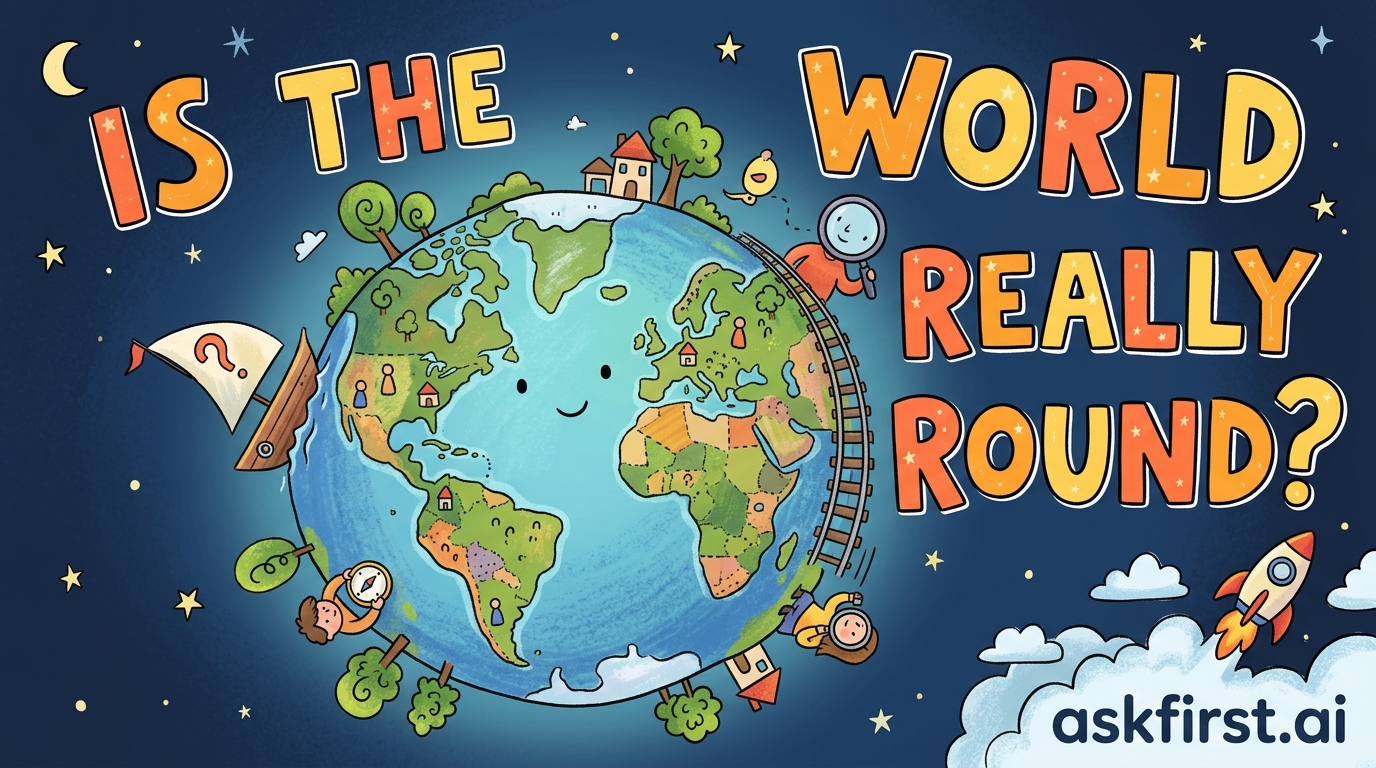
For centuries, the question of the Earth’s shape has been a subject of intense scientific inquiry, philosophical debate, and eventually, empirical verification. While it is common in casual conversation to describe the Earth as a "perfect sphere," the reality is far more nuanced. Geodesy—the science of accurately measuring and understanding Earth's geometric shape, orientation in space, and gravity field—confirms that our planet is an oblate spheroid, often referred to technically as a geoid.
The Historical Evolution of the Concept
The realization that the Earth is not flat dates back to antiquity. Ancient Greek scholars, most notably Eratosthenes of Cyrene (c. 276–194 BCE), performed one of the most famous experiments in scientific history. While serving as the chief librarian at the Library of Alexandria, Eratosthenes noted that at noon on the summer solstice in Syene (modern-day Aswan, Egypt), the sun shone directly down a deep well, casting no shadow. In Alexandria, however, a vertical pillar cast a distinct shadow at the same time. By measuring the angle of the shadow and knowing the distance between the two cities, he calculated the Earth's circumference with remarkable accuracy, proving the curvature of the planet.
Centuries later, during the Age of Discovery, Ferdinand Magellan’s expedition (1519–1522) provided the first practical proof of the Earth’s roundness through a successful circumnavigation. Today, we have moved beyond simple observation to high-precision satellite data, such as that provided by the European Space Agency’s GOCE (Gravity Field and Steady-State Ocean Circulation Explorer) mission, which mapped the Earth's gravitational anomalies to define its precise shape.
Why the Earth is Not a Perfect Sphere
If the Earth were a perfect sphere, the distance from the center to the surface would be identical at every point. However, Earth is an oblate spheroid. This means it is slightly flattened at the poles and bulges at the equator. The primary driver of this phenomenon is the Earth's rotation.
- Centrifugal Force: As the Earth rotates on its axis once every 24 hours, points near the equator must travel significantly faster than points near the poles to complete a full rotation in the same amount of time. This creates an outward force known as centrifugal force.
- Equatorial Bulge: Because the Earth is composed of matter that is somewhat malleable—particularly the liquid outer core and the semi-plastic mantle—this outward force causes the planet to bulge at the equator. The equatorial diameter of the Earth is approximately 12,756 kilometers, while the polar diameter is approximately 12,714 kilometers, a difference of about 42 kilometers.
The Geoid: A Complex Gravity Model
While "oblate spheroid" is a good geometric approximation, physicists use the term "geoid" to describe the Earth's true shape. The geoid is the shape that the surface of the oceans would take under the influence of gravity and the rotation of Earth alone, ignoring tides and winds.
Because the Earth’s interior is not perfectly uniform—containing varying densities of rock, magma chambers, and mountain ranges—the gravitational pull is not identical everywhere. In places with high-density materials, gravity is slightly stronger, pulling the "surface" of the geoid inward. Conversely, in areas with lower density, the geoid bulges outward. This results in a lumpy, irregular shape that defies the simplicity of a school-grade globe. This concept is detailed extensively in Geodesy: Introduction to Geodetic Datum and Geodetic Systems by Wolfgang Torge, which serves as a foundational text for understanding how topography and mass distribution influence the geoid.
Empirical Evidence in the Modern Age
The evidence for the Earth’s roundness is not merely theoretical; it is visible in our daily lives and technological infrastructure:
- Satellite Constellations: The Global Positioning System (GPS) relies on precise mathematical models of the Earth’s curvature. If the Earth were flat, the signal timing and triangulation calculations would fail instantly, rendering navigation systems useless.
- The Horizon: When observing a ship sailing away at sea, the hull disappears from view before the mast. This is a direct consequence of the observer's line of sight being interrupted by the Earth’s curvature.
- Lunar Eclipses: During a lunar eclipse, the Earth passes between the Sun and the Moon. The shadow cast upon the surface of the Moon is always circular. Only a sphere can cast a circular shadow from every possible angle of light.
Conclusion
The world is indeed "round," but in the language of science, it is an oblate spheroid with a complex, irregular gravitational surface known as a geoid. The transition from the ancient observations of Eratosthenes to the hyper-accurate satellite measurements of the 21st century marks one of humanity’s greatest intellectual triumphs. We inhabit a dynamic, rotating planet that is constantly shifting under the influence of its own gravity and internal heat. Understanding that the Earth is not a perfect, static ball, but a complex, spinning geoid, is essential to fields ranging from climate modeling to global telecommunications. The Earth is round, but its true beauty lies in the intricate irregularities that define its unique place in the solar system.