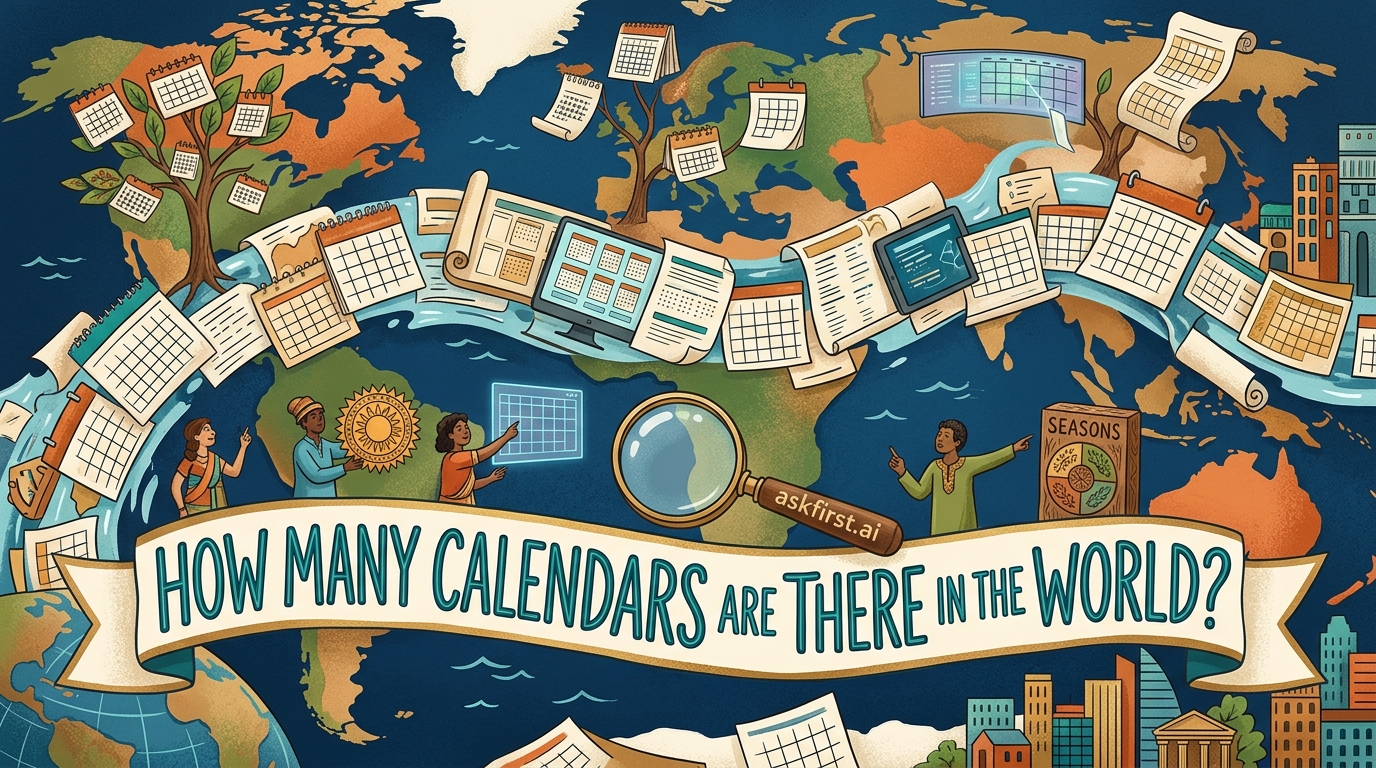
The concept of a "calendar" is far more complex than the simple grid of months and days hanging on a kitchen wall. While the Gregorian calendar is the international civil standard, it is merely one of dozens of systems currently in use across the globe. To ask how many calendars exist is to ask how humanity has chosen to measure the rhythm of the cosmos, the cycles of agriculture, and the sanctity of religious observation.
The Gregorian Hegemony: A Global Baseline
The Gregorian calendar, introduced by Pope Gregory XIII in 1582 to correct the drift of the Julian calendar, is the undisputed "lingua franca" of timekeeping. It is a solar calendar based on the Earth's orbit around the sun, lasting approximately 365.2425 days. Because of its precision in aligning with the equinoxes, it was adopted globally for administrative, financial, and scientific purposes. Almost every country on Earth uses it for international trade and civil governance. However, this is a layer placed over the top of deeper, older, and more culturally significant systems.
Religious and Lunisolar Systems
Beyond the civil standard, there are dozens of active religious and traditional calendars. These are often lunisolar, meaning they track both the moon’s phases (for months) and the sun’s position (for years).
- The Hebrew Calendar: Used for Jewish religious observances, this is a complex lunisolar system. It tracks years based on the cycle of the moon but adds a "leap month" (Adar II) seven times every 19 years to keep the holidays aligned with the seasons. As noted by author Arthur Spier in his definitive work, The Comprehensive Hebrew Calendar, this system is a marvel of mathematical precision, balancing religious necessity with astronomical accuracy.
- The Islamic (Hijri) Calendar: Unlike the Gregorian or Hebrew systems, the Islamic calendar is strictly lunar. It consists of 12 months that cycle through the solar year, meaning the Islamic year is roughly 11 days shorter than the Gregorian year. Consequently, holy months like Ramadan shift forward by about 11 days each year, eventually cycling through all four seasons over a 33-year period.
- The Hindu Calendars: India possesses a tapestry of timekeeping systems. The Vikram Samvat and the Shaka Samvat are two of the most prominent. These are highly sophisticated, often incorporating astrological data and lunar mansions (nakshatras). The Indian National Calendar, a standardized version of the Shaka system, was formally adopted in 1957 to unify the diverse regional traditions of the subcontinent.
Traditional and Indigenous Systems
Many cultures maintain traditional calendars that serve as the heartbeat of their communities, often used alongside the Gregorian system.
- The Chinese Calendar: This is a traditional lunisolar calendar that determines the dates of the Lunar New Year and other significant festivals. It is deeply rooted in the agricultural cycle and traditional Chinese cosmology. Each year is associated with an animal from the zodiac and one of the five elements.
- The Ethiopian Calendar: Ethiopia stands as a unique outlier. It follows a calendar that is roughly seven to eight years behind the Gregorian system due to a different calculation of the Annunciation of Jesus. It consists of 13 months—12 months of 30 days and a 13th month of five or six days. This system is still widely used for all religious and many civil matters within the country.
The Complexity of "Counting" Calendars
It is difficult to provide a single integer for "how many" calendars exist because many are regional variations of broader systems. For instance, in Southeast Asia, the Buddhist calendar is used in various forms in Thailand, Cambodia, Laos, and Myanmar. While they share a root—the death of the Buddha—the specific start dates and leap-year intercalations can vary by country.
Furthermore, there are many astronomical or scientific calendars used by researchers. The Julian Day count, for example, is a continuous count of days since January 1, 4713 BCE, used by astronomers to avoid the complexities of months and leap years. As described by Jean Meeus in his classic reference Astronomical Algorithms, this system is essential for calculating exact intervals between celestial events.
Conclusion
There is no single "number" of calendars because timekeeping is a reflection of human identity. If one counts every regional variation, traditional agricultural system, and religious liturgical calendar, the number easily exceeds 50 to 100 distinct systems currently in active, daily use.
We live in an era of "pluralistic time." While the Gregorian calendar allows the world to function as a singular economic unit, the persistence of the Hijri, Hebrew, Chinese, and Ethiopian calendars ensures that the cultural and spiritual dimensions of human existence remain anchored to their own unique, ancient rhythms. The diversity of our calendars is a testament to the fact that time is not just a scientific measurement; it is a profound expression of our history, our faith, and our relationship with the universe.