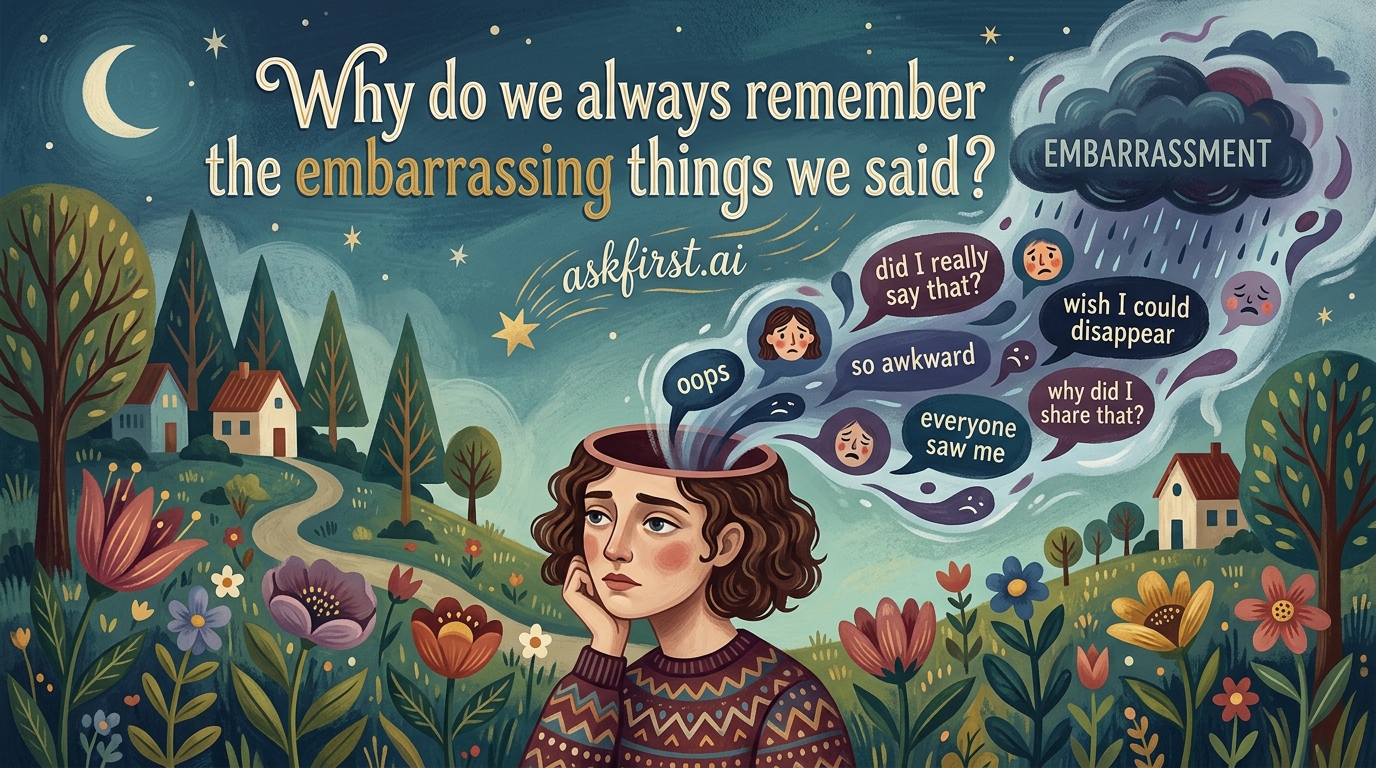
The Psychology of Lingering Embarrassment
The phenomenon of vivid, intrusive recall regarding past social blunders is a deeply ingrained facet of the human condition. While it often feels like a personal curse, this persistent memory mechanism serves several complex evolutionary and psychological purposes. From an neurological perspective, embarrassment is a high-arousal emotional state that triggers the amygdala, the brain's alarm system, ensuring that socially significant events are etched into memory with unusual intensity.
The Evolutionary Survival Mechanism
Humans are fundamentally social creatures. Throughout evolutionary history, our survival depended on our standing within the tribe. Being exiled or ostracized meant death. Consequently, the brain developed a highly sensitive 'social radar.' Embarrassment functions as a biological deterrent against repeating behaviors that threatened our social cohesion. By keeping those cringeworthy moments at the forefront of our minds, the brain is effectively engaging in a constant safety drill: it reminds us of what not to do to ensure we remain accepted and safe within our community.
The Spotlight Effect and Cognitive Bias
One of the primary drivers of this fixation is the Spotlight Effect. This cognitive bias leads individuals to believe that other people are paying much more attention to their appearance and behavior than they actually are. In reality, most people are far too consumed by their own 'Spotlight' to notice or dwell on the minor social missteps of others. However, the brain struggle to grasp this objective truth, opting instead to maintain a laser focus on the error because the individual remains the protagonist of their own life story.
- The Negativity Bias: The human brain is evolutionarily wired to prioritize negative experiences over positive ones. A single biting criticism often carries more weight than ten compliments. This bias ensures that we learn from our mistakes, though it often manifests as an endless loop of replayed social awkwardness.
- Rumination vs. Reflection: It is essential to distinguish between productive self-reflection and unproductive rumination. When the brain re-accesses an embarrassing memory to analyze how to handle a similar situation differently in the future, it is engaging in a growth-oriented process. When it repeats the scenario solely to generate self-judgment, it becomes a maladaptive cycle.
How the Brain Stores 'Cringe'
Memories are not static recordings; they are reconstructed every time they are accessed. When an embarrassing memory is retrieved, the emotional context—the feeling of heat in the face, the rapid heartbeat, the desire to disappear—is re-triggered. This emotional reenactment makes the memory feel 'fresh' and current, regardless of how many years have passed. The neural pathways associated with that moment become reinforced through repeated firing, creating a 'mental groove' that makes the memory easier to access than mundane, everyday details.
Strategies for Managing the Memory Loop
To break the cycle of obsessive remembrance, one must engage in conscious cognitive reframing:
- Perspective Taking: Actively visualize the event from the perspective of an outside observer. Recognizing that others likely forgot the incident within minutes can significantly decrease the emotional charge attached to the memory.
- Self-Compassion: Research in positive psychology suggests that treating oneself with the same kindness one would offer a friend helps deactivate the defensive stress response. Acknowledge that error is a prerequisite for human experience.
- The 'So What?' Test: Ask whether the specific event has any actual, ongoing consequence in your life today. Most of the time, the answer is a resounding no, which helps the prefrontal cortex regain control over the emotional brain.
- Acceptance and Mindfulness: Trying to forcibly push away an intrusive thought often causes it to bounce back with more vigor, a phenomenon known as ironic process theory. Instead of fighting the memory, acknowledge its presence calmly and allow it to drift away like a cloud, rather than holding onto it as an anchor.
Ultimately, remembering embarrassing moments is proof of a functioning social conscience. It signifies that the individual cares about their reputation, their relationships, and their role within the human collective. By understanding the neurological 'why' behind these memories, it becomes easier to transform the sting of regret into the wisdom of social experience. Embrace these memories as lessons, not as life sentences, and shift the focus back to the present, where future possibilities remain unwritten.