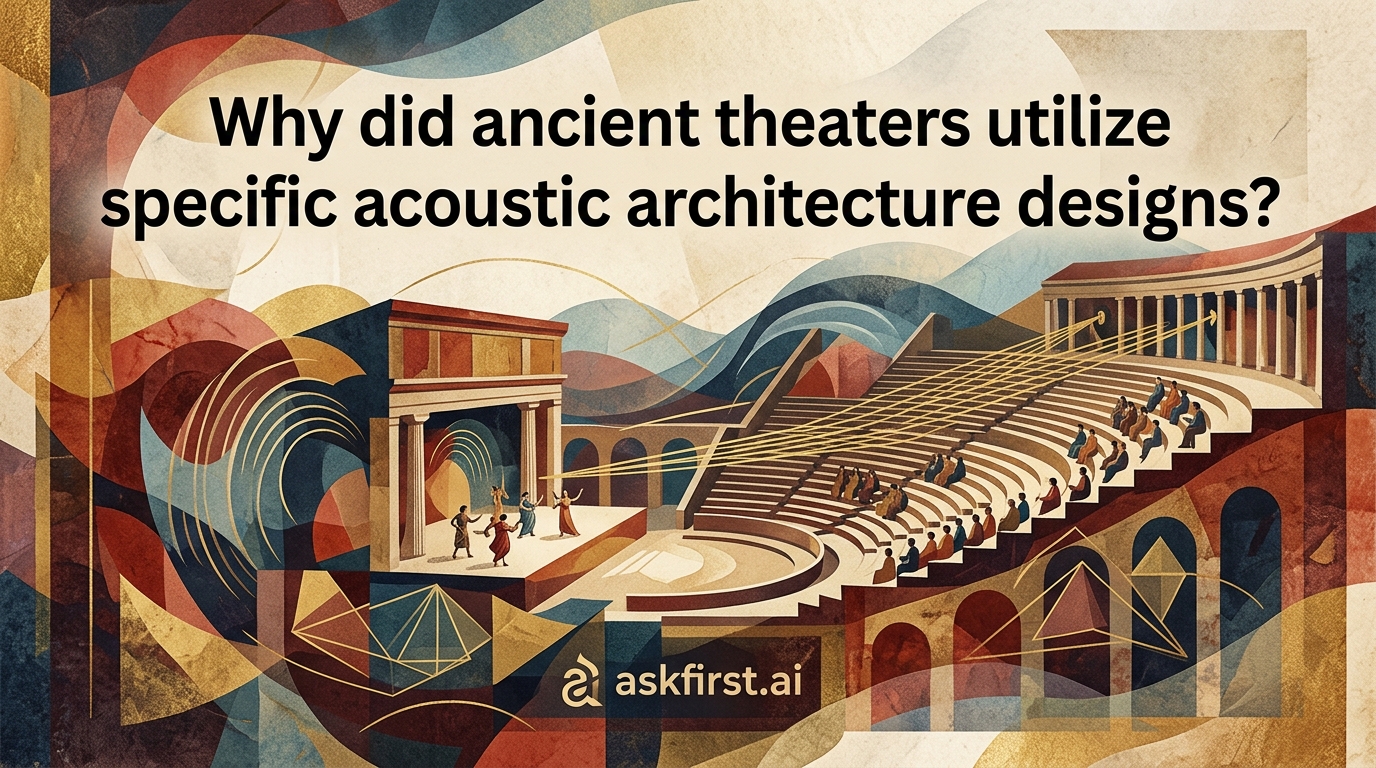
The Science of Sound in Antiquity
Ancient theaters, particularly those built by the Greeks and Romans, represent a pinnacle of acoustic engineering that modern science is still studying today. The primary reason for their specific architectural designs was the absolute necessity of delivering clear, undistorted vocal performances to audiences of thousands without the aid of modern amplification. In an era where a speaker was the sole source of sound, architects had to manipulate the physical properties of space to extend the reach of the human voice across stone tiers.
The Geometry of Clarity
The fundamental secret behind the acoustic success of theaters like the one at Epidaurus lies in geometric precision. Ancient architects utilized a 'fan-shaped' design that allowed sound waves to propagate outward from the stage, or 'orchestra,' toward the audience.
- Surface Reflection: By angling the seating rows, architects ensured that sound waves hitting the stone surfaces would be reflected toward the listeners rather than away from them. This essentially acted as a primitive sound reinforcement system.
- The Scaenae Frons: Behind the stage, a massive structure called the scaenae frons served as a vertical acoustic mirror, reflecting sound back into the auditorium and preventing it from being lost in the open air behind the actors.
Frequency Filtering and Background Noise
A fascinating, counter-intuitive discovery revealed by researchers in recent decades is that these theaters acted as acoustic low-pass filters. The stone seat rows functioned like a diffraction grating. As sound waves travel across these tiered rows, the surfaces effectively suppress lower-frequency background noises—such as the rustling of garments or the murmuring of a crowd—while allowing the higher-frequency components of the human voice to propagate clearly. This phenomenon essentially 'cleans' the audio signal, making the speech of the actors more intelligible over long distances.
Psychological and Engineering Mastery
The design was not merely accidental; it was a testament to the mastery of natural physics. The inclination of the seating areas—often steeper than modern stadiums—allowed every person in the audience to have a direct line of sight and sound to the center of the performance area.
- Impedance Matching: The transition from the dense stage floor to the open air and then to the seating mass was carefully managed to prevent excessive sound absorption, ensuring energy was preserved.
- Phase Coherence: By arranging the seating in a semi-circular arc, architects minimized the time difference between the direct sound from the actor and the reflected sound from the seats. When these waves arrive within a few milliseconds of each other, the human ear perceives them as a single, amplified sound, preventing the muddying effect of echoes.
The Legacy of Ancient Engineering
It is a common myth that ancient theaters were perfectly designed solely by luck or artistic flair. In reality, the construction was rooted in a sophisticated, empirical understanding of how sound behaves in an open-air environment. These structures remain an evergreen benchmark for modern architectural acoustics. Today, architects looking to design open-air arenas or performance spaces still utilize these principles: maximizing the reflection of sound toward the audience, minimizing noise interference through seat geometry, and utilizing massive, hard surfaces to redirect vocal energy.
In conclusion, the genius of ancient theater architecture resides in its integration of form and function. By understanding the limitations of the human voice and the physics of wave propagation, ancient builders created spaces where, even at the highest tiers, a whisper on stage could be heard with startling clarity. This remains a masterclass in human ingenuity, proving that deep knowledge of the physical world can turn stone and air into instruments of perfect communication.