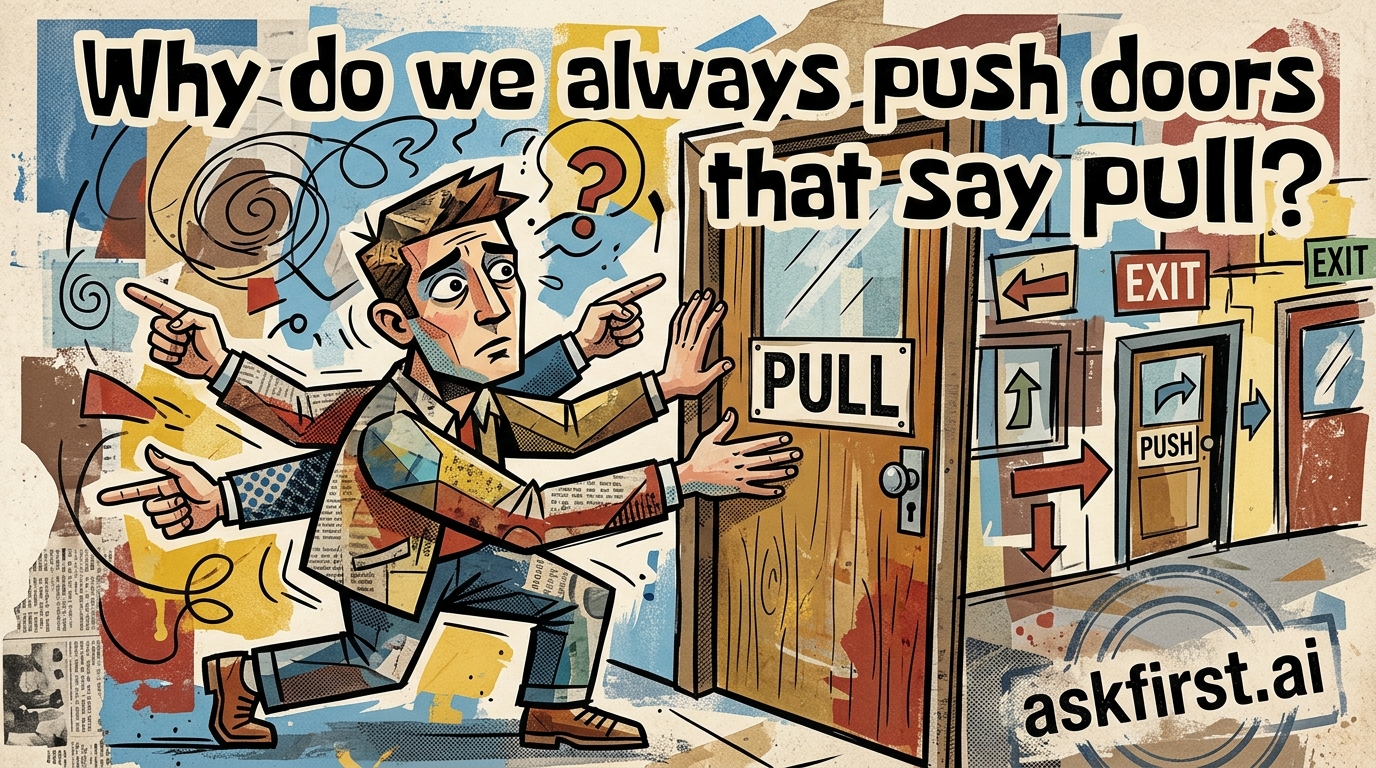
The phenomenon of pushing a door labeled 'pull' is a classic case of a 'Norman Door', a concept coined by design expert Don Norman in his seminal book, The Design of Everyday Things. This behavioral error is rarely a reflection of human intelligence but rather a failure of industrial design to communicate its affordances effectively. An 'affordance' is a visual property of an object that indicates how it should be used. When a door is designed with a flat metal plate where a handle should be, the human brain instinctively interprets that plate as a surface to push, regardless of the text printed upon it.
The Psychology of Habitual Interaction
Human cognition relies heavily on heuristics—mental shortcuts that allow for rapid decision-making. When approaching a doorway, the brain subconsciously searches for environmental cues to guide behavior. If a door has a vertical handle, it communicates 'pull' via its shape. If it has a flat plate, it communicates 'push'. When a door that requires a pull action is equipped with a flat plate, it creates a design-action conflict. The physical form (the plate) contradicts the instructions (the label). In these instances, the brain prioritizes the physical affordance over the symbolic information, leading to the reflexive push action. Research in ergonomics suggests that sensory input from tactile surfaces outweighs linguistic instructions in high-speed, routine navigation.
The Impact of Cognitive Load
Why does this happen even when we are alert? Modern life is characterized by high cognitive load. We are constantly processing information, navigating spaces, and thinking about upcoming tasks. As a result, our interaction with common architecture becomes largely automatic. This 'autopilot' mode is essential for cognitive efficiency, but it makes us highly susceptible to design flaws. When the environment provides a prompt that matches our expectations based on previous experience, we do not read the text. Reading is a slow, analytical process, whereas interacting with a handle or plate is a fast, intuitive one. We push simply because our brain has categorized the door as a 'push-object' before our eyes have processed the word 'pull'.
Principles of Intuitive Design
To eliminate this confusion, architects and product designers adhere to the following principles:
- Visible Affordances: A door that needs pulling should have a handle that fits the hand, not a plate.
- Conceptual Models: The design of the hardware should reflect the internal mechanism of the latch.
- Feedback Loops: A well-designed door provides immediate physical feedback, preventing the user from ever needing a 'push' or 'pull' sticker. If a door requires a sign, the design is often considered a failure.
The Role of Cultural Expectation
Furthermore, cultural patterns play a massive role. In many regions, the standard fire safety regulations mandate that public doors must swing outward (a push action) to facilitate emergency egress. Because so many public building doors are designed to be pushed, we develop a strong cultural conditioning toward that movement. When we encounter a rare exception—a door that must be pulled—our conditioned response overrides the analytical caution required to read the signage. We are essentially fighting against the subconscious programming of our own cultural environment.
Redefining the Human-Environment Interface
Understanding this phenomenon is vital for anyone involved in design, urban planning, or even simple home improvement. The takeaway is profound: good design should be invisible. If a user must be told how to operate an object, the object is likely poorly designed. By aligning physical cues with expected outcomes, designers can create environments that respect human psychology rather than contradicting it. Next time you find yourself pushing a 'pull' door, recognize it not as a personal failure, but as a fascinating demonstration of how profoundly our environments dictate our behavior. We do not fail the door; the door fails to communicate with our natural psychological processes.