The Neurochemistry of Attachment and Illusion
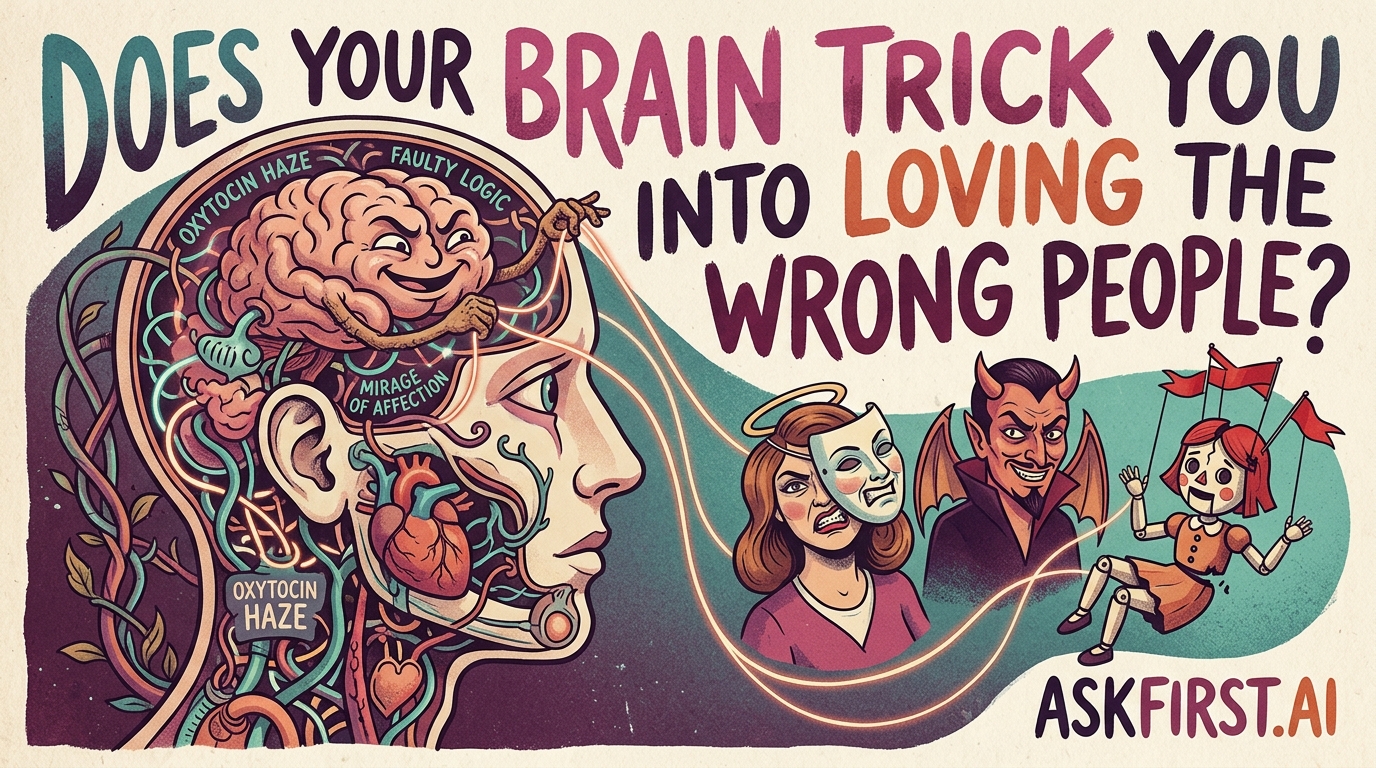
The phenomenon of falling for the 'wrong' person is a recurring human experience, often rooted not in conscious choice, but in an intricate dance of neurochemistry and evolutionary biology. When the brain initiates the process of attraction, it operates under a sophisticated system of reward circuitry, neurotransmitter regulation, and historical conditioning. Understanding why this system occasionally produces 'errors' requires an examination of the invisible forces shaping human preference.
The Reward Circuitry and Dopamine Flooding
At the core of initial attraction is the brain's reward system, particularly the ventral tegmental area and the nucleus accumbens. When a potential partner is identified, these regions release massive quantities of dopamine. This neurotransmitter does not merely signal pleasure; it signals motivation and salience. It essentially tells the brain that the object of focus is highly significant, creating a state of hyper-focus that can override logical assessment.
Research indicates that this chemical 'high' effectively suppresses the activity of the prefrontal cortex—the area responsible for executive function, critical thinking, and social judgment. Consequently, the brain may temporarily disable its internal warning system. Signs of incompatibility or red flags that would be obvious in a neutral setting are frequently dismissed or reinterpreted as 'mystery' or 'excitement.' This is the brain prioritizing the potential for reward over the necessity of safety or long-term compatibility.
The Blueprint of Attachment Styles
Beyond chemistry, the brain is governed by established attachment blueprints. Developed during childhood, these styles—secure, anxious, or avoidant—serve as internal templates for how a person expects love to function. If an individual grew up in an environment where love was inconsistent or emotionally distant, the brain may normalize these patterns.
- The Familiarity Bias: The brain tends to prefer the familiar over the optimal. An individual with an anxious attachment style may find themselves drawn to partners who are emotionally unavailable. To the nervous system, this dynamic feels 'correct' or 'normal' because it mimics the early childhood experience.
- Cognitive Dissonance: When the brain encounters someone who fits a familiar, albeit unhealthy, blueprint, it works overtime to rationalize their behavior. It will invent narratives to justify a partner's neglect or volatility, protecting the individual from the discomfort of recognizing a poor choice.
Evolutionary Survival vs. Modern Romance
From an evolutionary perspective, the brain was not designed to maximize personal happiness; it was designed to maximize survival and reproduction. In ancestral environments, the primary objective was finding a mate who offered the best chance for offspring survival. Modern dating environments, which offer endless options and focus heavily on emotional compatibility, exist in sharp contrast to these ancient biological drivers.
- The Novelty Effect: The brain is hardwired to be attracted to novelty. High-conflict partners or those who keep one guessing often provide intermittent reinforcement, a type of reward schedule that is notoriously addictive. This keeps the dopamine flowing, making the partner appear more desirable simply because the brain is constantly 'chasing' the reward.
- Genetic Complementarity: Some theories suggest we are subconsciously drawn to others whose immune systems (the Major Histocompatibility Complex or MHC) differ from ours to produce healthier offspring. These pheromonal signals operate entirely below the level of conscious awareness, leading to a pull that feels like destiny but is strictly biological.
Breaking the Cycle through Cognitive Regulation
While the brain may be predisposed to certain 'tricks,' it is not an unchangeable machine. The key to mitigating the selection of incompatible partners lies in metacognition—the practice of thinking about one’s own thinking.
- Delay Decision Making: When the initial rush of attraction occurs, it is critical to introduce a cooling-off period. Delaying major emotional investments or life-altering decisions allows the prefrontal cortex to regain its capacity for rational analysis.
- Audit the Patterns: Analyze past relationships for recurring themes. Identifying commonalities in past partners—such as emotional distance, lack of reciprocity, or instability—can reveal the subconscious template at work.
- Active Engagement of the Prefrontal Cortex: By intentionally focusing on a partner's actions rather than their potential or one’s own feelings, the brain can be shifted back into analytical mode. Observing behavior over time—specifically, how a person treats others and handles conflict—provides a data-driven picture that overrides the emotional illusion.
Ultimately, the brain is not necessarily tricking the individual with malicious intent; it is simply functioning according to ancient, automated scripts. By acknowledging these neurological biases, one can reclaim control, moving from a position of passive emotional reactivity to one of conscious, informed decision-making in the pursuit of long-term healthy connection.