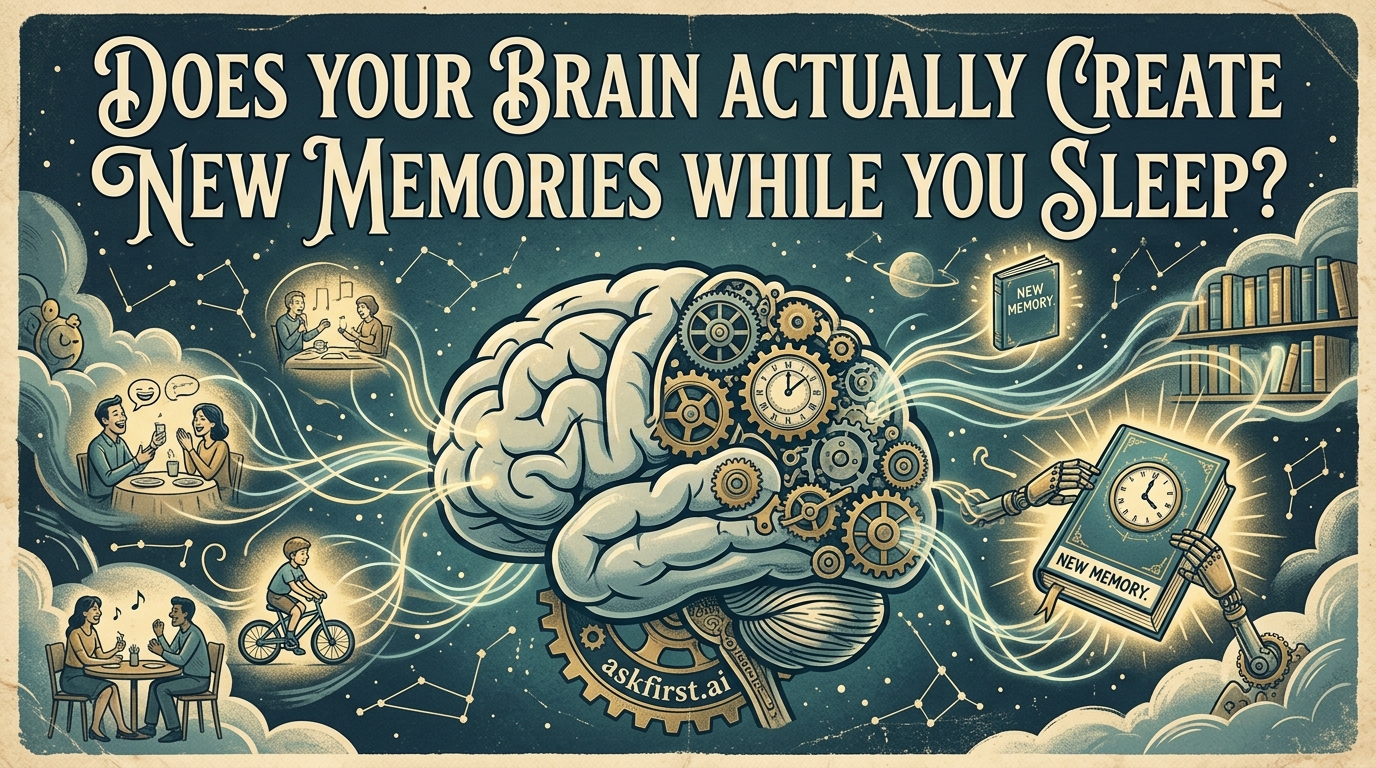
The Nocturnal Architect: Memory Consolidation During Sleep
Contrary to the common misconception that sleep is a period of inactivity, the human brain functions as an active, relentless architect during the night. The answer to whether the brain creates new memories while asleep is nuanced: while the brain is not typically acquiring new sensory input from the environment, it is deeply engaged in memory consolidation, a sophisticated process where fleeting experiences are transformed into long-term knowledge.
The Mechanics of Consolidation
Memory processing occurs across three distinct stages: encoding, consolidation, and retrieval. Encoding happens while awake, but consolidation—the stabilization of a memory trace after initial acquisition—reaches its peak efficiency during specific sleep cycles. Scientists categorize this into two primary forms:
- System Consolidation: This involves the transfer of information from the hippocampus (the brain's temporary storage center) to the neocortex (where long-term memories reside).
- Synaptic Consolidation: This occurs at the cellular level, strengthening the connections between neurons, known as synaptic plasticity, which effectively 'hardwires' the information into the brain's circuitry.
The Role of Sleep Stages
Sleep is divided into Non-Rapid Eye Movement (NREM) and Rapid Eye Movement (REM) phases, both of which serve critical, distinct roles in how the brain manages data:
- Slow-Wave Sleep (Deep NREM): During this phase, the brain exhibits slow, synchronized oscillations. Research indicates that these waves act as a rhythmic 'replay' button, allowing neurons to repeat the firing patterns experienced during the day. This is akin to a computer background task optimizing its file system.
- REM Sleep: Often associated with dreaming, REM is primarily linked to the consolidation of emotional and procedural memories—tasks involving motor skills or artistic creativity. By integrating new experiences into the vast web of existing knowledge, REM sleep fosters cognitive insight, often resulting in the classic 'Aha!' moment upon waking.
Why You Cannot Simply Learn a Language via Audio Tracks
While the brain processes memories during sleep, it remains selective. The idea that one can passively absorb vast amounts of new facts—like a foreign language or complex mathematical formulas—merely by listening to recordings while sleeping is largely debunked. The brain effectively gates sensory input during sleep to protect the process of internal consolidation. If the brain were constantly processing external information, the integrity of stored memories would be compromised by interference. The brain is not 'creating' new memories from scratch based on external auditory input, but rather 'refining' and 'solidifying' the data already present in the mind.
Scientific Evidence and Studies
Studies utilizing fMRI (functional Magnetic Resonance Imaging) have consistently shown that the same regions of the brain that were active during a learning task become reactivated during subsequent sleep. For instance, in spatial navigation tasks, researchers observed that the hippocampus 'replays' routes learned earlier in the day at a higher speed, effectively 'practicing' the map to ensure retention. Furthermore, studies on sleep deprivation have demonstrated that when individuals are denied deep sleep, the capacity to form and recall memories drastically decreases, regardless of how much time they spent studying while awake.
Practical Implications for Daily Life
Understanding that the brain processes memory during sleep provides actionable insight for human behavior:
- Spacing Effect: Studying in blocks with sleep in between is far more effective than 'cramming' for a single, long session. The sleep acts as a bridge that allows the knowledge to settle.
- Pre-Sleep Priming: Reading difficult or highly relevant material shortly before bed can theoretically bias the brain toward prioritizing the consolidation of that information during the night.
- The Power of Naptime: Even short periods of sleep (20 to 90 minutes) trigger the replay mechanisms, proving that memory consolidation is a continuous, iterative process.
Conclusion: The Brain Never Truly Rests
In summary, the brain does not simply turn off. It undergoes a miraculous transformation every night, shifting information from the 'workspace' of the hippocampus to the 'permanent archives' of the neocortex. It is not necessarily creating new input, but it is creating new access points and structural reinforcements for the data acquired throughout the day. By appreciating the complexity of this nocturnal ritual, one can better respect the necessity of a healthy sleep cycle for optimal cognitive health. Protecting sleep is essentially protecting the architecture of your own life story.