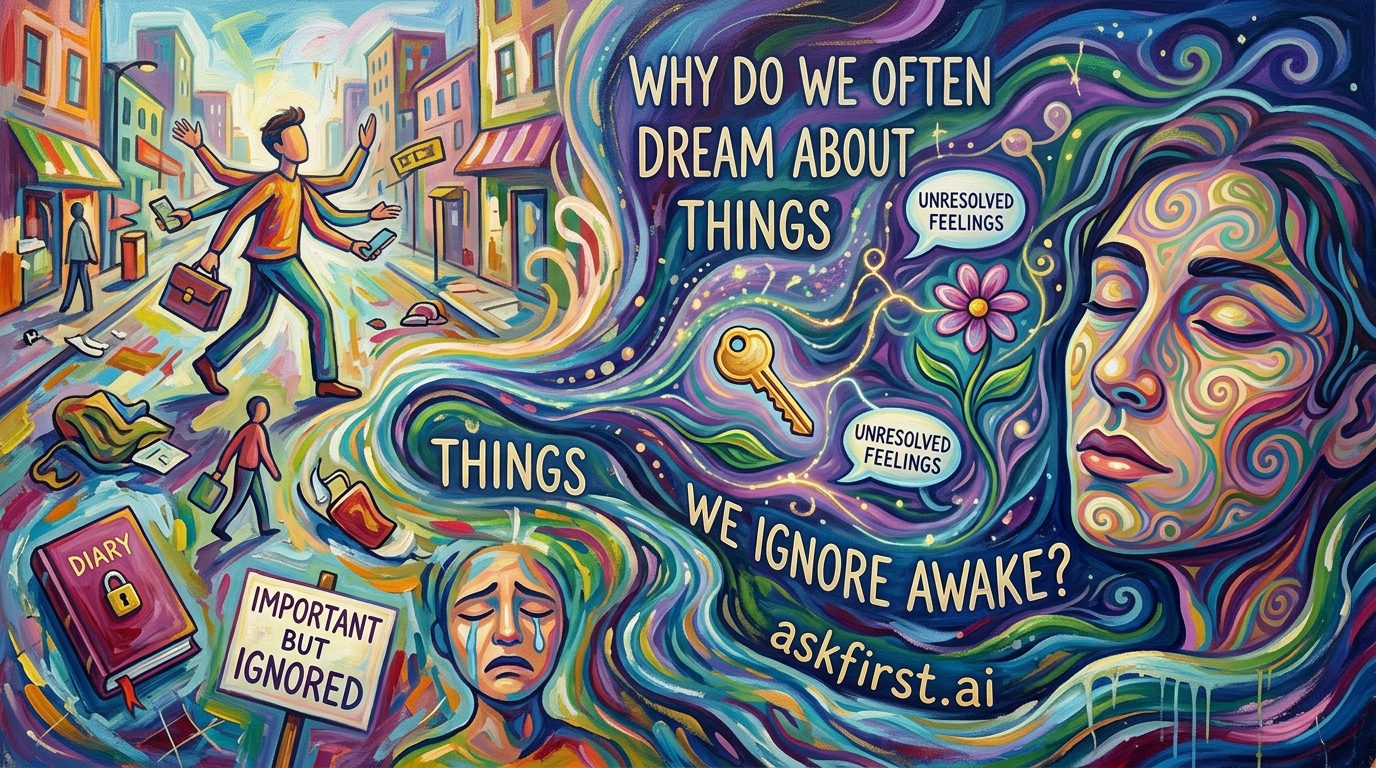
The Cognitive Architecture of the Subconscious
The phenomenon of dreaming about seemingly irrelevant or ignored information is a fascinating intersection of neurology, cognitive psychology, and evolutionary biology. While the waking mind operates through the lens of executive function—prioritizing immediate survival tasks, social navigation, and deliberate problem-solving—the sleeping brain shifts into a divergent processing mode. During the Rapid Eye Movement (REM) stage, the prefrontal cortex, which governs logical filtering and impulse control, experiences a state of relative deactivation. This allows the brain to engage in what researchers call 'associative activation,' where the mind explores weak associations between disparate concepts that are typically suppressed during the day.
The Role of Selective Attention and Sensory Gating
During waking hours, the brain functions as an efficiency machine. Through a process known as selective attention, it filters out millions of bits of data to prevent sensory overload. The peripheral sounds, minor visual cues, or fleeting emotional states we ignore while awake are not discarded; they are stored in the temporary buffers of the brain. When we drift into sleep, the 'gatekeepers' of our attention system relax. The brain takes this opportunity to integrate this ignored background data into the long-term memory architecture. Dreaming becomes the landscape where these 'insignificant' pieces of information are cross-referenced with established knowledge, effectively performing a data consolidation routine.
Theoretical Frameworks: Why the Mind Wanders
- The Activation-Synthesis Hypothesis: Proposed by Hobson and McCarley, this theory suggests that dreams are merely the brain's attempt to make sense of random electrical impulses generated in the brainstem. The cortex takes these raw signals and weaves them into a coherent narrative using the vast library of latent information—the 'ignored' content—stored in our memory banks.
- The Threat Simulation Theory (TST): This evolutionary perspective posits that dreaming serves as a biological rehearsal. By integrating ignored or subtle environmental cues into dream narratives, the brain prepares for potential future challenges. Even if the 'ignored' content seems trivial, the brain is testing its capacity to respond to complex, unpredictable stimuli.
- Memory Consolidation and Integration: Emerging research suggests that sleep acts as a digestive system for information. By replaying overlooked data, the brain strengthens neural pathways associated with creative problem-solving and lateral thinking, a concept often referred to as the 'incubation effect.'
The 'Neglect' Paradox: Why It Matters
We often wonder why a fleeting conversation from three years ago or a specific pattern on a rug surfaces in a dream. This occurs because the human brain is a pattern-recognition machine that never truly rests. While the conscious mind deems certain data 'unimportant' for immediate survival, the subconscious registers its structural, emotional, or symbolic value.
- Emotional Regulation: Often, what we ignore while awake is actually an emotional burden we aren't ready to face. The dream state acts as a 'nighttime therapy,' allowing us to process these emotions in a low-stakes environment where we are safe from real-world consequences.
- Creative Synthesis: Many breakthroughs in art, mathematics, and science have occurred because the mind, when unburdened by the demand for logical consistency, links 'ignored' data to active projects. This is the neurobiological basis of 'thinking outside the box.'
- Neural Cleanup: Sleep allows for the shedding of redundant synaptic connections. Dreaming helps identify which ignored data should be archived and which should be deleted, keeping our cognitive architecture streamlined and efficient.
Embracing the Wisdom of the Subconscious
It is time to shift the perception of these 'ignored' dreams from nonsense to neurological necessity. These nocturnal narratives are the brain's way of maintaining psychological equilibrium and expanding its associative breadth. The next time a dream features an element that felt insignificant during the day, recognize it as a piece of the puzzle that the brain is currently fitting into the broader picture of your cognitive identity. By analyzing these occurrences, one can actually gain profound insights into their subconscious priorities, allowing for a more harmonious connection between the waking persona and the inner self. Ultimately, the things we choose to ignore during the bustle of the day find their voice at night, ensuring that no experience—no matter how small—is ever truly lost to the archives of the mind.