The Temporal Paradox of Aging
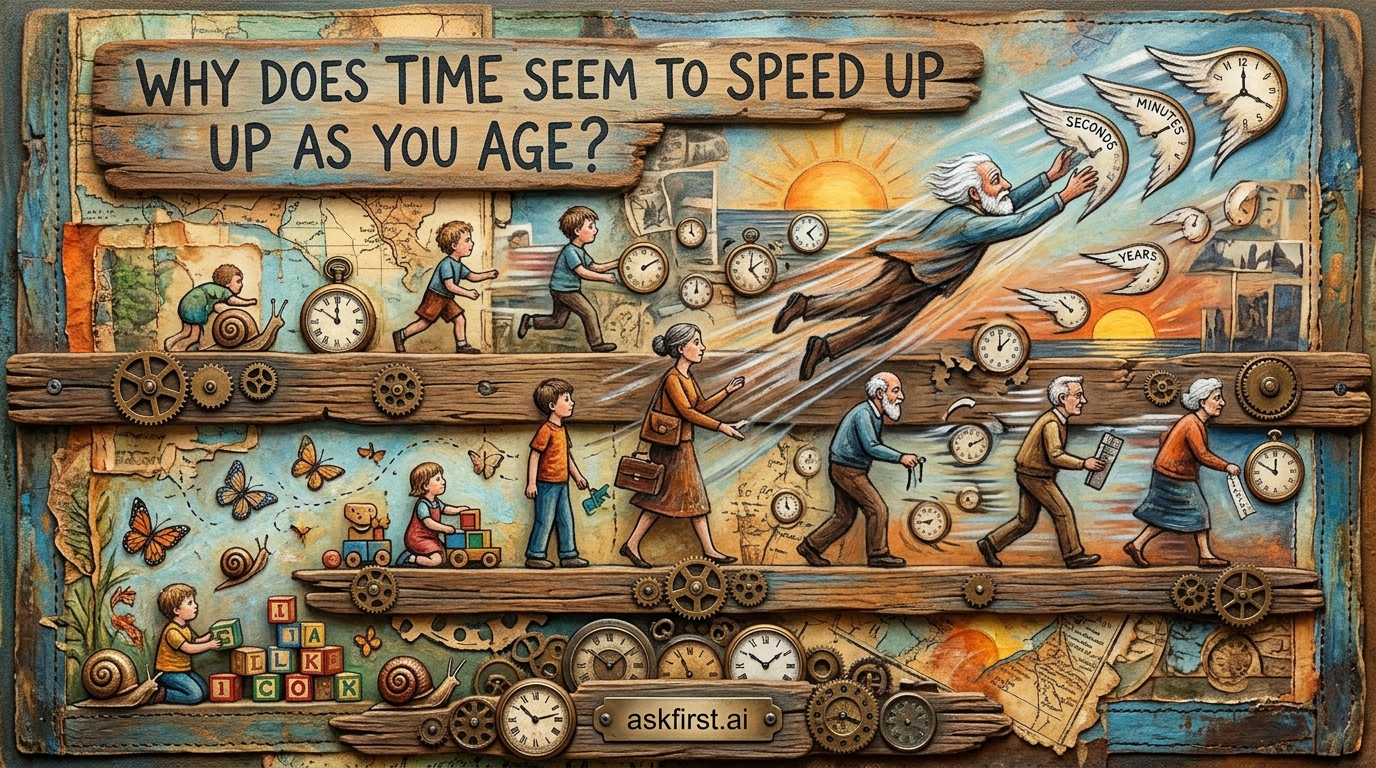
The phenomenon of time seeming to accelerate as humans grow older is a widely observed psychological reality that has fascinated neuroscientists, philosophers, and psychologists for centuries. While the objective measurement of time remains constant—a second is always a second—the subjective experience of time is fluid, malleable, and highly dependent on cognitive processing. This illusion of speed is known as the 'Holiday Paradox' or the 'Proportional Theory' of time perception.
The Proportional Theory: The Mathematics of Experience
One of the most prominent explanations for the perception of time speed is the Proportional Theory, first suggested by philosopher Paul Janet in 1877. This theory posits that our brain perceives a unit of time (a year, for example) as a fraction of our total life lived.
- At Age Five: A single year represents 20% of an individual's entire life experience. It is a massive, significant duration that allows for expansive growth, new school years, and endless exploration.
- At Age Fifty: That same year represents only 2% of the individual's life. Because it is a smaller piece of the 'total pie,' the brain perceives the duration as significantly shorter and less impactful than in youth. This mathematical perspective helps explain why childhood summers felt endless, while adult years seem to pass in a blur of routine.
Neurobiological Coding and Memory Density
Beyond simple mathematics, the way the brain encodes memories plays a critical role in the perception of duration. Our brains are essentially prediction machines that rely on novelty to gauge time. When we encounter something new—a first job, a first romantic relationship, or moving to a new city—the brain creates dense, high-resolution neural networks.
According to the 'Memory Gradient' hypothesis, the brain stores novel experiences with more detail. When looking back on a period filled with new experiences, the brain perceives it as having lasted a long time because of the vast amount of data recorded. Conversely, as adults fall into routine and predictability, the brain stops creating detailed new records. A commute driven a thousand times is processed as 'background noise.' When the brain looks back at a year of routine, there is very little new 'data' to distinguish one month from the next, resulting in a feeling that the year passed almost instantaneously.
The Role of Dopamine and Neural Processing
Scientific research into neurotransmitters, specifically dopamine, suggests that the speed of our internal 'clock' is linked to how we process information. Dopamine influences the speed of our neural firing.
- High Dopamine States: In children, the brain is rapidly developing, creating new synaptic connections and learning at a breakneck pace. This high level of neurological activity may cause an internal 'overclocking' effect, where the brain records more 'ticks' of the clock than an adult's more stable, lower-dopamine nervous system.
- Predictive Processing: As we age, our brains become highly efficient at predicting the environment. This efficiency reduces the amount of sensory input we need to process to understand our surroundings. When the brain can easily predict what comes next, it spends less time 'attending' to the world, which translates to a shortened perception of duration.
Strategies to 'Slow Down' Time
Understanding that this phenomenon is a byproduct of neural efficiency and routine, one can take active steps to alter the subjective experience of time. The secret lies in Novelty Injection.
- Seek New Environments: Engaging in travel, picking up a new hobby, or learning a complex skill forces the brain to move out of 'autopilot' mode. When the brain is forced to focus intensely, it creates more distinct memories, effectively slowing down the perception of the passage of time.
- Practice Mindfulness: Deep, sustained attention to the present moment disrupts the habit of mental wandering. By focusing on sensory input—the feeling of textures, the nuances of sound, or the taste of food—you increase the 'resolution' of your daily experience, making the passage of time feel more expansive.
- Break Routine: Small, consistent changes in daily habits—such as taking a different route to work or rearranging a home office—can prevent the brain from falling into the pattern of predictive efficiency that contributes to the 'blur' of adulthood.
In conclusion, time does not actually speed up as we age. Rather, our brains become masters of efficiency, smoothing over the details of life and treating the mundane as invisible. By prioritizing novel experiences and maintaining a state of curiosity, it is possible to reclaim that childhood sense of long, expansive days.