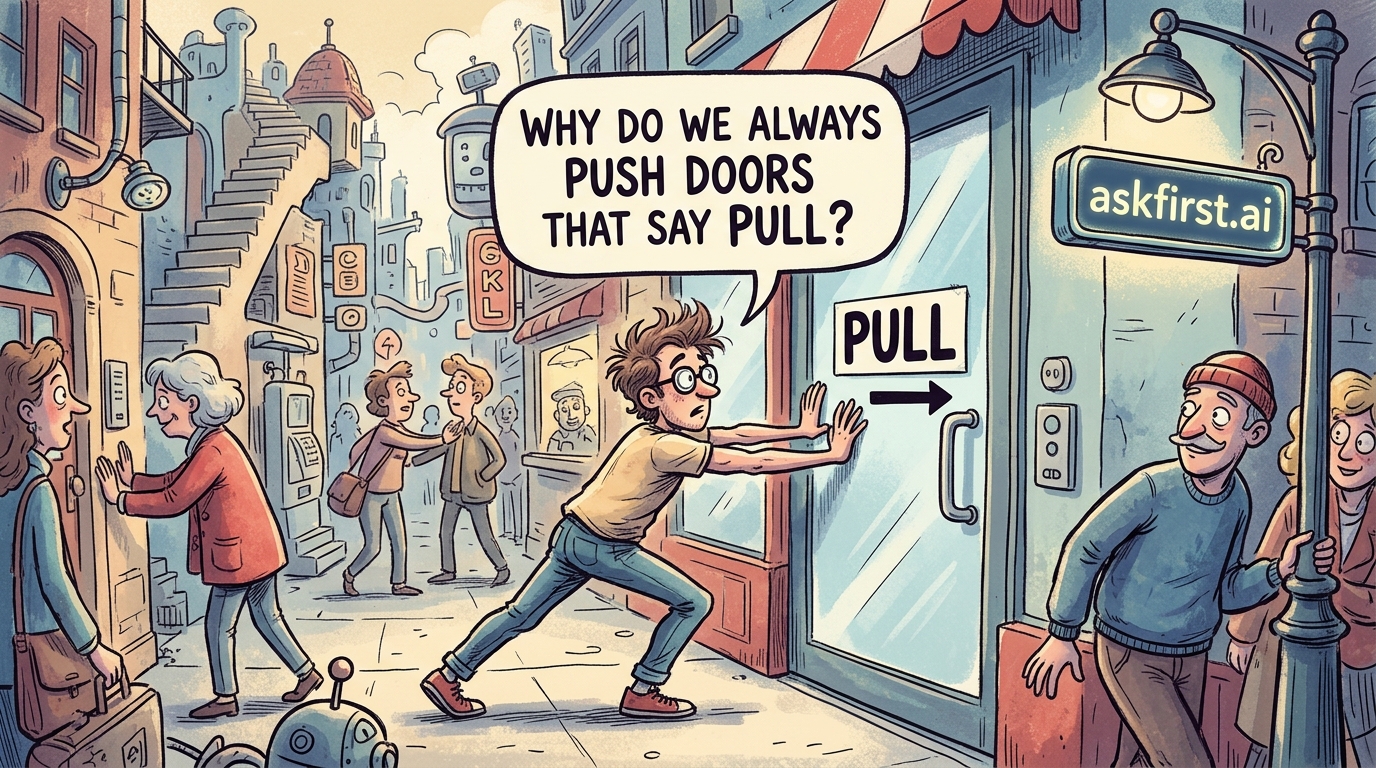
The phenomenon of pushing a door labeled 'pull' is a classic example of a 'Norman Door'—a term coined by cognitive scientist Don Norman in his seminal work, The Design of Everyday Things. It highlights a fundamental disconnect between human behavior and poor interface design. This confusion is not a sign of individual intellectual failure but rather a failure of the object to provide clear, intuitive instructions, often referred to as 'affordances.'
The Psychology of Affordances
An affordance is a visual clue that suggests how an object should be used. For a door, the handle serves as a physical prompt. When a door has a flat plate, it implies pushing. When it has a vertical bar or a handle, it screams 'pull.' If an architect places a flat metal plate on a door that actually requires a pull, the human brain ignores the written label 'pull' and follows the tactile feedback of the plate. The mental model developed through thousands of daily interactions—flat plate equals push—overrides the textual information provided by the sign. In essence, the environment forces a behavior that contradicts the signage.
The Cognitive Burden of Design
Humans operate using two types of cognitive processes: System 1 (fast, intuitive) and System 2 (slow, analytical). When approaching a door, the brain operates primarily in System 1. It scans the environment for quick cues to minimize mental effort. If the visual design of the door provides a 'push' cue, the brain executes that action before System 2 has a chance to read the text. By the time the hand hits the door, the error has already been physically initiated. If the user had to stop, read the sign, and cognitively process the instructions before acting, the door would be considered poorly designed because it forces the user to switch to System 2 for a task that should be reflexive.
Why Good Design Matters
Good design effectively removes the need for signage entirely. Consider these key principles:
- Mapping: The relationship between controls and their movements should be intuitive. A door that requires pulling should have a handle that fits a human hand, and nothing else.
- Feedback: The door should provide immediate physical feedback that confirms whether the action taken is correct. If the door moves when pushed, the user is reinforced in that behavior.
- Visibility: If a user has to look for a sign, the design is already failing. The mechanics of the door should be self-evident from its appearance.
The 'Push-Pull' Paradox
Most people assume they are the ones making the mistake because they feel foolish when the door does not budge. However, this is a form of 'learned helplessness' regarding the built environment. When we encounter these design flaws repeatedly, we begin to doubt our own spatial awareness rather than blaming the architect. This internalizes the struggle, making us feel clumsy or inattentive. In professional engineering and industrial design, this is documented as a failure of 'signifiers'—the signs, symbols, and perceivable indicators that communicate where an action should take place and how it should be performed.
Improving Future Interactions
To bridge the gap between design and human behavior, architects and engineers are increasingly turning to evidence-based design. This involves:
- Removing Plates from Pull-Doors: Replacing push-plates with vertical grips on one side and nothing on the other.
- Contextual Clarity: Ensuring the door's function aligns with its aesthetic profile.
- Human-Centric Testing: Testing door hardware with users who are distracted or in a hurry, because that is when real-world usage occurs.
In conclusion, the frustration of pushing a door labeled 'pull' is a testament to the fact that we are deeply influenced by our environment. The 'Norman Door' serves as a perpetual reminder that when people fail to use a simple tool correctly, the problem usually lies with the design of the tool itself, not the user. Understanding this allows us to look at our world with more empathy for ourselves and a higher standard for the designers who shape the spaces we inhabit. Next time you pull a 'push' door, recognize it as an interaction failure and appreciate the intricate mechanics of human psychology at play.