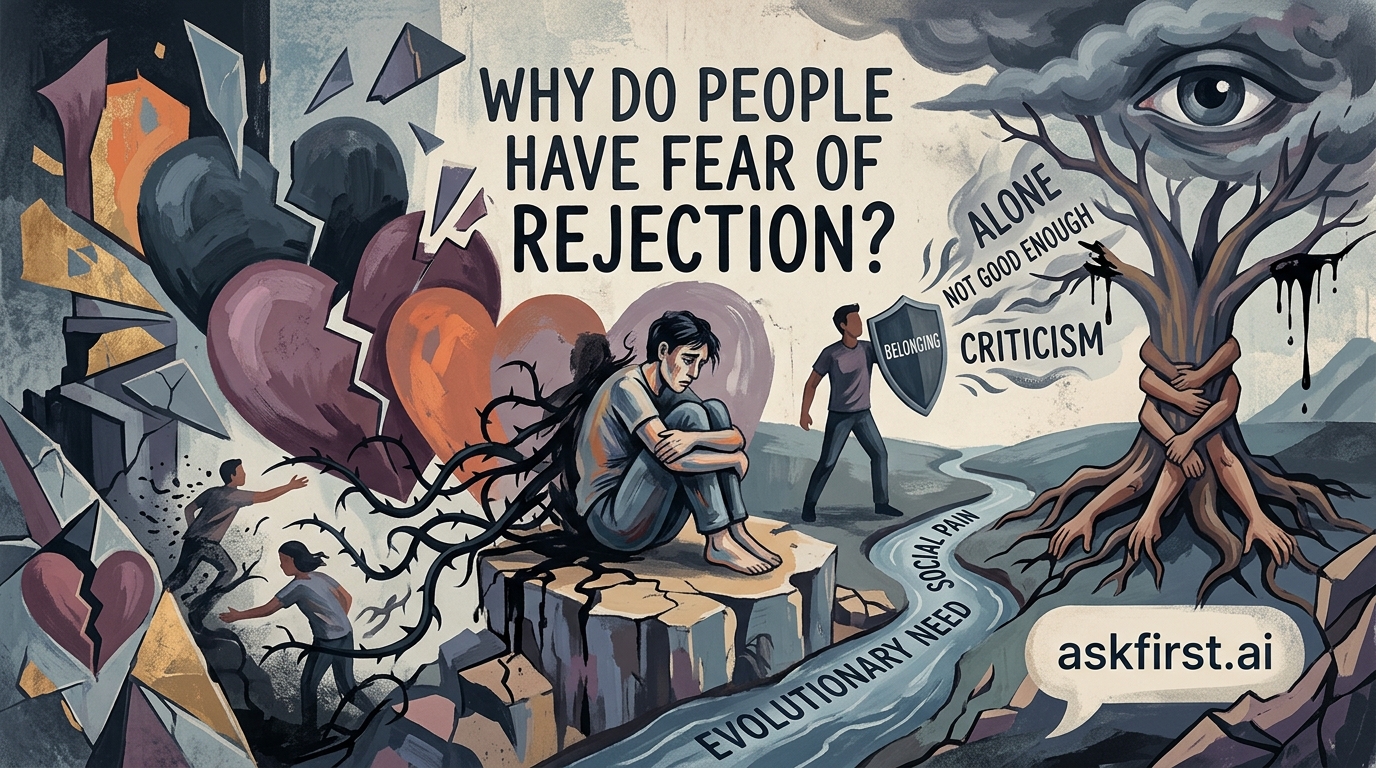
The fear of rejection, scientifically referred to as autophobia or more specifically rejection sensitivity, is one of the most pervasive human experiences. It is not merely a personality quirk or an emotional hurdle; it is a deeply embedded evolutionary mechanism that has shaped the trajectory of human survival for millennia. When we feel the sting of being turned away—whether by a romantic partner, a potential employer, or a social group—we are experiencing a complex neurobiological response that mirrors physical pain.
The Evolutionary Roots of Social Exclusion
To understand why we fear rejection, we must look back to our ancestral origins. As noted by evolutionary psychologists Roy Baumeister and Mark Leary in their seminal paper “The Need to Belong: Desire for Interpersonal Attachments as a Fundamental Human Motivation,” early humans lived in small, tight-knit hunter-gatherer tribes. In this environment, social inclusion was synonymous with survival. Being cast out of the tribe meant a loss of protection, a lack of access to shared resources, and an almost certain death at the hands of predators or the elements.
Over hundreds of thousands of years, natural selection favored those who were hyper-vigilant about their standing within the group. Those who cared deeply about social acceptance were more likely to conform, cooperate, and avoid behaviors that would lead to banishment. Consequently, the fear of rejection became hardwired into our DNA. Today, even though we no longer face immediate physical death if a date declines a second meeting, our primitive brain still sounds the same alarm bells, interpreting social rejection as a life-threatening event.
The Neurobiology of the "Social Pain"
Modern neuroscience provides a fascinating look at why rejection hurts so acutely. Researchers such as Dr. Naomi Eisenberger at UCLA have utilized functional MRI (fMRI) scans to observe brain activity during experiences of social exclusion. Her research, published in journals like Science, demonstrates that the same regions of the brain that process physical pain—specifically the dorsal anterior cingulate cortex (dACC)—are activated during experiences of social rejection.
This suggests that the brain does not distinguish significantly between a broken bone and a broken heart. When we are rejected, our body releases stress hormones like cortisol and adrenaline, triggering the "fight, flight, or freeze" response. This physiological reaction explains why rejection often feels visceral: our chest tightens, our stomach knots, and we experience a surge of anxiety. It is the body’s way of prioritizing social connection as a biological necessity.
Psychological Conditioning and Early Development
While our evolutionary history provides the blueprint, our individual life experiences act as the architect. Developmental psychologists, such as John Bowlby in his foundational work on Attachment Theory, suggest that the seeds of rejection sensitivity are often sown in early childhood.
If a child experiences inconsistent or unresponsive caregiving, they may develop an "insecure attachment style." Someone with an anxious-preoccupied attachment, for example, is constantly scanning their environment for signs of disapproval or distance from their primary caregivers. As these individuals move into adulthood, they often carry this "rejection radar" with them. They become hyper-sensitive to tone of voice, delayed text responses, or neutral facial expressions, often misinterpreting these as signs of impending rejection. This psychological conditioning creates a self-fulfilling prophecy: the fear of rejection leads to behaviors like clinginess or withdrawal, which may eventually push others away, thereby confirming the individual's original fear.
The Impact of Modern Social Structures
In the 21st century, the fear of rejection has been amplified by the digital landscape. Social media platforms quantify our social value through likes, comments, and followers. When we post something and receive little engagement, the brain registers this as a form of social rejection. As Dr. Sherry Turkle discusses in her book Alone Together, our reliance on digital validation has made us more fragile. We have outsourced our self-worth to an algorithm, making us susceptible to a constant, low-level fear of being "unliked" or ignored by our digital tribes.
Furthermore, the modern "meritocratic" culture—where we are constantly auditioning for jobs, schools, and romantic partners—creates a high-stakes environment where rejection is frequent. We are told to "put ourselves out there" to succeed, but we are rarely taught how to process the inevitable "no" that accompanies growth.
Conclusion
The fear of rejection is a multifaceted phenomenon, born of ancestral survival instincts, sustained by the neurobiology of physical pain, and exacerbated by our current social environment. It is a fundamental part of the human condition, acting as both a guardian of our social bonds and a barrier to our personal potential.
Recognizing that this fear is a biological relic rather than a personal failing is the first step toward overcoming it. By understanding that our brains are wired to equate rejection with danger, we can learn to pause, regulate our physiological responses, and engage in more rational self-talk. Rejection is not a reflection of our inherent worth; it is merely a data point in the complex, unpredictable experiment of human interaction. Embracing this perspective allows us to view rejection not as a death knell, but as a necessary and inevitable component of a full, courageous life.