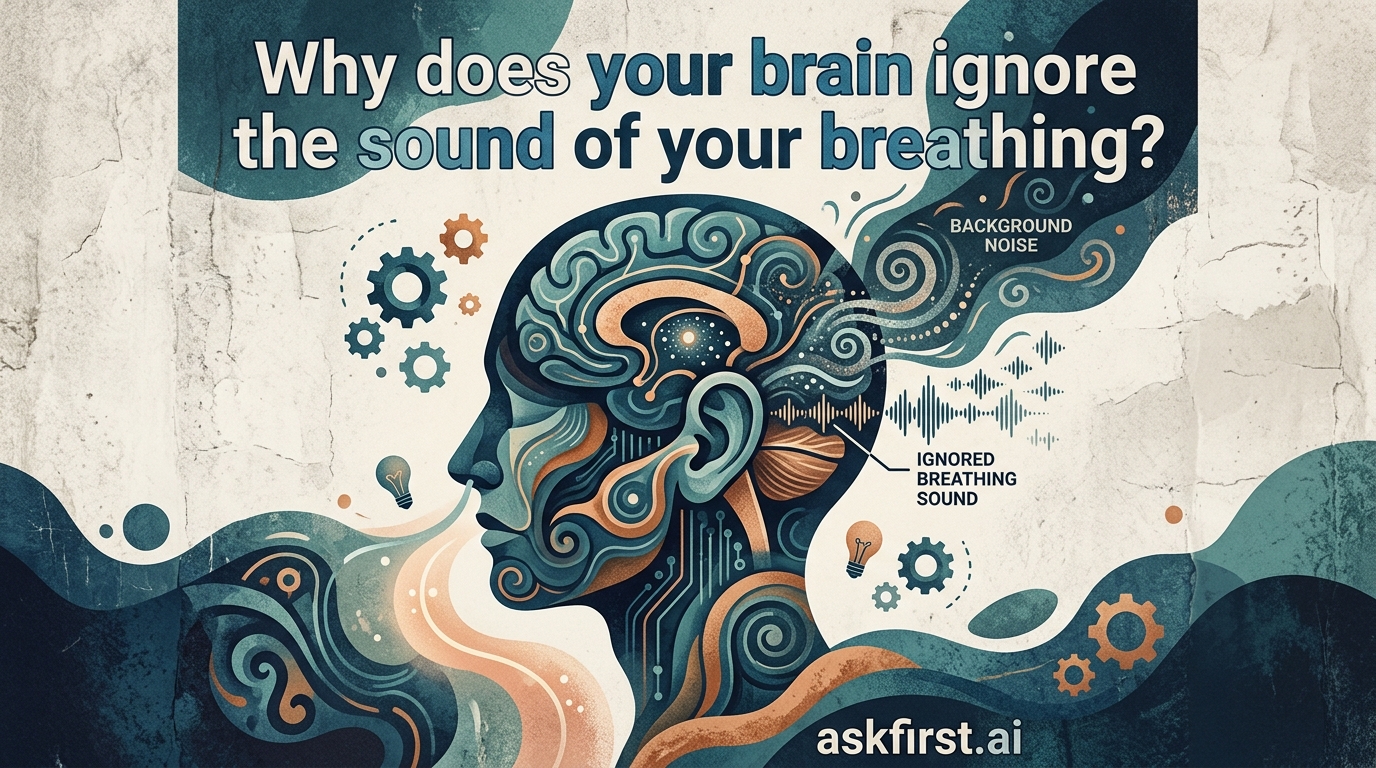
The Neural Architecture of Sensory Gating: Why We Become "Deaf" to Our Own Breath
The human brain is an extraordinary information processor, yet it is constantly bombarded by a deluge of sensory data—sights, sounds, smells, and tactile sensations—that would result in complete cognitive overload if processed consciously at all times. To function efficiently, the brain employs a mechanism known as sensory gating, a sophisticated filtering process that prioritizes novel or significant stimuli while suppressing predictable, redundant, or self-generated input. One of the most persistent examples of this phenomenon is the brain’s ability to effectively "mute" the sound of our own breathing.
The Concept of Corollary Discharge and Efference Copy
The primary reason we do not hear our own breath—or at least why it does not command our conscious attention—lies in the mechanism of corollary discharge. When the brain’s motor cortex sends a command to the respiratory muscles to contract and expand the lungs, it simultaneously sends a duplicate signal, known as an efference copy, to the sensory processing areas of the brain.
This efference copy acts as a "predictive model." Essentially, the brain tells the auditory cortex, "I am about to cause a sound by moving air through the larynx and nasal passages; ignore it." Because the brain predicted the exact timing and acoustic profile of the sound, it classifies that sound as "self-generated" rather than an external threat or an interesting environmental cue. According to neuroscientist Dr. Sarah-Jayne Blakemore in her seminal work The Social Brain, this process is fundamental to distinguishing the "self" from the "environment." If we did not possess this filtering mechanism, the constant rush of air through our own airways would be as loud and distracting as a constant windstorm, rendering us incapable of focusing on subtle auditory cues from our surroundings.
The Role of Habituation in Neural Efficiency
Beyond the immediate motor-sensory loop, the brain utilizes habituation, a form of non-associative learning. Habituation occurs when the nervous system decreases its response to a stimulus after repeated exposure. In the context of breathing, the sound is constant, rhythmic, and predictable.
In the book Principles of Neural Science edited by Eric Kandel, James Schwartz, and Thomas Jessell, the authors explain that synaptic depression—the weakening of synaptic connections in response to repetitive stimulation—is the biological basis of this phenomenon. When a neuron is fired repeatedly by the same stimulus without any change in the environment, the neurotransmitter release diminishes. Consequently, the brain essentially stops allocating metabolic energy to process the sound of breathing because it provides no new information about the world. This is a survival mechanism: the brain is programmed to detect change. A sudden silence in your breathing or a change in its rhythm (such as wheezing or gasping) would immediately trigger a "re-alerting" response, pulling the sound back into your conscious awareness because the predictability has been violated.
Sensory Gating and the Thalamic Filter
The thalamus serves as the brain's primary relay station, acting as a gateway for sensory information traveling to the cerebral cortex. Research conducted at the University of California, San Francisco (UCSF), under the direction of neurobiologist Dr. Robert Knight, has demonstrated that the thalamus, in conjunction with the prefrontal cortex, actively suppresses input that is deemed irrelevant.
When you are in a quiet room, you might notice your breathing for a few seconds if you focus on it. This is because you have shifted your "top-down" attention. However, as soon as you turn your focus to a conversation or a task, the thalamic filter tightens. The brain reclassifies the breath as "background noise." This is not a passive process; it is an active, ongoing suppression. If you were to listen to a high-fidelity recording of your own breathing while unaware of the source, you would likely find it quite loud and intrusive. However, because your brain controls the source, it effectively deletes the file before it reaches your conscious perception.
Evolutionary Significance: Prioritizing Survival
From an evolutionary standpoint, the ability to ignore internal biological "noise" is essential for vigilance. Early humans needed to hear the snap of a twig, the rustle of leaves, or the growl of a predator. If the auditory cortex were preoccupied with the rhythmic sound of one's own respiration, the reaction time to external threats would be significantly delayed. By filtering out the self-generated sound, the brain clears the "auditory bandwidth" for external stimuli that could signify danger or opportunity.
Conclusion
The silence of our own breath is a testament to the brain's incredible capacity for predictive modeling and efficiency. Through the interplay of corollary discharge, synaptic habituation, and thalamic gating, the brain ensures that we remain blissfully unaware of the constant mechanical work our lungs perform. We do not hear our breath because our brain has categorized it as a "known constant," a prerequisite for maintaining focus on the complex, ever-changing world around us. This seamless integration of motor control and sensory suppression allows us to navigate our environment with clarity, proving that what we don't perceive is often just as important as what we do.