The Psychology of Design and the 'Norman Door' Phenomenon
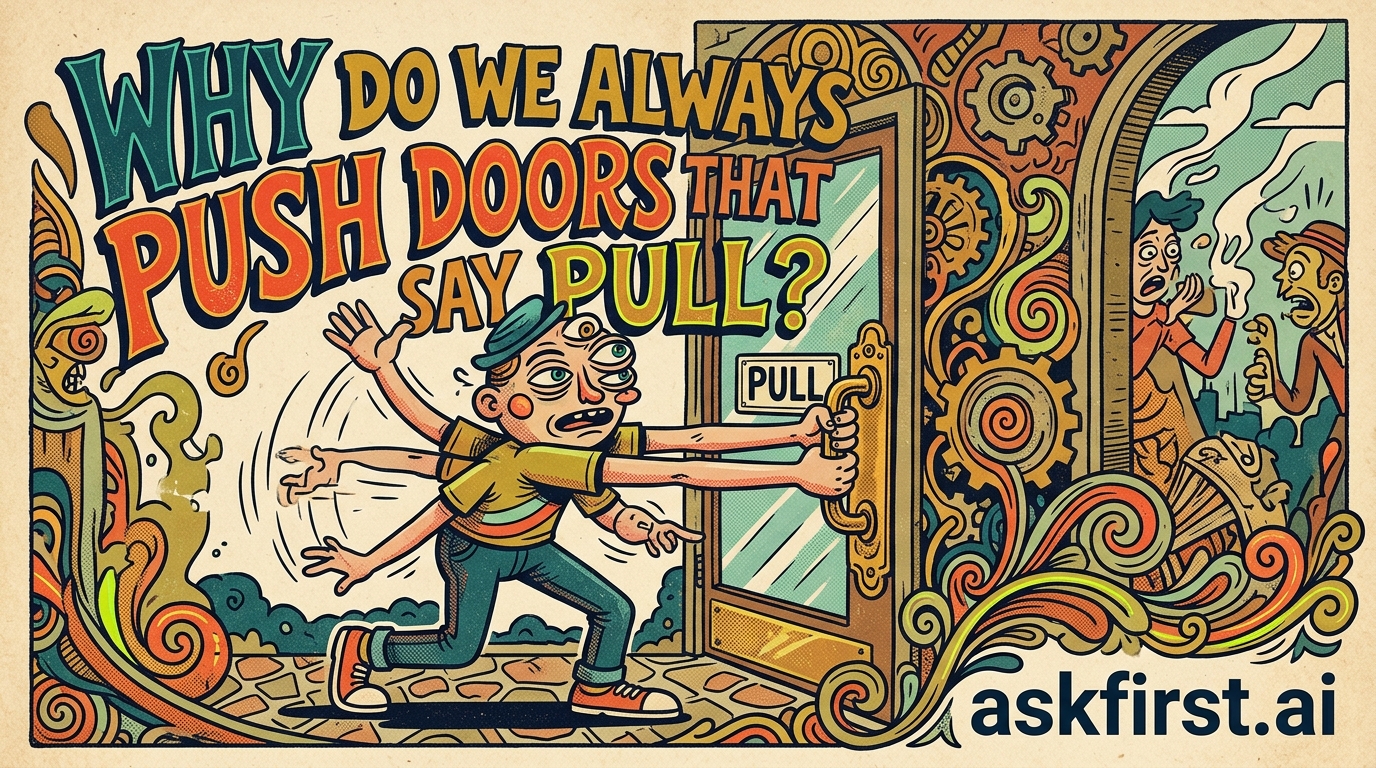
The frustration of pushing a door that demands to be pulled is a quintessential human experience. This phenomenon, often termed the 'Norman Door' after cognitive scientist Don Norman, occurs when the physical design of an object conflicts with the user's intuitive mental model. Despite the presence of labels, human behavior is frequently dictated by 'affordances'—cues that suggest how an object should be used.
The Power of Affordances
Affordances are perceived properties of an object that signal its potential function. A flat metal plate on a door is a strong visual affordance for pushing; it invites the palm to press against it. When that plate exists, the brain automatically classifies the object as a push-door. If a small 'PULL' sticker is applied, it creates a cognitive conflict. The subconscious urge to push based on visual geometry overpowers the slower, conscious effort to read the sign. This is a classic example of System 1 (fast, instinctive) thinking overriding System 2 (slow, logical) processing.
Cognitive Load and Habituation
Human beings operate on 'scripts'—patterns of behavior developed through years of interaction with the environment. Most doors in public spaces are designed to open outward for fire safety regulations. Consequently, 'pushing' has become the default physical script for exiting buildings. When encountering a door, the brain performs a rapid assessment based on past interactions. Because we have pushed open thousands of doors, the brain assumes the current door follows the same heuristic. By the time we register the 'pull' sign, the motor command to push has already been executed. This is not a failure of intelligence; it is a manifestation of cognitive efficiency.
The Role of Sensory Feedback
Physical design cues can be broken down into three categories of interaction:
- Mapping: How controls relate to effects. If a handle is vertical, we expect to grip it. If a plate is flat, we expect to push.
- Feedback: How an object confirms the success of an action. A door that does not budge after a push creates a momentary 'feedback loop error'.
- Constraints: Physical barriers that prevent incorrect actions. A poorly designed handle that looks like it should be pushed but can only be pulled lacks the necessary constraints to prevent the user from making a mistake.
Engineering and Architecture: The Fire Safety Dilemma
It is critical to note that the ubiquity of outward-opening doors is rooted in safety. Following disasters like the Iroquois Theatre fire in 1903, building codes mandated that exit doors must open in the direction of egress to prevent 'crush' scenarios during panic. However, this safety feature complicates intuitive design. Designers often struggle to create a door that opens outward (push) but clearly indicates it requires a pull mechanism (such as a handle) without conflicting with the visual urge to press a plate. This results in the infamous 'push/pull' paradox where architectural requirements and psychological usability clash.
Mitigation Strategies for Better Design
To bridge the gap between human intuition and functional requirements, designers use several key psychological interventions:
- Uniformity: If all doors in a building are designed with the same mechanism, the brain learns the pattern rapidly.
- Visual Cues: Replacing 'PUSH' signs with handles that have no flat surface prevents the incorrect assumption that the door is meant for pushing. If there is no flat plate to push, the mind naturally searches for a grip, leading to the correct action.
- Color Coding: Using contrasting colors to highlight pull-mechanisms helps draw the eye toward the part of the door that requires engagement, effectively guiding the hand to the handle rather than the center of the door.
Conclusion: It Is Not You, It Is The Design
The next time you find yourself fruitlessly pushing a door that stubbornly refuses to yield, remember that the fault lies in the interaction between human heuristics and architectural design. We are creatures of habit living in a world of visual prompts. When those prompts are contradictory, our subconscious mind leans on the most frequent past experiences. Understanding this process reveals that even the most simple, everyday objects are complex interfaces designed to guide us through our environment. By aligning design with the natural cognitive scripts of the human brain, architects and engineers can reduce these minor frictions, making the mundane act of walking through a door an intuitive and seamless experience.