The Psychology of the 'Norman Door' Phenomenon
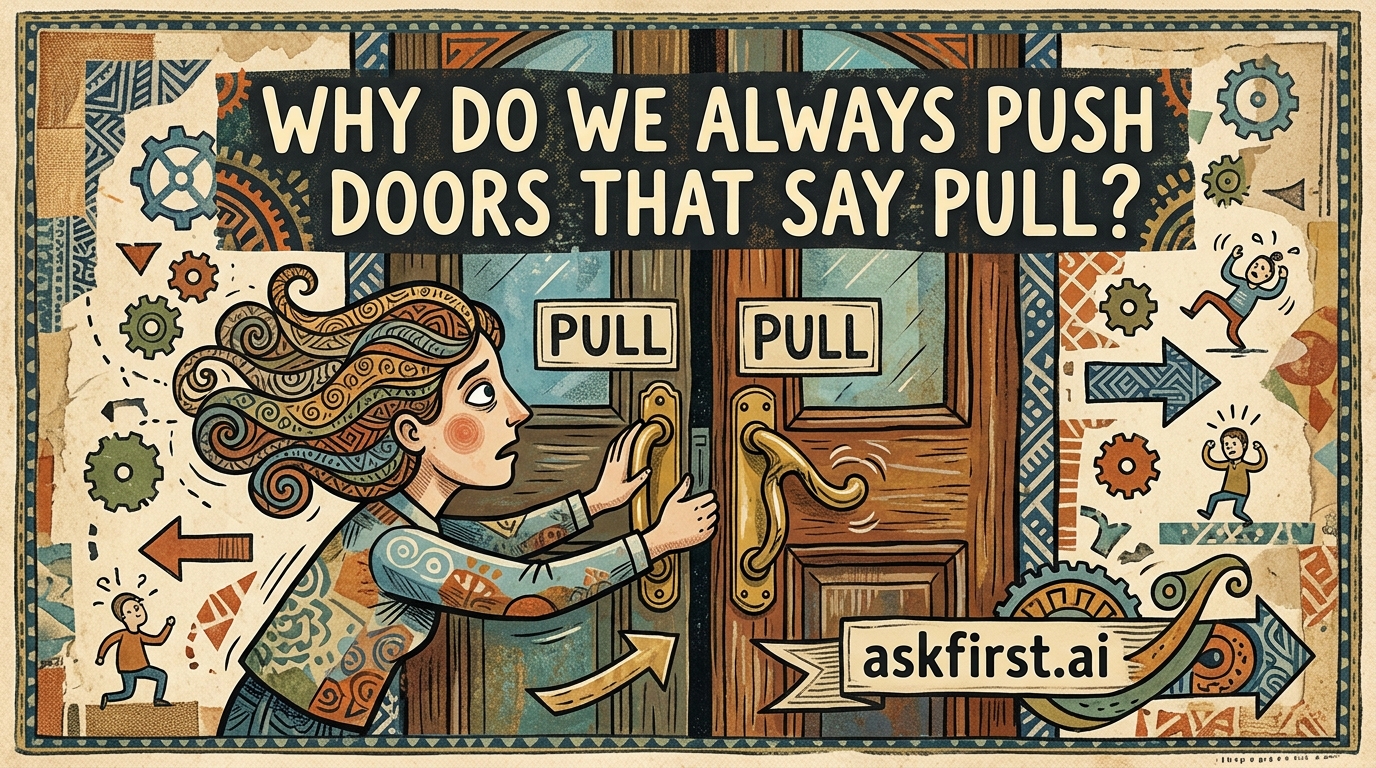
Human interaction with everyday objects is governed by complex cognitive processes that often operate beneath the level of conscious awareness. The phenomenon where individuals push doors marked 'pull'—frequently referred to as the Norman Door—is not a sign of poor intelligence, but rather a perfect example of poor design. The term originates from cognitive scientist Don Norman, who, in his seminal work The Design of Everyday Things, illustrated how physical features often lead users to make the wrong decisions, regardless of signage.
The Role of Affordances
In the field of industrial design, the concept of an affordance is paramount. An affordance refers to the physical properties of an object that imply how it should be used. For instance, a flat metal plate attached to a door provides a sensory cue that invites the hand to push. When a designer installs a flat, push-friendly plate on a door that is meant to be pulled, they have created a conflict between the visual 'affordance' and the instructions on the sign. According to cognitive studies, the human brain processes visual cues and physical shapes significantly faster than it reads text. Consequently, the urge to push the plate overrides the intellectual instruction to pull.
Cognitive Overload and Autopilot
Modern existence is defined by a high volume of sensory input. To navigate environments efficiently, the brain relies on heuristics—mental shortcuts that allow for rapid decision-making. Through years of conditioned experience, the brain associates flat plates with 'pushing' and handle-like mechanisms (such as grips or knobs) with 'pulling.' When a door is improperly designed, the user acts on 'autopilot.' By the time the brain registers the text 'pull,' the motor action of pushing has already been initiated. This is a failure of system-level design, not a failure of the human subject.
The Evolution of Design Principles
To prevent the 'Norman Door' trap, architects and engineers focus on signifiers that match the intended action. Effective design ensures that:
- Physical shape dictates function: If a door must be pulled, it should be equipped with a vertical handle, not a flat plate.
- Visual feedback: The door should visually indicate which side is the active side of the hinge.
- Consistency: Standardizing door behavior in public buildings reduces the cognitive load on inhabitants.
When design ignores these principles, it forces the user into a state of 'learned helplessness,' where the individual begins to doubt their own competence because they consistently fail to operate basic machinery. The psychological burden of these interactions is cumulative, leading to subtle but persistent frustration in urban environments.
The 'Signage' Trap
Signage is often used as a 'band-aid' for poor design. Designers sometimes attempt to fix a physical conflict by adding a label. However, research in human factors engineering demonstrates that signs are frequently ignored in high-traffic or high-stress environments. If the environment requires a sign to explain how to interact with an object, the design is fundamentally broken. A well-designed door should make its operation self-evident; a door should never require a user to stop and read instructions to gain passage.
Why This Matters for the Future
As we advance into the future, the lessons learned from the 'Norman Door' remain relevant for all human-computer interaction (HCI). Whether dealing with digital interfaces, home appliances, or physical architecture, the core principle holds true: good design should make the correct action easy and the incorrect action difficult.
- Intuitive Interfaces: Digital systems that rely on intuitive navigation foster higher user satisfaction.
- Error Prevention: Proactive design minimizes the possibility of human error by structuring the environment correctly from the outset.
- Universal Design: By considering how individuals of all cognitive abilities interact with the world, designers create spaces that are accessible and welcoming, rather than confusing and friction-heavy.
In conclusion, the next time a door is pushed despite a 'pull' sign, it is not a testament to human error. It is a testament to the power of environmental cues. The brain is doing exactly what it was designed to do: respond to the physical shape of the world faster than it can parse written language. By recognizing these cognitive patterns, designers and engineers can continue to create a more functional and intuitive world, one door at a time.