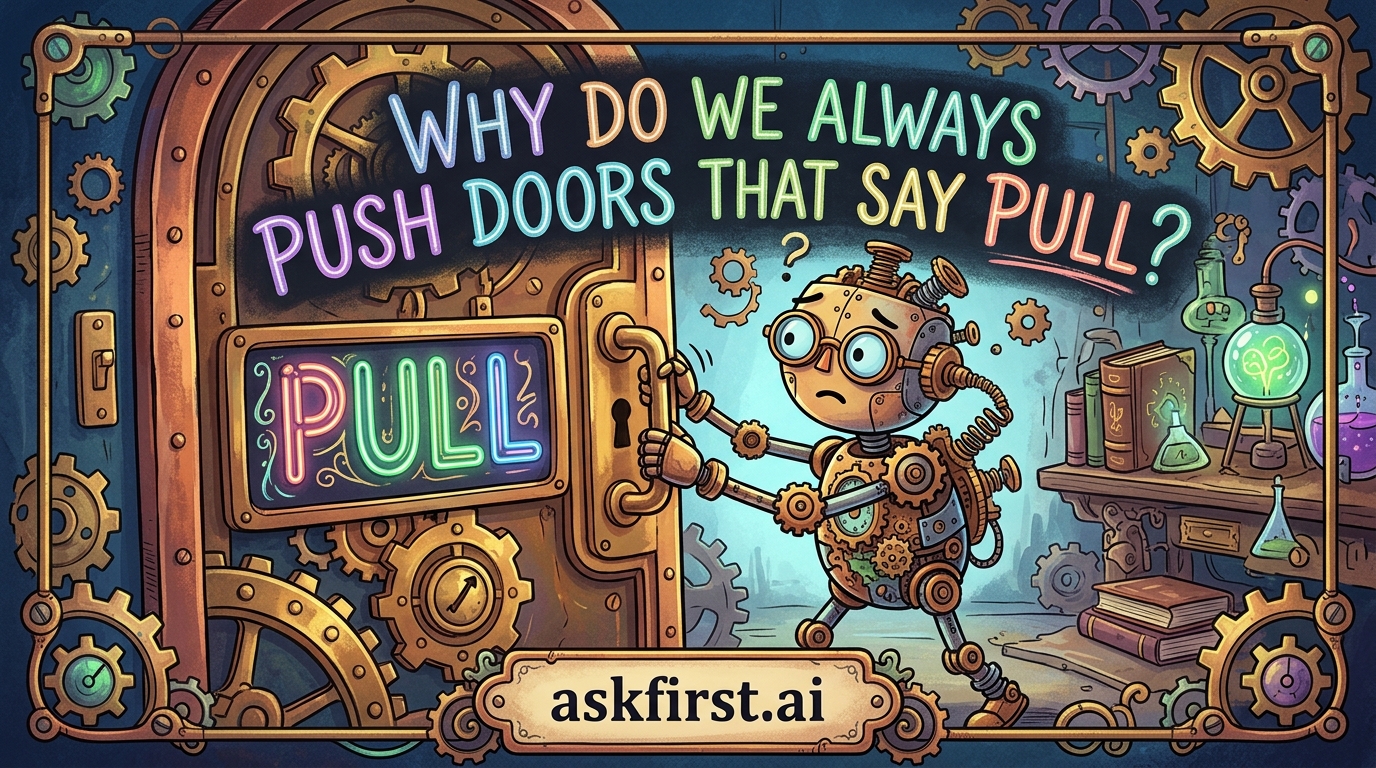
The phenomenon of pushing a door labeled 'pull' is a classic example of a 'Norman Door'—a term coined by design expert Don Norman in his seminal work, The Design of Everyday Things. This confusion arises not from personal failure or a lack of intelligence, but from a fundamental breakdown in the communication between an object and its user. When a door's design—its handles, plates, and orientation—contradicts its instruction, the human brain prioritizes tactile and visual cues over printed text.
The Psychology of Affordances
In cognitive psychology, the concept of affordances refers to the properties of an object that show a user how to interact with it. A flat metal plate on a door signals 'push' because it offers no grip for pulling; it invites the palm of the hand. Conversely, a vertical bar or a handle offers an affordance for gripping and pulling. When a door features a handle that looks like it should be pulled but has a sign demanding a push, the brain experiences cognitive dissonance. The subconscious mind processes the physical affordance of the hardware faster than the linguistic processing of the sign. Humans have evolved to react to physical environments through instinct rather than reading, which is a much newer invention in the grand scale of evolution.
Why Instructions Often Fail
Instructions are secondary to physical design. When a person approaches a door, the brain performs a rapid analysis of the surface. If that surface looks like it needs to be pushed, the brain sends a motor command to the arm. By the time the eyes notice the small sign reading 'pull,' the body is already in motion. This is known as automatic processing. We function on autopilot for routine tasks. Stopping the motor movement mid-stream requires a 'cognitive break,' which is mentally taxing. Most people would rather force the door than halt their momentum, leading to the habitual error of pushing when instructed otherwise.
The Role of Environmental Design
Architectural design choices often prioritize aesthetics over functionality. A clean, minimalist lobby might feature heavy glass doors with identical hardware on both sides to maintain symmetry. This architectural symmetry is the enemy of intuitive usage. If the inside and outside of a door look identical, the user has no external clue regarding which direction to operate the mechanism. In such cases, the brain defaults to the most common interaction experienced in that specific building or similar environments. If the person has encountered several 'push' doors that day, they will likely apply the same logic to the next door regardless of the label.
How Proper Design Resolves the Conflict
To eliminate this frustration, designers suggest implementing 'idiot-proof' or intuitive interfaces. This involves:
- Hardware Differentiation: Use a flat plate where a push is required and a handle where a pull is required. This makes the correct action obvious even without signs.
- Contextual Cues: Ensure the door's hardware style matches the motion required. If a sign is necessary, it signifies that the door design itself has failed to communicate effectively.
- Standardization: Public spaces should adhere to building codes that make 'push' and 'pull' functions consistent across all exits, allowing users to build a mental map of how the building operates.
The Evolutionary Perspective
From an evolutionary standpoint, the ability to rapidly assess a physical environment and act without hesitation provided a massive survival advantage. Those who took the time to read a sign during a threat would be at a disadvantage compared to those who acted instinctively. Modern society has repurposed these ancient neural pathways for navigating simple everyday objects. When we see a 'push' action as a default, we are essentially relying on a heuristic—a mental shortcut. While shortcuts often lead to success, they are prone to systematic errors when the environmental design contradicts them.
Conclusion
Ultimately, pushing a door that says 'pull' is a testament to the power of environmental influence over conscious thought. It proves that design speaks louder than text. For architects and product designers, the goal is to create environments that require zero instruction. The next time you find yourself pushing a door that demands a pull, remember that the fault lies not in your habit, but in the failure of the object to clearly express its intended function to your brain's intuitive systems.