The Quantum Connection: A Scientific Exploration
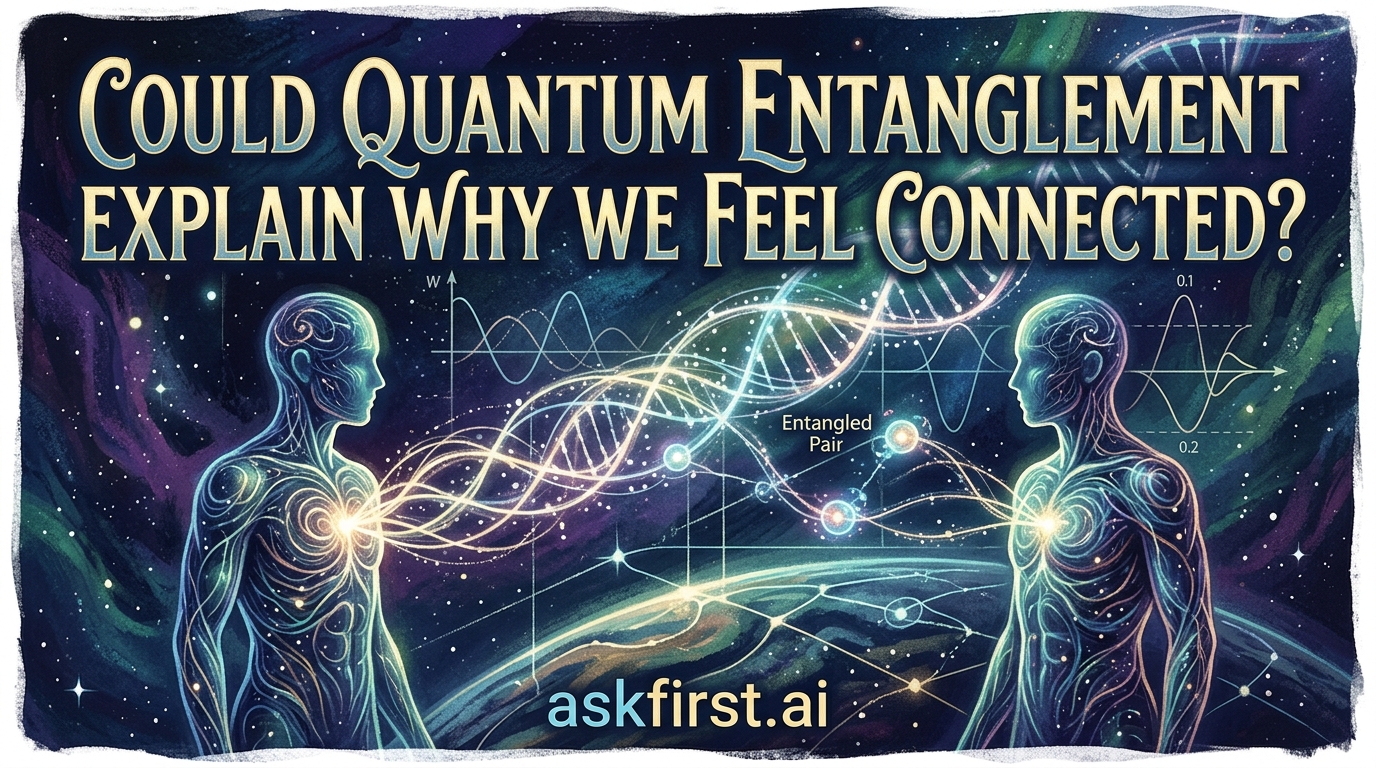
Quantum entanglement remains one of the most enigmatic phenomena in modern physics. Often described by Albert Einstein as 'spooky action at a distance,' this quantum mechanical state occurs when groups of particles are generated or interact in ways such that the quantum state of each particle cannot be described independently of the state of the others. Even when separated by vast distances, a measurement performed on one particle appears to instantaneously influence the state of its partner. This leads to a fascinating, albeit highly debated, hypothesis: Could this physical phenomenon provide a framework for understanding the profound sense of human interpersonal connection?
Understanding the Mechanism
At the subatomic level, entanglement challenges our classical understanding of locality. In our macroscopic world, objects only influence their neighbors through direct contact or force fields. However, entangled particles do not exchange signals through conventional spacetime in a way that suggests a faster-than-light communication, yet they share a unified destiny. The key distinction to make here is that while particles are linked, quantum mechanics prohibits the transmission of information through entanglement, a constraint known as the No-Communication Theorem. Therefore, physical entanglement cannot serve as a 'radio' for telepathic connection between humans.
The Metaphorical Bridge
Despite the physical limitations, many theorists and philosophers find value in using quantum entanglement as a powerful metaphor for human consciousness. The human brain is a complex bio-electrochemical network. Some researchers, such as Roger Penrose and Stuart Hameroff, have proposed the Orch-OR (Orchestrated Objective Reduction) theory, suggesting that consciousness might originate from quantum processes occurring within the microtubules of neurons. While this remains a fringe theory in mainstream neuroscience, it bridges the gap between biological reality and quantum potential. If consciousness were indeed rooted in quantum states, it would shift our perspective on empathy, intuition, and the 'sixth sense' people report feeling toward loved ones.
The Psychological Perspective: Mirroring and Resonance
Rather than looking to physics to explain interpersonal intimacy, psychologists point to mirror neurons and emotional resonance. Humans are evolved social creatures. When we interact, our brains synchronize their neural oscillations. This 'social brain' hypothesis posits that we are not isolated individuals but components of a collective cognitive network. The sense of 'connection' that feels so ethereal and mysterious is often a highly sophisticated byproduct of rapid, non-conscious pattern recognition and shared environmental processing. We do not need particles to be entangled to feel deep bonds; our evolved neurobiology does this remarkably well through pheromones, micro-expressions, and shared physiological states.
Busting the Quantum Myth
It is vital to distinguish between quantum entanglement as a physical reality and the 'quantum mysticism' that has permeated popular culture. There is no empirical evidence suggesting that human brains contain entangled macroscopic systems at room temperature. The brain is a 'warm, wet, and noisy' environment, a condition typically hostile to the fragile state of quantum coherence. Environmental decoherence—the process by which quantum systems lose their quantum behavior due to interaction with the outside world—occurs in the brain almost instantaneously. Consequently, while the idea of a quantum-linked consciousness is romantic and inspiring, it currently sits firmly in the realm of speculation rather than proven science.
Why the Mystery Persists
Why do we insist on finding a physical explanation for human connection? Perhaps it is because our subjective experience of love, empathy, and intuitive understanding feels larger than the sum of our neurological parts. The human desire to find a 'quantum link' speaks to our profound need to transcend our individual boundaries. Whether through the lens of physics or the lens of evolutionary psychology, the feeling of connection is a pillar of the human experience.
Summary of Key Findings
- Entanglement Basics: Particles share a state regardless of distance, but this does not facilitate the transmission of information.
- Neurobiology: Human connection is likely driven by mirror neurons, neurochemistry, and social evolution rather than subatomic physics.
- The Gap: Science has not yet discovered a mechanism for macroscopic quantum effects in the brain.
- The Power of Connection: Regardless of the underlying mechanism, the subjective reality of human connection remains one of the most vital components of a healthy life.
In conclusion, while quantum entanglement offers a beautiful and intriguing framework for imagining a connected universe, it remains a stretch to label it as the literal engine behind human empathy. We remain connected not through the mechanics of subatomic particles, but through the shared experience of being human, mediated by the astonishing complexity of our nervous systems.