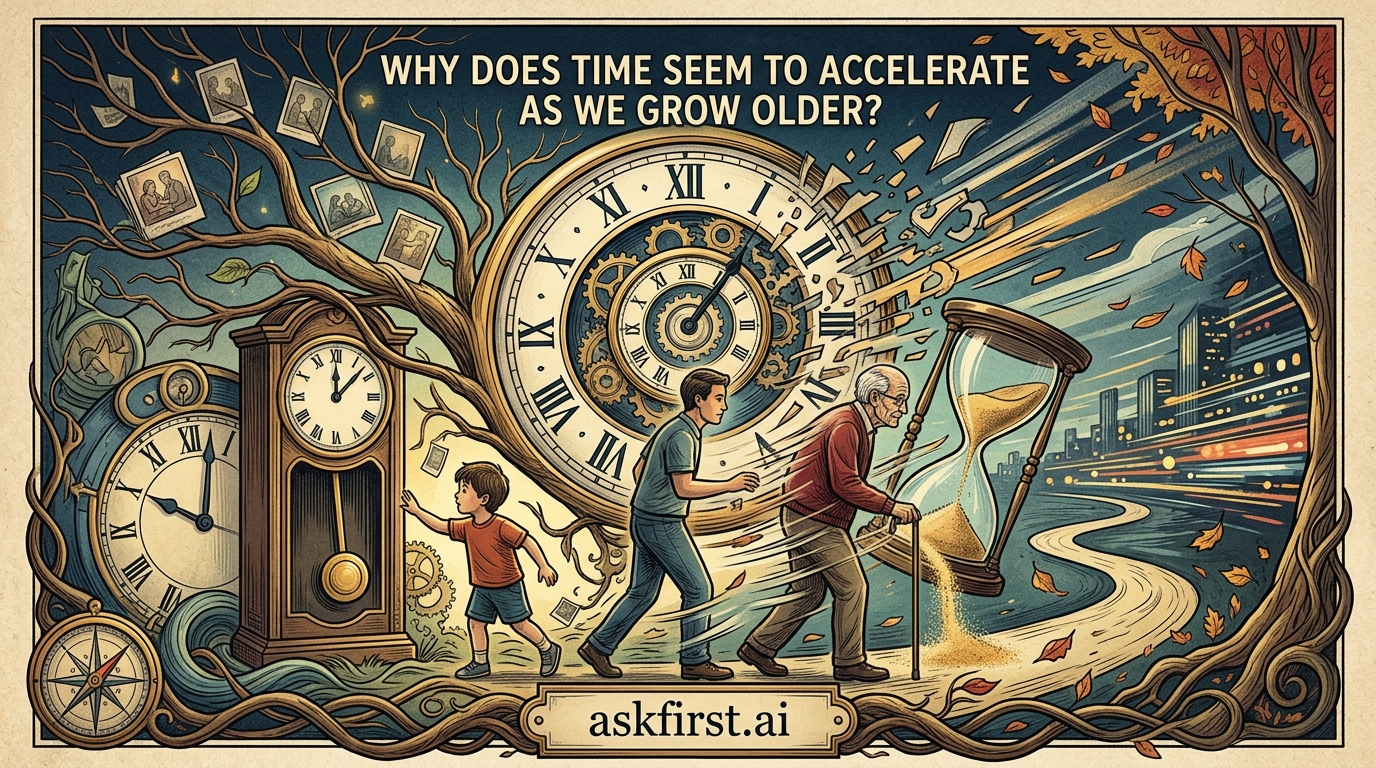
The Phenomenon of Temporal Acceleration
The perception that time accelerates as humans age is a well-documented psychological phenomenon known as the Holiday Paradox or the Proportional Theory of Time. While the physical duration of a second remains constant, the human brain functions as an internal clock that interprets the passage of time based on novelty, memory formation, and biological changes. When individuals are children, their experiences are overwhelmingly new; every season, school grade, and social encounter presents fresh stimuli. As the brain processes these novel experiences, it lays down more detailed memories, creating the illusion of a longer, more drawn-out period.
The Proportional Theory
One of the most compelling mathematical explanations is the Proportional Theory, first proposed by French philosopher Paul Janet in 1877. This theory suggests that as we age, each unit of time represents a smaller fraction of our total life experience. To a five-year-old, one year represents 20% of their entire existence. To a fifty-year-old, that same year is merely 2% of their life. Because the human brain calibrates time relative to the proportion of life already lived, years feel exponentially shorter as the denominator of total life duration increases. This shift changes the subjective significance of a single calendar year.
The Role of Novelty and Cognitive Encoding
Psychologists emphasize that the brain remembers time based on the density of new information stored. Neuropsychologist Peter Mangan conducted studies suggesting that the brain encodes memories differently as we reach adulthood. During childhood, the brain is in a state of high plasticity, constantly mapping out the world. We encounter new people, new skills, and new emotional landscapes daily. This rapid acquisition of knowledge consumes significant cognitive resources, forcing the brain to expand its perception of time.
Conversely, as adulthood sets in, routines become established. Daily habits—the commute to work, the repetitive nature of tasks, and established social structures—require less cognitive effort to process. The brain stops recording the mundane details of these daily routines because they are predictable. Consequently, the brain 'compresses' these segments of time into fewer stored memories. When looking back on a month of routine living, the brain has less data to retrieve, leading to the retrospective impression that the month 'flew by.'
Biological and Neurochemical Factors
Beyond psychology, biological changes play a significant role. Some researchers suggest that as the human heart rate and metabolic processes undergo subtle changes over decades, the internal biological pacemaker may alter its firing rhythm. In a theory known as Brain Wave Speed, some neuroscientists speculate that the speed at which the brain processes visual information slows down with age. As the rate of image acquisition decreases, the brain integrates fewer 'frames per second.' Much like a camera with a slower shutter speed, the brain perceives less 'information density' in a period, which creates the sensation that events are happening more rapidly.
Strategies to Expand Perceived Time
Understanding these mechanisms allows individuals to actively 'slow down' their perception of life by introducing conscious novelty. To disrupt the acceleration of time, one must engage in activities that force the brain out of its automated routine:
- Novelty Seeking: Travel to new destinations, learn a complex language, or adopt a challenging new hobby. High-novelty environments force the brain to dedicate more neural energy to encoding new experiences.
- Mindful Presence: Practicing mindfulness or meditation increases focus on the 'here and now,' preventing the brain from slipping into the autopilot mode that contributes to the compression of memories.
- Variable Routines: Altering daily paths, working in new environments, or diversifying daily habits can signal to the brain that it needs to pay closer attention, effectively creating more 'anchor points' in memory.
Conclusion
The perception of time is not a fixed reality but a cognitive construct built from the complexity of our internal and external lives. By prioritizing learning and embracing new challenges, the human mind can counteract the feeling of rapid temporal erosion. The key to making life feel longer is not to change the calendar, but to change the depth and novelty of the experiences filled within it. By consistently exposing oneself to the unfamiliar, the brain keeps its 'shutter speed' high, effectively reclaiming the sense of expansive, slow-moving time that characterized childhood.