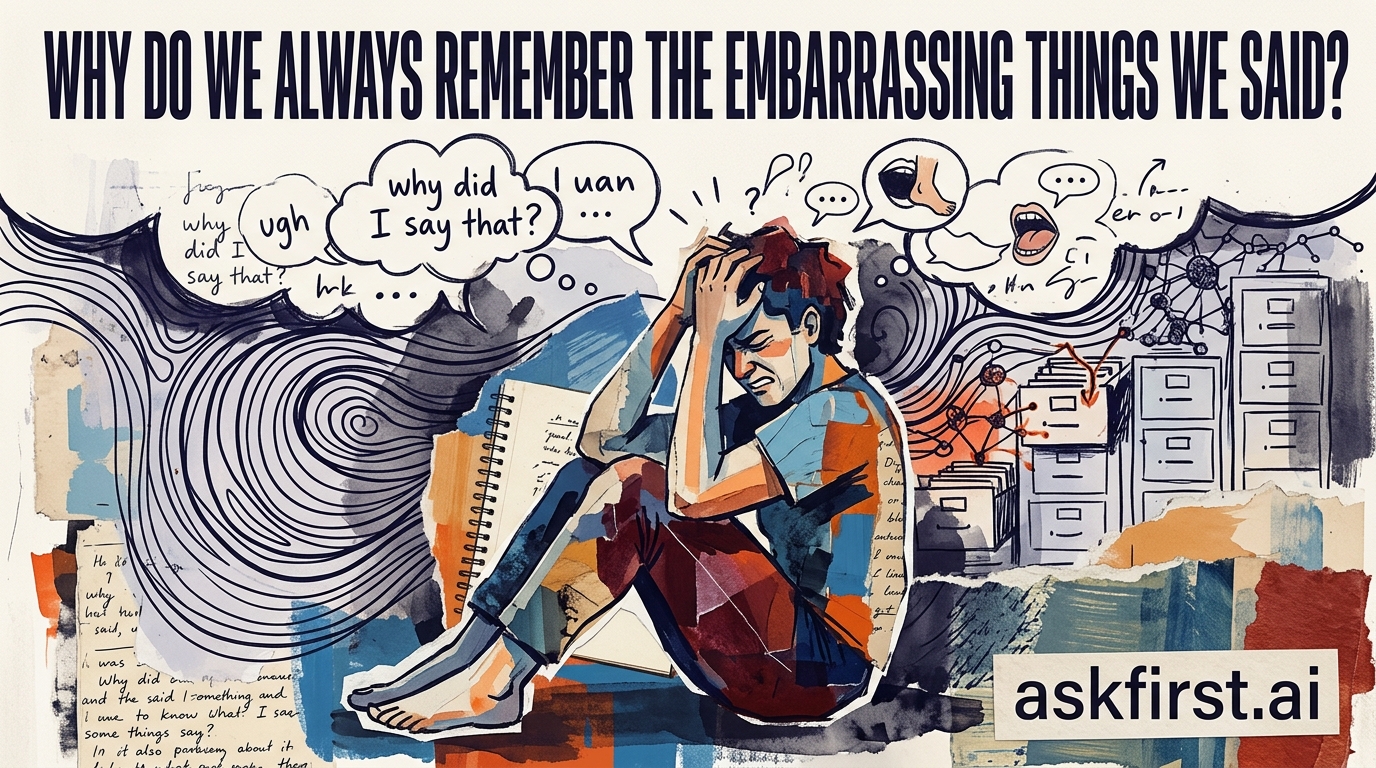
The Psychology of Memory Persistence: Why Embarrassment Lingers
Human memory is not a perfect archival recording of life events; rather, it is a highly selective, emotional filter. The phenomenon where an embarrassing moment—a slip of the tongue, a mispronounced word, or a social faux pas—occupies the mind years later is known in psychological circles as the Spotlight Effect and the Negativity Bias. These cognitive mechanisms are designed to keep us safe in a social hierarchy, though they often misfire in modern life.
1. The Evolutionary Driver: The Need for Social Survival
From an evolutionary standpoint, early humans relied heavily on group cohesion for survival. Being ostracized from the tribe because of a social mistake could mean life or death. Consequently, the brain developed a hyper-sensitive alarm system for social errors. When something embarrassing happens, the brain tags that memory with high-intensity emotional markers. This is why a simple comment can feel as vivid as a traumatic event. Evolutionarily, we are wired to ruminate on social rejection to ensure that we never repeat that specific mistake again. It is a protective, albeit exhausting, mechanism.
2. The Spotlight Effect
Psychologist Thomas Gilovich identified the Spotlight Effect as a cognitive bias where people tend to overestimate how much others notice their appearance or behavior. In reality, most observers are far too concerned with their own inner monologues and potential social missteps to pay significant attention to yours. However, the brain assumes the 'spotlight' is brighter than it actually is, leading to a lingering internal narrative that the embarrassing moment was a defining event for everyone present. Recognizing this bias is the first step toward reducing the emotional weight of a past embarrassment.
3. The Negativity Bias: Why Painful Memories Stick
Scientific research consistently demonstrates that the human brain processes negative stimuli more intensely than positive ones. This is the Negativity Bias. Our brains prioritize bad news, threats, and failures over rewards and accomplishments. When you recall an embarrassing moment, your brain gives that memory more 'airtime' than a memory of a successful presentation or a kind remark. You are essentially fighting against your own neurological architecture that is hard-wired to prioritize potential danger—or, in this case, potential social embarrassment—above all else.
4. The Zeigarnik Effect: Unfinished Social Business
Often, embarrassing memories persist because they feel like 'unfinished business.' The Zeigarnik Effect is a psychological phenomenon where the brain remembers incomplete or interrupted tasks better than completed ones. If an embarrassing moment is left unaddressed—meaning you didn't 'fix' the situation or get over the awkwardness—the brain keeps that memory file 'open' and ready for access, hoping for a resolution. This is why you might mentally rehearse how you 'should' have responded to that person years ago.
5. Practical Strategies to Tame the Rumination
While these psychological mechanisms are robust, they are not insurmountable. Here is how to regain control over these intrusive thoughts:
- Cognitive Reappraisal: Reframe the memory from a third-person perspective. Looking at the situation as an observer rather than a participant often dilutes the emotional sting.
- The 'Five-Year Rule': Ask yourself if this specific memory will matter in five years. If the answer is no, give yourself permission to release the emotional weight.
- Practicing Self-Compassion: Acknowledge that everyone makes mistakes. Empathy for your past self, who was doing their best in a stressful situation, can turn a source of shame into a moment of human relatability.
- Mindfulness and Grounding: When the memory surfaces, gently acknowledge it and focus on your current environment. Bringing your focus back to the present moment helps silence the internal loop.
Conclusion
Remembering embarrassing moments is not a sign of a failing mind; it is a sign of a functioning social brain. By understanding that these memories are merely reflections of our desire to belong and our natural survival instincts, we can learn to view them with less judgment. The next time a cringeworthy moment from the past resurfaces, treat it as a fleeting thought rather than an identity-defining truth. Your brain is trying to protect you, but in the modern world, it is often just trying to protect you from something that already faded from everyone else's memory a long time ago.