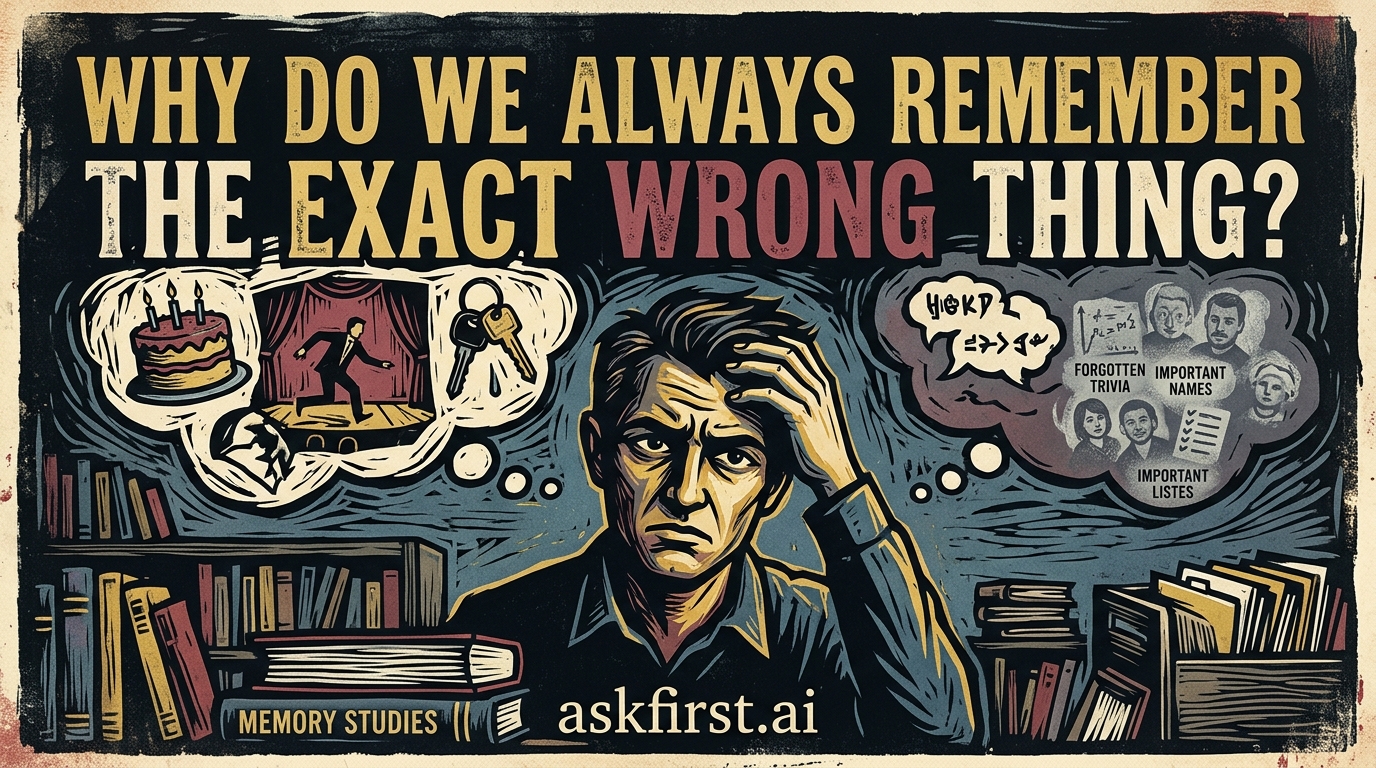
The Paradox of Selective Recall
The phenomenon of remembering the 'wrong' information—while forgetting critical details—is a fascinating byproduct of human cognitive architecture. Rather than operating like a digital camera recording an objective stream of reality, the human brain functions as an interpretive reconstruction engine. Memory is not a library of static books but a dynamic, creative act of piecing together fragmented sensory inputs based on current emotional states, expectations, and biological priorities.
The Biological Priority: Survival over Accuracy
From an evolutionary standpoint, the human brain prioritizes utility over accuracy. During our ancestral development, the brain did not need to remember the precise color of a leaf or the exact sequence of a conversation to survive; it needed to identify threats and opportunities. Consequently, the brain is hard-wired to prioritize emotional salience. When an experience is tagged with strong emotion—fear, surprise, or embarrassment—the amygdala signals the hippocampus to prioritize that memory. Unfortunately, this system is imprecise. We often remember the 'threat' (the sudden noise) while failing to encode the 'context' (where the car keys actually were). This creates a reality where we recall the shock of losing our keys but possess zero access to the actual location where we placed them.
The Mechanics of Interference
One primary reason for erroneous recall is proactive and retroactive interference. Our minds are constantly filling in gaps. If someone has performed the same task (like locking a door) thousands of times, the brain creates a 'schema'—a generalized mental template. When the brain tries to retrieve a memory, it often pulls the 'average' experience instead of the unique instance of the day in question. This is known as schema-driven memory distortion. Essentially, the brain takes a shortcut by assuming today's event was exactly like every other time that event occurred, leading to a false sense of certainty about irrelevant details.
The Role of Misattribution and Source Monitoring
Human cognition suffers from a constant struggle with source monitoring errors. We often remember a piece of information clearly but fail to attribute it to the correct source. Perhaps an idea was heard on a podcast or read in a fleeting article, but the brain misfiles it as a personal epiphany or a childhood memory. This phenomenon, known as cryptomnesia, demonstrates how the brain consumes information as raw material, strips away the context of where that information originated, and reassembles it into our personal narrative.
Psychological Hooks: Why It Feels So Frustrating
- The Zeigarnik Effect: We tend to remember uncompleted tasks or interruptions much better than finished ones. This explains why we vividly recall that one forgotten ingredient at the grocery store but forget the five items we successfully purchased.
- Cognitive Biases: We suffer from hindsight bias, where we retrospectively believe our past selves should have known better, leading to 'false memories' of having predicted an outcome that was actually unpredictable.
- The Forgetting Curve: Hermann Ebbinghaus discovered that memory decay is exponential. The details that seem unimportant during encoding are the first to erode, leaving behind only the strongest emotional anchor points.
Strategies for Improved Cognitive Precision
To combat the tendency to remember the 'wrong' thing, one must move from passive storage to active encoding. Studies in cognitive psychology suggest that the following techniques can refine memory reliability:
- Dual Coding: Pairing verbal information with visual mental imagery. The brain has separate processing channels for visual and auditory data; using both increases the likelihood of retrieval.
- The Feynman Technique: Explaining a concept or event aloud as if teaching a child. This forces the brain to identify gaps in understanding and reconstruct the event in a linear, logical structure rather than relying on fragmented emotional snapshots.
- Contextual Anchoring: Creating deliberate associations with physical environments or sensory cues. If a task is performed, briefly narrating the action out loud ('I am putting my keys on the hook by the mirror') triggers auditory processing, which creates a stronger, multi-sensory memory trace.
Conclusion
The frustration of remembering the 'wrong' thing is actually a testament to the brain's incredible efficiency. By prioritizing emotional impact, pattern recognition, and generalized schema, the human mind ensures that we survive in a complex world. While it may occasionally cause us to lose our belongings or misremember an argument, this filtering process is exactly what prevents our consciousness from becoming overloaded with trivial sensory data. Understanding these biological limitations is the first step toward working with our brain's natural tendencies rather than against them.