The Cognitive Science of Pluviophilic Inspiration
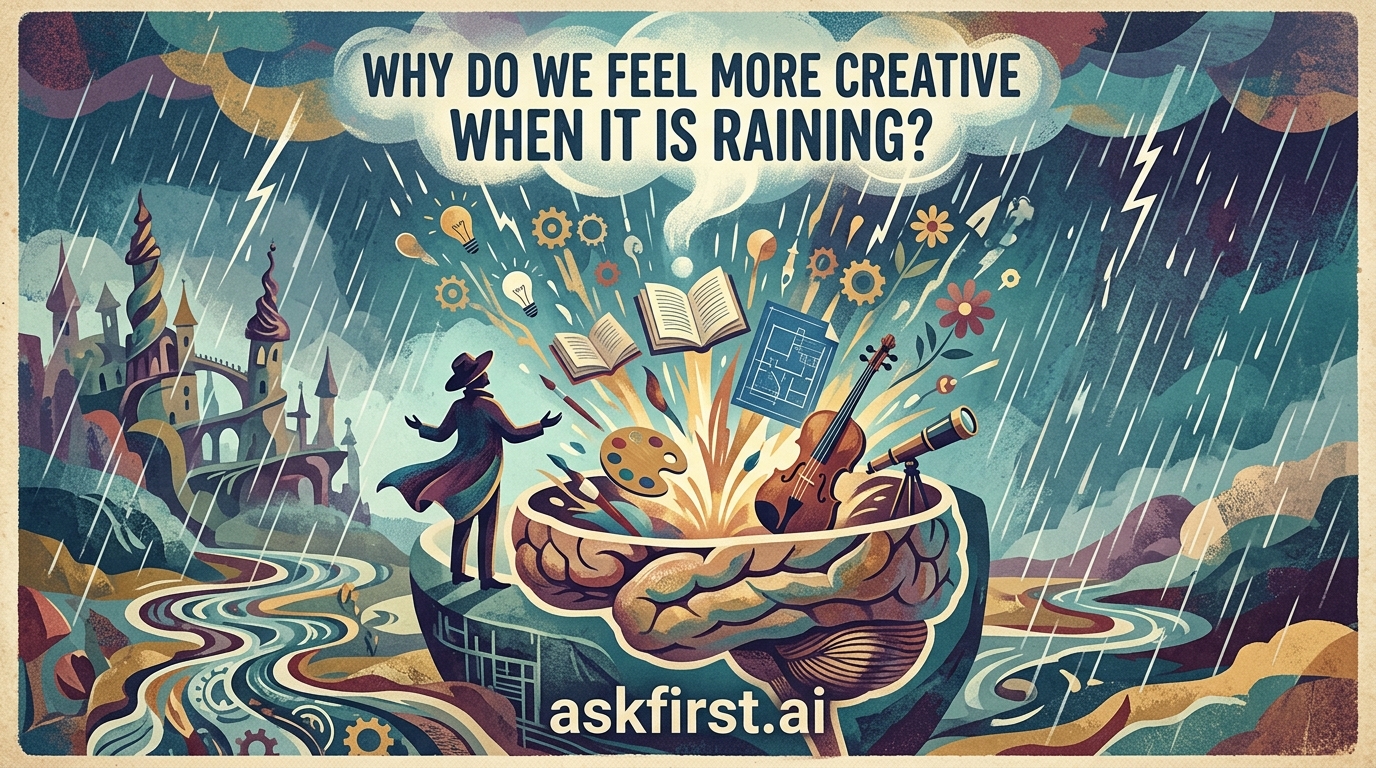
The phenomenon of increased creativity during rainfall is not merely a romanticized notion or a case of collective nostalgia; it is a manifestation of complex cognitive and sensory processing. When the skies turn gray and the rhythmic pitter-patter of rain begins, the human brain undergoes a subtle shift in its operational mode. This state, often referred to by psychologists as a 'cognitive sanctuary,' provides the perfect conditions for divergent thinking.
1. Sensory Minimalism and the Restoration Theory
According to Attention Restoration Theory (ART), urban environments and high-stress professional settings constantly deplete our capacity for focused attention. The constant barrage of visual stimuli, digital notifications, and ambient noise demands 'directed attention,' which leads to mental fatigue. Rain, however, acts as a sensory filter. By muting the bright colors of the environment and masking erratic, high-frequency city noises with the steady, 'pink noise' of falling water, the brain is allowed to shift into 'soft fascination.' This state allows the prefrontal cortex to rest, giving the Default Mode Network (DMN)—the brain's command center for daydreaming and imaginative synthesis—the resources it needs to connect seemingly unrelated ideas.
2. The Power of Pink Noise
Auditory experts suggest that the sound of rain serves as a form of auditory masking. Unlike the unpredictable, sharp sounds of a bustling office, the consistent sound of rain creates a stable, non-threatening background track. This prevents the brain from entering a state of hyper-vigilance. Studies have shown that 'pink noise'—a sound spectrum where lower frequencies are louder and higher frequencies are quieter—synchronizes neural oscillations. This synchronization promotes deeper relaxation and can induce a trance-like state conducive to creative flow. When the mind is not occupied with reacting to sudden stimuli, it is free to wander the internal archives of memory and experience.
3. Environmental Psychology and Refinement
There is a psychological concept known as 'The Shelter Effect.' Evolutionarily, humans are hardwired to associate rain with the safety of a protective enclosure. Being tucked inside while the world is wet outside creates a subconscious sense of security. This physical state of comfort reduces cortisol levels and lowers defensive biological mechanisms. When the body feels safe, the brain is more willing to take intellectual risks. Creative breakthroughs require vulnerability; one must be willing to entertain strange, inefficient, or unconventional ideas. The 'cozy' atmosphere created by rain serves as a literal and metaphorical umbrella, shielding the creative mind from external stressors and judgmental societal pressures.
4. The Melancholy Advantage
While often mistaken for sadness, a light, reflective mood (often termed 'productive melancholy') has been proven to increase attention to detail. Rain fosters an introspective environment. This introspection is a critical component of the creative process. It forces the individual to look inward, examining personal narratives and internal emotional states. Many of the most iconic literary and musical works in history were born during periods of inclement weather, as the constraint of staying indoors forces people to find entertainment and stimulation within their own cognition.
5. How to Harness Rain-Induced Creativity
To optimize this natural phenomenon, one should adopt a few specific habits during rainy weather:
- Unplug Digitally: Eliminate the noise of digital distractions that threaten to pull you out of the 'soft fascination' state.
- Embrace Ambient Lighting: Use softer, warmer light sources to complement the dim, natural light. This reduces the harshness of the sensory experience.
- Engage in 'Low-Cognitive' Tasks: When the rain starts, don't jump immediately into high-pressure tasks. Spend the first 20 minutes engaging in free-writing, sketching, or brainstorming to prime the DMN.
- Minimize External Schedules: If possible, schedule your most abstract or 'big-picture' creative sessions for days when the weather forecast suggests steady, low-impact rainfall.
Conclusion
The synergy between rain and creativity is an exquisite interplay of neurobiology and environmental psychology. By reducing the load on the analytical brain and providing a cocoon of auditory consistency, rainfall essentially creates a 'digital-free' space in our heads. It reminds us that sometimes, to move forward creatively, we must slow down, pull back from the fray, and listen to the rhythmic pulse of the world as it washes away the static of the everyday.